

A project can stay on schedule and still be heading for conflict. When clients, site teams and subcontractors have different assumptions about scope, timing or responsibilities, even a late change can lead to rework and difficult conversations. Managing stakeholder expectations construction QLD projects calls for more than a one-off briefing. A clear process helps keep people aligned as conditions change.
Expectations can shift during a build. Supply issues, site conditions and changing priorities may affect the plan. The key is to raise concerns early, agree who makes each decision and record how a change affects the work ahead.
This guide sets out a repeatable way to align stakeholders before work and key decisions begin, resolve misunderstandings constructively and keep communication clear across the project team. It covers setting realistic expectations, managing change through a documented process and connecting project coordination with on-site execution. The aim isn’t to prevent every change. It’s to ensure everyone understands what happens next.
Key Takeaways
- Use a project brief and responsibility map to clarify scope, roles and communication before key decisions are made.
- Separate confirmed commitments from assumptions and proposed changes so stakeholders know what’s agreed.
- Compare stakeholder priorities with project constraints, then identify which preferences can be negotiated and which requirements cannot.
- For managing stakeholder expectations construction QLD projects, use a consistent change process and record decisions, approvals and next steps.
- Connect business planning, project coordination and on-site execution to keep communication practical as work progresses.
Why managing stakeholder expectations matters on Queensland construction projects
On a construction project, expectations are the assumptions people hold about scope, timing, quality, responsibilities and communication. What seems obvious to one person may never have been agreed with the rest of the team. For example, a client might expect a particular finish while the site team is working from different drawings or an earlier decision.
That gap can lead to avoidable rework, delayed decisions and strained conversations. Aligning expectations early gives people a shared reference point and makes unresolved questions easier to spot before they affect site work. The broader principles of Stakeholder management offer useful background, but projects in Queensland need a practical approach suited to their own people, location and delivery conditions.
Who counts as a construction project stakeholder in Queensland?
Map people according to their relationship to the work. Decision-makers may include the client and authorised representatives. Delivery partners can include consultants, subcontractors and the site team. Neighbours may be affected by construction activity, and external authorities may have a role in approvals or other project requirements.
Consider Traditional Owners where relevant to the project location and engagement context. Rather than relying on a generic stakeholder list, confirm who needs to be involved during project initiation. Verify any project-specific approval, consultation or notification requirements with the relevant authority.
What expectations should teams align before work starts?
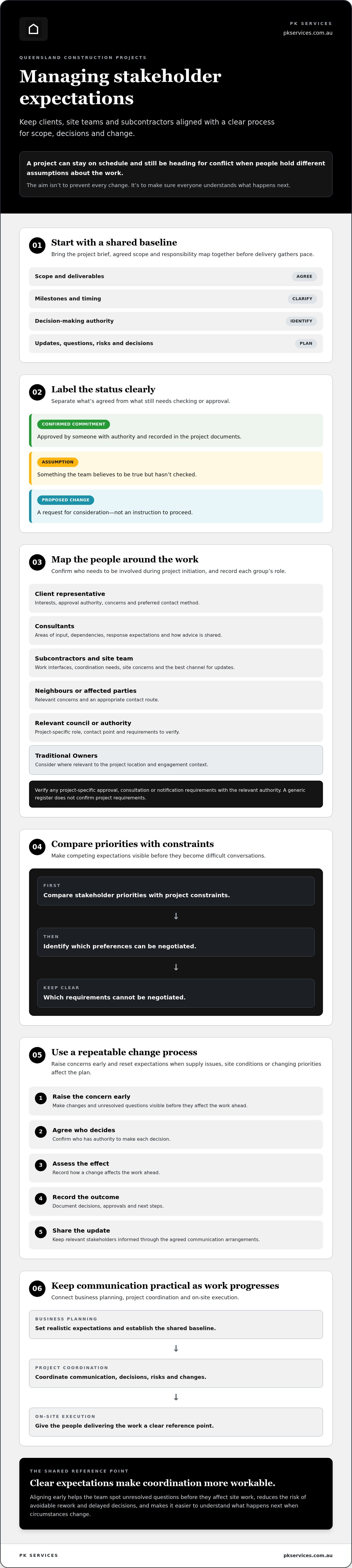
Set a shared baseline before work begins. Confirm the agreed scope, deliverables, milestones and decision-making authority. Then agree how updates, questions, risks and decisions will be shared, including who needs to receive each communication.
Label what’s confirmed and what remains an assumption or proposal. Record unresolved items, who will follow them up and when an answer is needed. This helps prevent a working assumption from being mistaken for a commitment and gives the team a clear reference point if circumstances change.
A consistent process for managing stakeholder expectations on Queensland construction projects makes coordination more workable from the outset. It connects decisions made by the client and project team with the people responsible for delivering the work on site.
Build a shared understanding of scope, roles and communication
A reliable baseline gives everyone the same reference point. Bring the project brief, agreed scope and responsibility map together before delivery gathers pace. Spell out the intended deliverables, milestones, decision-makers and communication arrangements. This helps the team judge whether a request fits the agreed work or needs to be assessed as a change.
Be precise about status. A confirmed commitment has been approved by someone with the authority to make that decision and recorded in the project documents. An assumption is something the team believes to be true but hasn’t checked. A proposed change is a request for consideration, not an instruction to proceed. Clear labels stop informal conversations from being mistaken for approval.
Create a Queensland project stakeholder and responsibility map
List each stakeholder group, its representative and its role in decisions or delivery. A simple register can capture the details that shape how you work with each person:
- Client representative: interests, approval authority, concerns and preferred contact method.
- Consultants: areas of input, dependencies, response expectations and how advice is shared.
- Subcontractors and site team: work interfaces, coordination needs, site concerns and the best channel for updates.
- Neighbours or affected parties: relevant concerns and an appropriate contact route.
- Relevant council or authority: project-specific role, contact point and requirements to verify.
Include Traditional Owners where relevant to the location and engagement context. Identify the appropriate council or authority for the project and verify applicable responsibilities directly. Requirements can depend on the project, so a generic register does not confirm approval or consultation duties.
Agree communication rhythms before site activity escalates
Decide how the team will keep information moving. Agree on meeting frequency, reporting format, escalation contacts and where decisions will be recorded. Match the level of detail to each stakeholder’s role and the project’s effect on them. Site teams may need timely, practical updates; a decision-maker may need a concise summary of the options and their impacts.
For each action, record what was agreed, who owns the next step and when it’s due. Set response expectations together instead of assuming everyone works to the same turnaround. A full-cycle construction project management guide provides useful lifecycle context for connecting early planning with delivery.
Strong managing stakeholder expectations construction QLD practices depend on clear ownership as much as clear messages. If your team needs help aligning processes and coordination from strategy through on-site execution, explore construction business consulting.
Compare stakeholder priorities and manage competing expectations
Stakeholders can want different outcomes from the same project. A client may value a particular finish, while a subcontractor needs workable sequencing and the site team needs to deliver within the agreed scope and quality requirements. The aim isn’t to promise everyone their preferred outcome. It’s to make competing needs visible, assess them consistently and identify who has authority to decide.
Use a comparison like this to guide the discussion. Check the details against the project documents and agreed responsibilities.
| Stakeholder | Likely priority | Constraint to check | Decision role | Potential impact |
|---|---|---|---|---|
| Client | Desired outcome, finish or use of the space | Agreed scope, quality requirements and project objectives | Approves decisions within their authority | Changed scope or revised priorities |
| Consultant | Design intent and technical input | Documentation, dependencies and relevant requirements | Advises within their area of responsibility | Updated information or further review |
| Subcontractor | Clear work sequence and access | Site conditions, interfaces and agreed work | Provides delivery advice for their work | Coordination or sequencing changes |
| Site team | Safe, practical coordination of activities | Site conditions, quality expectations and planned work | Raises issues and coordinates delivery | Work sequencing or site communication needs |
| Affected neighbour | Understanding potential disruption | Project arrangements and verified requirements | Provides feedback, not necessarily project approval | Questions or concerns requiring a response |
How do you prioritise conflicting stakeholder needs?
Assess each issue against the agreed scope, project objectives, constraints and documented responsibilities. Separate negotiable preferences, such as a choice between acceptable finishes, from matters that cannot be traded away, including safety, quality, contractual commitments or verified project requirements. Identify who decides, who advises and who needs an update. If a trade-off remains unresolved, follow the agreed project governance pathway rather than letting informal pressure settle it.
How can teams respond when expectations are unrealistic?
First, clarify the request and the need behind it. Ask what outcome the stakeholder wants, then check the project information. Explain the implications and available options plainly. For example, a request to bring work forward may affect sequencing or other activities, so check the programme before discussing a revised date. Don’t promise an outcome the team hasn’t assessed.
Record the decision, its owner and any follow-up, including whether scope or programme needs review. This evidence-led approach helps teams manage stakeholder expectations on Queensland construction projects without dismissing concerns or implying every preference can be met. It keeps the discussion constructive and makes agreed trade-offs clear to the people delivering the work.
Use a repeatable process to reset expectations when projects change
Changes are easier to manage when the response is consistent. Use the same sequence each time: identify what has changed, assess the impact, consult affected stakeholders, agree on a response, record the decision and communicate the approved direction.
For example, if a site condition affects planned work, separate what has been observed from what remains uncertain. Assess possible effects on scope, sequencing, resources and existing commitments. Ask the people whose work may be affected for relevant input before the authorised decision-maker confirms the way forward. This keeps the discussion grounded in evidence rather than assumptions.
What should a change conversation cover?
Keep the discussion focused. State what has changed and what is known, then identify assumptions that still need checking. Outline possible effects on the work and stakeholder commitments. Confirm who has authority to decide, when a response is needed, which option has been agreed and who will communicate it. If delivery partners are involved, check that they’re ready to carry out the revised work. A construction subcontractor vetting guide can help frame that readiness discussion.
How should project teams document and communicate decisions?
Use a change register to track requests and their status, alongside a decision log for outcomes. Each entry should make the reason, date, decision owner, approval, affected work and follow-up action easy to find. Keep proposals labelled as proposals until approved. That distinction helps prevent an informal conversation from becoming an unintended instruction.
Share concise updates with stakeholders whose responsibilities or expectations have changed. Ensure the site team and relevant subcontractors receive the current, approved direction, and identify any superseded information clearly. Assign an owner and due date to each follow-up so actions don’t disappear between meetings.
Set a regular review point to check risks, dependencies, stakeholder concerns and emerging site conditions. The review shouldn’t add process for its own sake. It gives the team a reliable opportunity to spot issues, confirm what has changed and decide whether expectations need to be reset. This review and response cycle is central to managing stakeholder expectations construction QLD.
If changes are exposing gaps in project coordination, explore construction project management support to help connect decisions with on-site delivery.
Connect stakeholder management with Queensland project delivery
Stakeholder alignment needs to extend beyond planning meetings. Business strategy sets the project’s direction. Project coordination turns that direction into decisions, responsibilities and priorities. On-site execution is where expectations meet real conditions, trade sequencing and available resources. If these levels aren’t connected, a decision may be understood in the office but missed by the people doing the work.
For example, a change in project priority may affect the work sequence and commitments made to delivery partners. Project management can help carry that decision through by clarifying its impact, sharing the approved direction with affected people and checking that follow-up actions are understood. This is the practical value of managing stakeholder expectations construction QLD: connecting what stakeholders agree to with what teams can deliver.
External consulting or end-to-end project management may help when roles, reporting or decision pathways are unclear, or when coordination needs to improve from strategy through to site activity. Construction business consulting in Australia can also help frame the relationship between business direction and project delivery.
When can project management support improve stakeholder alignment?
Consider additional support when updates aren’t reaching the right people, responsibilities overlap or decisions aren’t translating into clear site actions. A project manager can help coordinate communication and follow-through, but the client or authorised decision-maker still needs to make decisions. Keep decision authority clear, even when coordination is supported externally.
Trade and contractor support may also be relevant if a workforce gap puts agreed project commitments at risk. Clarify the work required and how new or changing site resources fit with existing responsibilities and communication arrangements.
What should Queensland firms do next?
Choose one active project and identify where expectations are least aligned. Focus on a specific issue, such as who approves a decision or how a changed instruction reaches the site. Then take three practical steps:
- Name an owner responsible for progressing the issue.
- Agree a communication action and the people who need the update.
- Set a review date to check whether the action has resolved the gap.
Small, clear actions can reveal coordination problems before they spread across the project. If you’re weighing up business consulting or project-management needs, discuss the roles, processes and delivery challenges your team wants to address.
Keep your next project moving with clarity
Strong stakeholder alignment isn’t a one-off task. It’s a practical project control: establish shared expectations, clarify responsibilities, assess competing priorities against agreed constraints, then record and communicate decisions as conditions change.
For managing stakeholder expectations construction QLD, consistency matters. A documented process helps clients, consultants, site teams and delivery partners understand what’s agreed, who owns the next action and when an issue needs review. It also connects project decisions with the work happening on site.
PK Services brings more than 15 years of construction industry experience, with consulting, project management and trades support across Queensland and New South Wales. If clearer coordination would help your project, talk with PK Services about your construction project. A focused discussion can help identify where expectations need attention and what practical support may fit.
Start with one project, one unresolved expectation and one clear next step. Better alignment grows from deliberate actions, and your team can begin today.
Frequently Asked Questions
Why is stakeholder expectation management important in construction?
Stakeholder expectation management helps keep people aligned on what the project will deliver, when key work is planned, who makes decisions and how updates are shared. Without that clarity, different assumptions can lead to misunderstandings, delayed decisions or avoidable rework. A shared reference point also helps teams respond to changes constructively. On Queensland and New South Wales projects, clear communication supports coordination between clients, consultants, contractors and site teams.
Who are the key stakeholders on a Queensland construction project?
Key stakeholders depend on the project, but often include the client and authorised decision-makers, consultants, subcontractors and the site team. Neighbours or other affected parties may also need to be considered. Relevant councils and authorities can have project-specific roles, so verify requirements with the appropriate authority rather than relying on a generic list. Consider Traditional Owners where relevant to the project location and engagement context, and identify representatives during project initiation.
How do you manage conflicting stakeholder expectations on a construction project?
Compare each request with the agreed scope, project objectives, constraints and documented responsibilities. Separate negotiable preferences from requirements that cannot be traded away, such as safety, quality or contractual commitments. Confirm who has authority to decide, who should provide advice and who needs an update. Explain options and trade-offs using project information, then record the decision and any unresolved issue. Escalate matters that can’t be resolved through the agreed project pathway.
What is a stakeholder register in construction?
A stakeholder register is a working record of the people and groups connected to or affected by a project. It can list each stakeholder’s representative, interests, influence, likely concerns, preferred contact method and role in decisions. Teams can also record response expectations and communication owners. Review the register as the project changes. For Queensland work, use it to identify relevant councils or authorities, but verify project-specific responsibilities separately.
How often should construction project stakeholders receive updates?
Set update frequency according to each stakeholder’s role, the project’s communication plan and how quickly their decisions or work may be affected. The site team may need updates around active work and approved changes, while a client may receive scheduled progress reporting. Agree the cadence early, including how urgent issues will be raised. Review it when project conditions, stakeholder responsibilities or communication needs change. Don’t assume one update rhythm suits everyone.
What should happen when a stakeholder requests a project change?
Record the request and clarify what has changed, what outcome is sought and which details are confirmed. Assess possible effects on scope, sequencing, resources and existing commitments, then consult affected stakeholders. The authorised decision-maker should confirm the option before teams proceed. Record the reason, approval, affected work, owner and follow-up action in the project’s change or decision log. Communicate the approved direction to everyone whose responsibilities or work may be affected.
How can a construction project manager reset unrealistic expectations?
A project manager can reset expectations by clarifying the request, the need behind it and the evidence supporting the expected outcome. Explain what the current scope, programme and known constraints allow, then outline options without promising unassessed dates or results. Confirm who can make the decision and whether scope or programme needs review. Document the agreed response and communicate it to affected people, including the site team and relevant delivery partners.
When should a Queensland construction firm seek project management support?
Consider support when responsibilities overlap, reporting is inconsistent, decisions aren’t reaching the site or coordination issues are affecting delivery. External project management can help connect expectations with practical actions, while business consulting may help improve processes and project coordination. PK Services provides construction consulting, project management and trades support across Queensland and New South Wales, drawing on more than 15 years of construction industry experience. The client’s decisions and approvals still need clear ownership.


