

What if the quickest way to improve a Sydney project isn’t adding another app, but fixing the handovers that slow the site down? When plans, updates and decisions are spread across messages, documents and people, it’s harder to see what’s on track and what needs attention. Delays can build between planning and site delivery, especially when responsibilities aren’t clear. Effective construction process management Sydney projects can rely on starts with finding where information or work gets stuck, then choosing changes that suit the team and the job.
This practical guide will help you identify which workflow issues to address first and weigh up process changes, software and external support. You’ll learn how to introduce improvements without adding unnecessary complexity or disrupting site delivery. We’ll also look at how better coordination can support progress from planning through to handover. PK Services brings over 15 years of construction industry experience, with consulting and project management that connect process decisions with site execution. The goal is a workflow that works for the people delivering the project, not just the systems around it.
Key Takeaways
- Use construction process management to clarify how information, decisions and tasks move between project stages.
- Map a workflow before choosing tools, including its handovers, decision points, owners and exceptions.
- Compare process redesign, software and external support against the specific bottleneck, team needs and ongoing ownership.
- Trial one defined workflow on a suitable project, using existing measures to check whether the change helps.
- Choose support that fits the gap, from business advice and project oversight to contractor services where site coordination calls for it.
What construction process management Sydney projects should solve first
Construction process management coordinates information, decisions, people and tasks across project stages so work can move from planning to site delivery and close-out. For a broad foundation, see this overview of construction process management. In practice, the aim is to make responsibilities and handovers clear, not to add extra admin.
Automation is useful when it supports a repeatable process. A clear approval path, consistent site updates and accessible project records can help people act on the same information. But automating an unclear process can make confusion move faster. First, identify where work stalls: duplicated data entry, late information, unclear ownership or a gap between what the site team reports and what the office understands.
Look for patterns, not just the loudest problem. A one-off delay caused by an unusual project complication may need a specific response. Repeatedly chasing the same approval or re-entering the same details is a stronger sign that a workflow needs review.
Which construction workflows are worth reviewing first?
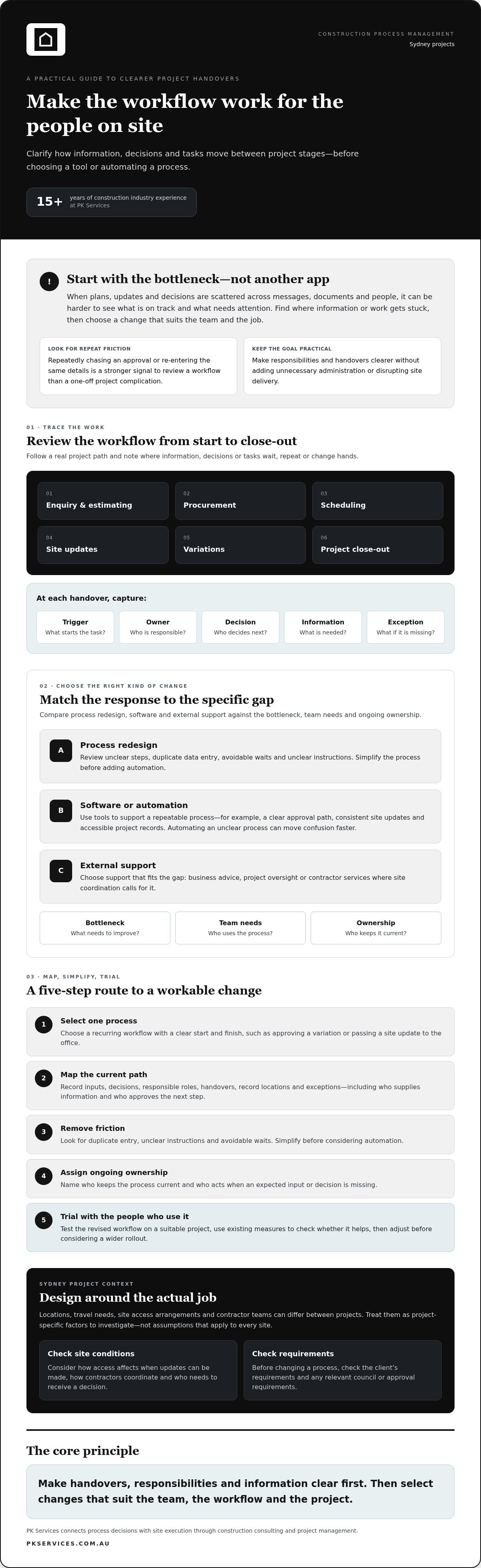
Trace work from enquiry and estimating through procurement, scheduling, site updates, variations and project close-out. Ask the people involved where they re-enter information, wait for a decision or have to chase an approval. Note what triggers each task, who owns it, what information they need and who receives the handover. This makes recurring friction visible before you choose a process change or tool.
- Where is project information recorded more than once?
- Which approvals or decisions regularly hold up the next task?
- What site updates does the office need, and who provides them?
- At close-out, what records or actions are often missing?
Why do Sydney project conditions affect process choices?
Sydney projects can involve different locations, travel needs, site access arrangements and contractor teams. Treat these as project-specific factors to investigate, rather than assumptions that apply to every site. A workflow that suits one job may need adjusting when people, materials or decisions move between several locations.
Before changing a process, check the project’s client requirements and any relevant council or approval requirements. Ask whether site access affects when updates can be made, how contractors coordinate their work and who needs to receive a decision. For construction process management Sydney teams can use consistently, design around the actual project conditions and the people delivering the work.
How to map and automate construction workflows without adding friction
A useful workflow map makes the path of work visible. A construction workflow map shows how information, decisions and tasks move from a defined trigger to a completed handover, helping teams spot delays and clarify ownership. Start with one live process that causes repeat questions or rework. Don’t try to document every project activity at once.
Use this five-step sequence:
- Select a process. Choose a recurring workflow with a clear start and finish, such as approving a variation or passing a site update to the office.
- Map it. Record each input, decision, responsible role, handover, record location and exception. Note who supplies information and who approves the next step.
- Remove friction. Look for duplicate data entry, unclear instructions and avoidable waits. Simplify the steps before adding automation.
- Assign ownership. Name the person responsible for keeping the process current and for acting when an expected input or decision is missing.
- Trial changes. Test the revised workflow with the people who use it, then adjust it before considering a wider rollout.
How do you map a construction process clearly?
Follow the workflow from trigger to completed handover, using a current project rather than an idealised version. Record who provides information, where it is stored, who makes each decision and what happens if information is incomplete. Then check the map with office staff, project leads, subcontractors and site teams. Each group may see a different gap. For relevant requirements, consult the Australian Standards for Construction overview and confirm which standards apply to the work.
What should you automate, standardise or keep human-led?
Automation tends to suit consistent, rules-based tasks such as routine reminders, status updates, document routing and capturing standard information. First, agree on templates, required inputs and responsibilities. Automating inconsistent steps can simply transfer the confusion into a new system.
Keep decisions that rely on context and judgement with accountable, suitably authorised people. That includes safety, commercial and site decisions. A workflow can prompt a review or route information to the right person, but it shouldn’t blur who is responsible for the decision.
For construction process management Sydney teams can put into practice, design the workflow around actual site and office routines. If an independent perspective would help connect process decisions with project delivery, explore construction business consulting from PK Services.
How to compare construction workflow automation options in Sydney
Choose an option based on the bottleneck, not the sales pitch. For construction process management Sydney projects, the right fit might be a simpler process, software that supports a stable workflow, or external project and consulting support. Compare each option against the same practical criteria.
| Option | Best fit | Effort, adoption and integration | Ongoing ownership |
|---|---|---|---|
| Process redesign | The steps, handovers or responsibilities are unclear or unnecessarily repetitive. | Requires time to agree on a better way of working. Staff adoption depends on involving the people who use the process. | An internal owner needs to keep responsibilities and instructions current. |
| Software adoption | The process is already consistent, with clear owners and repeatable information needs. | Setup and training take effort. Check that the software fits existing systems and that staff can use it on site as well as in the office. | Someone must manage access, process settings, training and ongoing use. |
| External project or consulting support | Workflow problems cross teams, project stages or site and office responsibilities. | Effort depends on the agreed scope. Check how the support will work with your team, project constraints and existing tools. | Agree who owns decisions, actions and any process changes once the support ends. |
Choose the smallest change that addresses a verified bottleneck. It may be a clearer approval path rather than a new platform. Software capabilities and provider service scopes vary, so ask for a demonstration of the workflow you need to improve. Use a relevant example, such as routing a variation for review, and check what happens when information is missing or a decision is delayed.
When is software enough, and when is process support needed?
Software may be enough when the process is stable, information requirements are known and people understand their responsibilities. If handovers, reporting or decision rights vary between teams, address the process first. External advice or project support may help clarify how work should move before you choose a tool. For organisations looking to build bespoke digital systems or implement smart automation, developers like 4mation can assist with custom technology solutions, whereas PK Services provides business consulting and project management, not workflow software.
What should you ask a construction management provider?
Ask how they’ll understand current workflows, site realities and project constraints before recommending a change. Confirm the deliverables, who makes decisions, how the team will communicate and how progress will be reviewed. If subcontractor selection is part of the challenge, use this construction subcontractor vetting guide as a separate reference, and clarify what support your project needs.
How to implement workflow changes across Sydney construction projects
A process that looks clear on paper still needs to work under site conditions. Trial one defined workflow on a suitable project before extending it to other jobs. Choose a contained task with visible handovers and a manageable group of participants, such as passing a site update to the office or routing a routine approval.
Before the trial, name an owner, explain the change to everyone affected and make the new steps easy to follow. Include a clear route for exceptions: who should be contacted if information is missing, a decision is delayed or the usual sequence doesn’t fit the work? Brief office staff, site leads and relevant contractors, then invite feedback as the process runs.
How can teams trial a workflow change on site?
Keep the trial focused. Check that participants understand their roles and know where to record updates. During the test, note missed information, waiting points and workarounds. Ask the team what felt clearer and what added effort. Review these observations before making the revised workflow standard. A small trial makes it easier to adjust the process without changing several project routines at once.
How do you measure whether the change is working?
Start with a baseline from existing project records. Choose indicators that match the problem, such as whether handovers are completed, how long approvals take or how often information is entered more than once. Don’t collect measures just because they’re easy to count.
Compare like-for-like stages and explain any limits. Project scope, timing and team composition can affect results, so a change in one trial shouldn’t be treated as proof that the same outcome will occur elsewhere. For wider business context, read about construction business profitability in NSW.
Before rolling out a change, verify which NSW requirements and project-specific obligations apply. Confirm them with suitably qualified advisers rather than assuming one process fits every project. Strong construction process management Sydney teams can rely on includes a way to raise concerns, review feedback and keep the workflow aligned with actual site needs. The same principle applies to projects in Queensland: check the relevant project requirements before adopting a process across different jobs.
If you need support connecting process decisions with project delivery, discuss construction project management with PK Services.
Choose a Sydney construction process partner that connects strategy with site delivery
The right support depends on where work is getting stuck. If responsibilities or routines need clarification, business consulting may help you assess the process and identify practical changes. If coordination across project stages is the issue, project management may be a better fit. Where site delivery depends on contractor coordination, trades and contractor services may also be relevant. Some projects need a combination, but it’s worth defining the gap before deciding.
What support can PK Services provide?
PK Services provides construction business consulting, full-cycle project management and trades and contractor services. Its project management covers the process from project inception through to completion, connecting operational decisions with practical site execution. The business has over 15 years of construction industry experience and serves clients in New South Wales and Queensland. For a Sydney project, confirm current service availability and discuss the project’s specific needs.
Trades and contractor services can support site requirements and workforce coordination. They are not recruitment or staffing services. To understand how end-to-end oversight can fit a project, see this guide to full-cycle construction project management.
What should you prepare before an initial discussion?
Bring one clear example of the workflow that needs attention. Explain where it slows down, who is involved and what a successful handover should look like. You don’t need a complete process redesign in hand. A specific example, such as a decision that repeatedly arrives late or a site update that doesn’t reach the right person, gives the conversation a useful starting point.
- Describe the project: Share its current stage, Sydney location and any relevant access, timing or coordination constraints.
- Identify the people involved: Note which internal teams, site leads and contractors take part in the workflow.
- Clarify the support you’re considering: Is the need mainly process advice, project oversight, contractor support or a combination?
- Protect sensitive information: Discuss the issue without sending confidential project, client or commercial details unless there’s an agreed reason and appropriate way to share them.
A useful first discussion should help clarify the fit, not assume a particular solution. Ask what support is in scope, who will make decisions and how it would connect with the people delivering the work. That keeps construction process management for Sydney projects grounded in the realities of the site and the business.
Make your next workflow change count
Better construction process management for Sydney projects starts with a verified bottleneck, not a new tool by default. Map how information and decisions move, clarify who owns each handover, then choose the smallest change that addresses the problem. If software is part of the answer, check that it fits the way your team works. Trial the change on a suitable project and review relevant measures and team feedback before expanding it.
Process decisions need to work for the people delivering the job. PK Services brings over 15 years of construction industry experience, with full-cycle project management from start to finish and trades and contractor services for construction sites. Its business consulting and project support can help connect operational decisions with practical site execution. Confirm current service availability and fit for your Sydney project when you get in touch.
Talk with PK Services about your construction project requirements. A clear starting point can help you move towards smoother coordination, one practical improvement at a time.
Frequently Asked Questions
What is construction process management?
Construction process management coordinates tasks, information, people and decisions across a project. It helps teams see who owns each step, what needs to happen next and how work moves from planning through site delivery. It can include mapping workflows, overseeing a project and reviewing handovers. It doesn’t automatically mean buying software. Start by identifying the coordination issue, then choose an approach that fits the project and the people doing the work.
How can construction workflow automation help a Sydney construction business?
Automation can support repeatable tasks such as reminders, routine status updates and document routing. It works best when the underlying process is clear and responsibilities are understood. For construction process management Sydney businesses can use effectively, consider each project’s practical conditions, including site access, contractor coordination and client requirements. First identify a real bottleneck, such as a recurring wait for routine information, then assess whether a process change, technology or both could address it.
Do construction businesses need software to automate workflows?
No. Some workflow improvements need no new software. Clearer responsibilities, consistent templates or a more reliable handover routine may be enough. Software can help when a process is stable and teams need a dependable way to share information or track repeatable tasks. Before adopting a platform, define the problem, check what your existing systems can do and consider how office and site teams will use the process. Don’t automate confusion.
How do you choose construction management software?
Start with the workflow problem, not a list of features. Compare how each option handles the information, approvals, handovers and reporting your team needs. Check whether it’s usable for both office and site staff, what implementation involves, how data can be accessed and who will own it over time. Ask providers to demonstrate a relevant workflow using your scenarios. Confirm current capabilities, support arrangements and commercial terms directly with each provider.
Can construction workflow changes be introduced while a project is underway?
Yes, but scope the change carefully. Trial one contained workflow, explain revised responsibilities and give affected people a clear way to flag exceptions. Before changing a process, consider current project commitments, safety and contractual requirements. Monitor how the trial works and gather feedback from the people using it before expanding the change. If it may affect formal obligations, seek advice from a suitably qualified professional familiar with the project and applicable NSW or Queensland requirements.
When should a Sydney builder engage a construction process management consultant?
Consider external support if recurring coordination issues remain unresolved, teams disagree about ownership or project leads lack capacity to review how work flows. A consultant or project manager should first understand the current process and site context, then clarify the scope, deliverables, communication arrangements and decision rights. Check relevant experience and ask for evidence behind any promised outcomes before committing. For projects in NSW or Queensland, confirm the provider’s availability and suitability for the specific job.
How can you tell whether construction workflow automation is working?
Set a baseline before making changes, then choose measures tied to the original bottleneck. Depending on the workflow, you could track completed handovers, approval turnaround or repeated data entry. Compare similar project stages and ask the people using the process whether it’s clear and practical. Be open about limits: project conditions and other changes may affect results. If the new workflow creates extra steps or missed information, review it and adjust before wider use.


