

A construction-site plumber in NSW needs the right plumbing qualification and a licence or certificate covering the work they’ll perform. Becoming a licensed plumber requires a Certificate III in Plumbing and an apprenticeship under a licensed plumber’s supervision. When hiring licensed plumbers for construction sites in NSW, match each person’s authorisation to the job rather than relying on a general trade title.
A plumbing qualification alone doesn’t cover every site task. Licence and certificate holders may perform or supervise only work within the scope of their authorisation. A qualified supervisor certificate does not allow its holder to contract for work.
This guide explains which site jobs require an authorised professional, how to check credentials, and what to consider for gasfitting, hot water and sewage work. Use it to plan site trades and keep the work aligned with NSW requirements.
Key Takeaways
- Identify which construction-site plumbing tasks require a licence or certificate that covers the specific work.
- Learn what to look for when assessing a plumber’s authorisation and experience for a site role.
- Understand why gasfitting, hot water and sewage work need particular attention to the relevant scope of work.
- Separate plumbing credentials from site safety tickets and inductions when planning work on site.
Plumbing work requiring a licensed professional
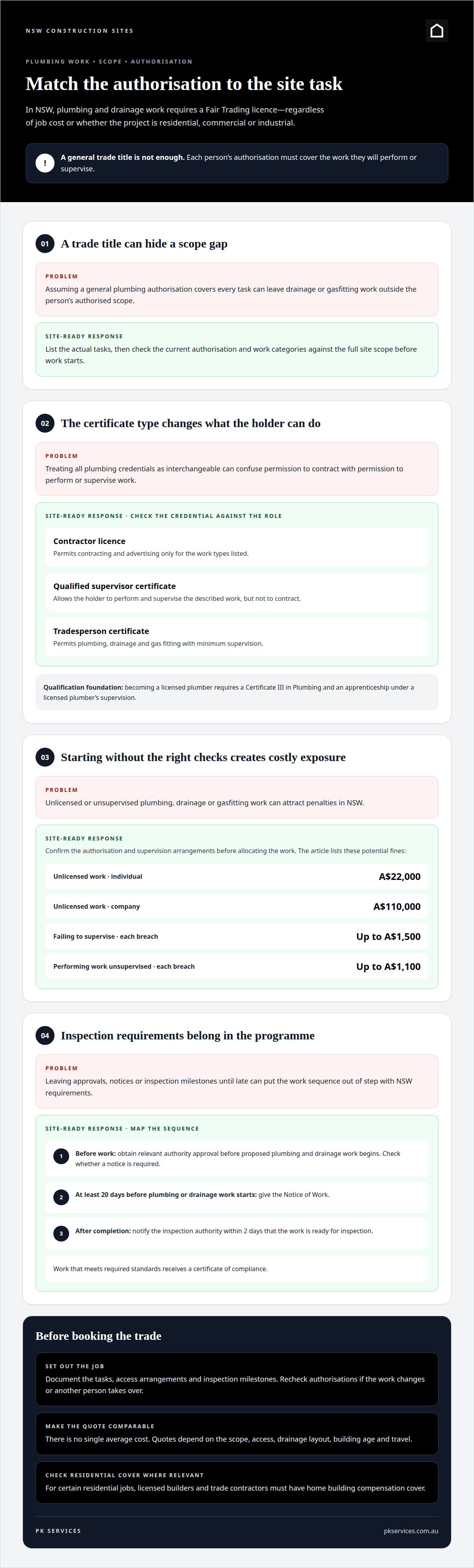
In NSW, plumbing and drainage work requires a Fair Trading licence, regardless of job cost or whether the project is residential, commercial or industrial. Construction firms engaging licensed plumbers for construction sites in NSW need to match each task to the licence or certificate scope. A general plumbing authorisation may not cover every drainage or gasfitting task.
Before work starts, check the contractor’s current authorisation and licence card. A contractor licence permits contracting and advertising only for the work types listed. A qualified supervisor certificate allows its holder to perform and supervise the described work, but not to contract. A tradesperson certificate permits plumbing, drainage and gas fitting with minimum supervision.
Penalties apply to unlicensed or unsupervised work. In NSW, unlicensed plumbing, drainage or gasfitting can attract a fine of A$22,000 for an individual or A$110,000 for a company. Failing to supervise can result in a fine of up to A$1,500 for each breach. Performing work unsupervised can attract up to A$1,100 for each breach.
Plan approvals and notices into the site programme. Obtain relevant authority approval before proposed plumbing and drainage work begins. Check whether a notice is required before work starts. After completion, notify the inspection authority within 2 days that the work is ready for inspection.
Insurance and workers compensation arrangements depend on the project and workforce structure. For certain residential jobs, licensed builders and trade contractors must have home building compensation cover.
There’s no single average cost for hiring a construction-site plumber. The quote depends on the scope, access, drainage layout, building age and travel, so provide the project details when requesting a quote.
Engaging licensed plumbers for construction sites in NSW starts with a clear scope, schedule and list of site requirements. Set out the tasks, access arrangements and inspection milestones, then check that they match the contractor’s authorisation before booking the work.
Checking a plumber’s credentials, licences and references
Start by checking the NSW public register before site work begins. Confirm the contractor’s current authorisation and match the licence holder’s details to the proposed agreement. The register’s required information is governed by section 120 of the Home Building Act 1989 and clause 69 of the Home Building Regulation 2014. This check helps distinguish the contractor’s authority from an individual worker’s qualifications.
Next, compare the authorised work categories with each task in the site scope. Licensed plumbers for construction sites in NSW need authorisations covering the actual work, not simply a general plumbing title. For a project involving water services, drainage and sewerage, check that the relevant categories cover every stage. Sydney Water accreditation category D1 applies to licensed plumbers accredited to apply for, perform or supervise water-service connections.
Check the authorisation period and certificate type too. NSW contractor plumbing licences can be issued for one, three or five years. Provisional tradesperson certificates are issued for 3 years and cannot be renewed. Individual licence or certificate applicants must submit a National Police Check no older than 4 months at application. These details help clarify whether an authorisation is current and applicable.
References provide useful context alongside a register check. Master Plumbers NSW advises checking credentials, licences and references. Request examples of similar completed work, such as a commercial drainage project or water-service connection. Clarify what the plumber did and whether they supervised others. For licensed plumbers for construction sites in NSW, relevant experience should match the project’s tasks and interfaces.
- Check identity, current authorisation and listed work categories.
- Match categories to the full work scope and relevant connections.
- Review references for comparable completed work and responsibilities.
Keep these records with the agreed scope, and revisit them if the work changes or another person takes over. For teams coordinating trades across a project, construction-site contractor support can help bring the scope and site requirements together.
Gas fitting, hot water systems and sewage connections
Gas fitting needs a qualified person whose authorisation covers the specific installation. In NSW, the Gas Supply Act 1996 defines gasfitting work. A restricted LP gasfitting authorisation covers installations designed for liquefied petroleum gas in vapour phase only, at pressures not exceeding 150 kilopascals. Match the proposed fitting and gas supply arrangement to the worker’s authorised scope before programming site work.
Hot water systems require licensed plumbing work, including when the work is DIY. Site plans may involve storage, continuous-flow, solar or heat-pump units. As installation details vary by system, specify the type, location and plumbing tasks in the work scope. This gives the qualified plumber a clear basis for planning and coordinating the work with other construction stages.
A licensed plumber must handle sewage connections. The NSW Notice of Work inspection process applies to plumbing and drainage infrastructure, from construction, maintenance or alteration through to connection with a water supply, public sewerage network or on-site sewage management system. Define the connection point clearly. Connecting a site to a public sewer, for example, involves a different interface from connecting to an on-site sewage system.
Before work begins, document the relevant system, connection point, work boundaries and inspection steps. The Notice of Work must be given at least 20 days before plumbing or drainage work starts. After completion, the inspection authority must be notified within 2 days that the work is ready for inspection. Work meeting required standards receives a certificate of compliance. That certificate confirms standards compliance for the plumbing and drainage work, not other project matters.
- Identify whether the task involves gas, hot water or sewage infrastructure.
- Match the plumber’s authorisation to the installation and connection work.
- Record the scope and required notices in the project documents.
Do plumbers working on NSW construction sites need additional safety tickets or inductions?
A plumbing licence confirms authorisation for plumbing work, but it doesn’t replace a construction-site induction. Any additional tickets or training depend on the tasks and site rules. A plumber installing pipework at ground level may have different access requirements from someone entering a confined space or working at height.
Before mobilisation, map each plumbing task against the site’s access process and hazards. The builder or principal contractor can set induction and competency requirements for the project. Record what evidence is needed, who must provide it and when. This avoids treating a plumbing licence as proof of every site-specific competency.
For example, a sewage connection may involve excavation or a confined space, while a hot-water installation may involve different work areas and interfaces. If confined-space work is required, plan controls for the specific task. Project documentation can include a Safe Work Method Statement and Construction Management Plan prepared for the work.
- Separate plumbing authorisation from site access and safety requirements.
- Identify task hazards, such as excavation or confined-space entry.
- Record inductions, competencies and controls before the scheduled work.
Keep site requirements tied to the work package. If the scope changes, such as by adding a connection or changing access arrangements, review the task controls and required evidence before proceeding. This gives the builder, plumber and nearby trades a clear record of the plan.
Need to align plumbing trade coverage with site requirements? Coordinate construction-site trade requirements as part of a clear project plan.
PK Services
PK Services helps construction firms organise the plumbing and contractor support their projects need. Turn to the team when a project needs skilled trades, clear scope coordination or support managing moving parts from start to finish.
PK Services’ Trades & Contractor Services can help fill essential gaps on construction sites, while Business Consulting supports operational planning. For a plumbing package, this means aligning the required work with project sequencing, site access and coordination across trades. The aim is an organised process, from defining the requirement through to managing the work.
Share your project scope, schedule and site requirements with PK Services to discuss the next step. Contact PK Services to talk through your construction project.
Set your next site stage up well
Make plumbing part of the project plan from the outset. Clear trade coordination connects the work package with site sequencing, access arrangements and the people responsible for each stage. This gives builders a practical foundation for moving from planning to delivery.
Choosing licensed plumbers for construction sites in NSW is one part of the process. Bring the right trades and project decisions together so plumbing work fits the construction programme instead of becoming a late-stage complication.
PK Services can support construction firms with the planning and contractor coordination that keeps project requirements moving. If you’re mapping upcoming site work or addressing a gap in trade coverage, contact PK Services about your site to discuss the project.
A well-organised plan gives your team a stronger starting point. Take the next step with confidence.
Frequently Asked Questions
What qualifications do plumbers need?
To become a licensed plumber in NSW, a person needs a Certificate III in Plumbing and an apprenticeship under a licensed plumber’s supervision. The qualification provides the training foundation; the relevant NSW licence or certificate authorises particular work. A Certificate IV in Plumbing and Services may also support plumbers expanding their skills for business ownership or management roles. Site tasks must still match the worker’s authorisation.
What plumbing licence is required for construction work in NSW?
The required authorisation depends on the work and the person’s role. A contractor licence permits contracting and advertising for the work types listed on the card. A qualified supervisor certificate covers performing and supervising the described work, but not contracting. A tradesperson certificate allows plumbing, drainage and gas fitting with minimum supervision. Classes such as water plumbing, roof plumbing and LP gasfitting cover different scopes.
How can I verify a NSW plumber's licence and authorised work types?
Use the NSW public register to check the plumber or contractor’s current authorisation, then match its listed scope to the proposed tasks. Check the licence holder’s name and status as well as the work categories. Contractor licences may be issued for one, three or five years, so confirm the current period. If a project involves several plumbing stages, check that each is covered.
What plumbing and drainage work requires a licence in NSW?
Plumbing and drainage work generally requires the appropriate NSW licence or certificate, including tasks such as installing or altering pipework and drainage systems. Gasfitting, hot-water system work and sewage connections also require an appropriately authorised professional. Some small maintenance tasks are treated differently: examples include replacing tap washers or O-rings, fixing minor pipe leaks and replacing toilet seats. The task’s scope determines the applicable authorisation.
What are the NSW rules for plumbing inspections, certificates and compliance on building sites?
Plumbing and drainage work must follow the applicable notice and inspection process. The inspection authority depends on the service area: NSW Fair Trading applies where Sydney Water or Hunter Water operates water or sewerage services; elsewhere, the local council acts under delegation. A certificate of compliance records that inspected plumbing and drainage work meets required standards. It does not certify other aspects of the project.
How do construction companies find and compare licensed plumbers in NSW?
Compare proposals against one consistent work scope, including task boundaries, connection points, project sequence and required records. Then check that the authorisation covers each task and that relevant references show similar completed work. For example, a site package involving roof plumbing and sewage connections needs both scopes addressed, not just a general plumbing description. Clear comparisons make exclusions and coordination needs easier to spot.


