

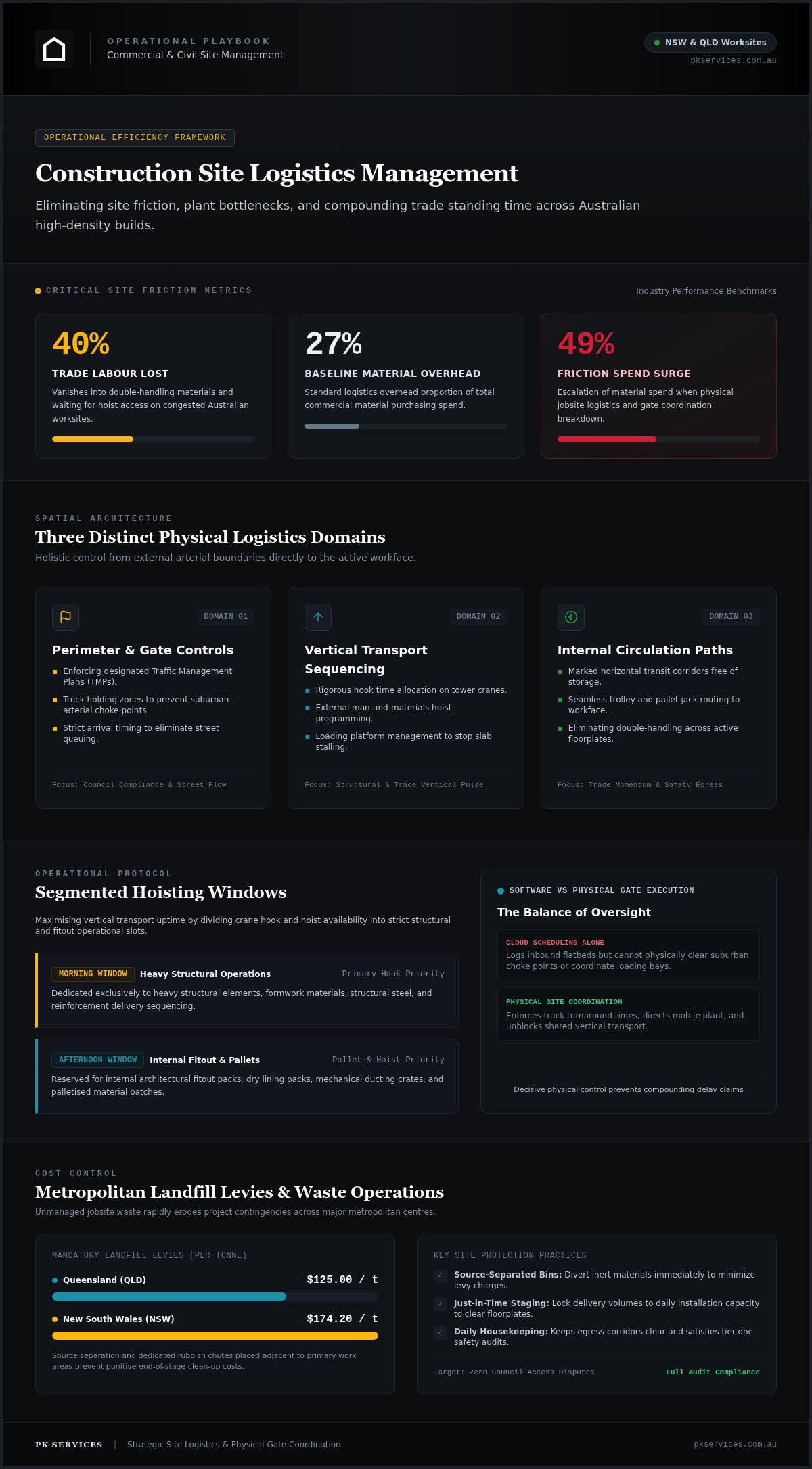
Up to 40% of trade labour hours on congested Australian worksites vanish into double-handling materials and waiting for hoist access. You know the daily frustration firsthand. Semitrailers queue down narrow suburban access roads, delivery drivers clash over shared loading bays, and skilled trades stand idle on upper slabs waiting for crane hooks. Cloud-based scheduling platforms can map delivery slots to the minute, but construction site logistics management falls apart the second real-world site friction takes over. Software alone doesn't clear access gates; decisive physical coordination does.
Every minute a delivery truck blocks a traffic lane or a crew waits for materials, project margins bleed. This 2026 playbook shows you how to master site logistics planning across Queensland and New South Wales to eliminate costly delivery delays and trade downtime. We unpack the practical systems needed to secure uninterrupted material flow from entry gate to final workface, sidestep punitive council compliance breaches, and maintain an uncompromising daily construction programme.
Key Takeaways
- Master modern construction site logistics management by treating material staging and plant sequencing as operational levers for profitability.
- Discover why digital delivery booking tools fall short without disciplined, hands-on gate controllers enforcing turnaround times on site.
- Maximise shared plant and vertical transport uptime to keep specialist trades productive on the slab rather than waiting for hooks.
- Deploy a five-step logistics planning framework that eliminates council access disputes and neighborhood complaints across New South Wales and Queensland projects.
- Learn how an end-to-end management approach bridges strategic programme scheduling with physical worksite execution to protect trade momentum.
What Is Construction Site Logistics Management in 2026?
Modern worksites are intricate operational machines. True construction site logistics management orchestrates every moving component: incoming raw materials, plant assets, and trade teams. Research shows logistics overhead accounts for up to 27% of total material purchasing spend on commercial builds. When site coordination fails, that friction escalates to 49%. Software dashboards can log an inbound flatbed, but they cannot secure an access gate or clear an obstructed hoist run. Real logistics management unites strategic scheduling with immediate physical control.
Every delayed delivery sets off an expensive chain reaction. Subcontractors hit pause. Floor cycles slip. Neighbouring businesses lodge council complaints. Mastering jobsite logistics protects your baseline programme from compounding delay claims before trade standing time erodes project margins.
The Scope of Modern Jobsite Logistics
Site logistics extends far beyond booking delivery slots. It demands total control over three distinct physical domains:
- Perimeter and gate controls: Managing designated Traffic Management Plans (TMPs), truck holding zones, and strict entry timing to prevent suburban arterial choke points.
- Vertical transport sequencing: Allocating hook time on tower cranes, programming external man-and-materials hoists, and managing loading platforms without leaving crews stalled on upper floors.
- Internal circulation paths: Enforcing clear, safe egress paths across active decks so specialist trades move efficiently from material drop zones straight to the workface.
Why Logistics Fails on Australian Builds
Most jobsite failures happen at the perimeter. Subcontractors dispatch deliveries unannounced, resulting in multiple heavy vehicles competing for a single loading bay. That chaos spills into surrounding streets, inviting rapid council scrutiny.
Inadequate laydown zones make the problem worse. When staging areas lack rigorous daily planning, structural packs and delicate architectural finishes are dumped wherever space exists. The result is chronic double-handling, weather damage, and trade downtime. Too often, head contractors leave this massive undertaking to site supervisors who are already stretched thin tracking defects. Without dedicated physical oversight running the front gate, construction site logistics management quickly collapses into constant crisis management.
The Core Pillars of Strategic Construction Logistics
Flawless jobsite execution requires separating long-range procurement strategy from daily perimeter control. Successful principal contractors treat plant and equipment as the pulse of the build. If your crane stops swinging or your hoists sit idle during key trade changeovers, structural cycles grind to a halt. Effective construction site logistics management establishes transparent protocols so every subcontractor knows precisely when their materials can enter the site footprint.
Just-in-time delivery remains the foundation. Storing weeks of plasterboard or ducting on an active floorplate creates unnecessary hazards and limits working room. Forward-thinking teams lock down strict delivery allocations linked directly to installation capacity, keeping working decks uncluttered and productive.
Vertical and Horizontal Transport Coordination
Cranes and hoists are your project's primary arteries. Managing them requires uncompromising structure:
- Segmented hoisting windows: Reserve morning hook time for heavy structural elements, formwork, and reinforcement. Schedule afternoon slots for internal fitout packs and pallets.
- Dedicated unloading bays: Coordinate telehandlers and mobile plant strictly within designated landing zones so flatbeds discharge and clear streets quickly.
- Clear deck pathways: Keep marked horizontal transit corridors completely free of temporary storage, allowing pallet jacks and trolleys to reach the workface without diversion.
Waste Management and Site Clearing Operations
Rubbish accumulation is a silent productivity killer. With metropolitan landfill levies sitting at $125 per tonne in Queensland and $174.20 per tonne in New South Wales, unmanaged jobsite waste rapidly destroys project contingencies. Position dedicated rubbish chutes and source-separated bins directly adjacent to primary work areas. Enforcing daily trade housekeeping keeps egress routes safe, satisfies tier-one safety audits, and avoids the panic of end-of-stage cleanups.
Traffic Control and Local Council Compliance
Suburban worksites face relentless regulatory scrutiny. Operating heavy transport down narrow residential corridors requires rigorous alignment with local council Work Zone permits, noise curfews, and clearway restrictions.
Every delivery route must incorporate certified traffic controllers who enforce positive pedestrian-vehicle separation under SafeWork NSW and Workplace Health and Safety Queensland standards. Protecting public thoroughfares prevents costly council stop-work notices and preserves community goodwill. Partnering with seasoned specialists like PK Services gives builders end-to-end operational support, ensuring compliant physical coordination from the entry gate right through to final handover.
Digital Tools vs. Hands-On Logistics Oversight: The Balance
Cloud-based delivery platforms look impressive in executive meetings. They provide neat Gantt charts, colour-coded loading bay allocations, and instant booking confirmations. But digital dashboards don't marshal trucks. Relying solely on software to control active site gates is a proven recipe for gridlock. Highly effective construction site logistics management pairs modern digital planning with disciplined, physical leadership at the boom gate.
Subcontractors work under intense deadline pressure. When a concrete pour runs late or structural steel arrives off-schedule, drivers don't consult apps to see if their loading bay is clear. They pull up to the gate anyway. Without an experienced site controller directing physical traffic, your digital booking system quickly becomes meaningless paperwork.
The Limitations of Software-Only Logistics
Software platforms track site issues, but they lack the authority to fix them in real time:
- Speculative bookings: Trade packages often book crane slots "just in case", causing vertical transport assets to sit idle while other trades desperately wait for lifts.
- Passive notifications: An automated SMS warning about an incoming oversize load cannot clear double-parked delivery vans off a shared suburban boundary road.
- Rigging delays: No delivery app inspects whether pre-slung packs meet lifting standards before the truck arrives at the crane hook.
The Role of the Dedicated Site Logistics Coordinator
A physical logistics manager acts as the build's air traffic controller. They inspect every inbound vehicle, confirm loads are strapped and rigged safely, and reject deliveries that fail to match scheduled staging windows. If a flatbed exceeds its allocated thirty-minute turnaround window, they step in immediately to clear the loading dock.
This hands-on coordination bridges the gap between high-level site strategy and daily reality. The coordinator consults the digital schedule, assesses current floorplate congestion, and negotiates shared hook time directly with trade foremen before disputes erupt. Digital tools establish the operational baseline. Decisive human supervision turns that plan into continuous site flow, elevating modern construction site logistics management from reactive troubleshooting into a predictable operational advantage.
A Five-Step Framework for Optimising Site Logistics
Logistics planning isn't a static document you file away after council approval. It is an active operational rhythm that shifts as your building moves from groundworks to internal finishes. Implementing a structured framework ensures site access remains fluid regardless of project density. When applied properly, disciplined construction site logistics management protects your programme against compounding delays and unexpected trade friction.
Executing this strategy requires a balance between rigorous pre-construction planning and nimble daily execution on the ground.
Steps 1 to 3: Planning, Hoarding, and Procurement Gates
Laying a resilient logistics foundation begins well before the first excavator arrives on site:
- Step 1: Audit access constraints: Review local council haulage limits, overhead power lines, and clearway restrictions across New South Wales or Queensland worksites. Establish boundary turning radiuses to ensure heavy transport can enter and exit without blocking municipal traffic.
- Step 2: Publish the master logistics plan: Define mandatory hoarding lines, gate numbers, and designated unloading bays. Distribute these enforceable protocols to every tendering subcontractor so site rules are understood before contracts are signed.
- Step 3: Standardise material delivery packaging: Require suppliers to deliver materials strapped, palletised, and pre-slung for rapid unloading. Mechanical handling should take minutes, not hours of manual sorting on the dock.
Steps 4 and 5: Daily Marshalling and Phased Transitions
Long-term plans only succeed when backed by rigorous daily management and progressive staging updates:
- Step 4: Run afternoon logistics stand-ups: Hold a non-negotiable ten-minute meeting at 3:00 PM with all trade foremen. Review tomorrow's scheduled deliveries, assign hoist priorities, and resolve crane booking clashes before trucks hit the road.
- Step 5: Transition staging zones dynamically: Structural concrete pours, rough-ins, and architectural fitouts have distinct spatial needs. Reallocate floorplate laydown areas as wet trades hand over work areas to finishing trades, preventing trade crossover congestion.
Learn how our full cycle construction project management keeps programmes running smoothly across every build stage. If you want to eliminate delivery bottlenecks and maximise contractor productivity on your next project, partner with PK Services for end-to-end operational support.
Driving Project Excellence: How PK Services Unlocks Site Flow
Operational efficiency separates profitable projects from distressed programmes. Protecting your bottom line demands more than passive advice; it requires practical, decisive action. Strategic construction site logistics management acts as your strongest operational safeguard, keeping trades moving and plant operating at peak capacity.
PK Services redefines site delivery by connecting boardroom strategy with active site execution. Backed by over 15 years of specialised Australian construction industry experience across New South Wales and Queensland, we know that theoretical plans fall flat without disciplined leadership on the ground. We bridge that gap by combining executive advisory with experienced site management and reliable trade delivery.
Strategic Advisory Aligned with On-Site Reality
True logistical efficiency begins with critical analysis. We evaluate your baseline project workflows to pinpoint hidden bottlenecks, excessive material double-handling, and plant allocation dead time before they compromise your milestones.
Our team designs bespoke logistics masterplans engineered specifically for constrained urban footings and tight suburban corridors. We account for regional statutory guidelines, council clearways, and progressive structural handovers. Discover how our construction business consulting Australia redefines project operational standards from pre-commencement planning straight through to daily worksite rhythm.
Integrated Trade and Project Management Delivery
Coordinating complex logistics requires active physical management. Unlike traditional consultancies that hand over reports and disappear, we manage the entire process from start to finish:
- End-to-end operational oversight: We direct site establishment, traffic staging, and daily access sequencing to maintain trade momentum.
- Skilled trade contractor support: We provide experienced trade contractors who understand strict material handling protocols, keeping floorplates organised and safe.
- Programmed continuity: Our supervisors resolve trade disputes and gate delays immediately, protecting your critical path.
By uniting strategic planning with hands-on trade execution, we eliminate standing time and keep your build moving. Explore how PK Services can transform your next project build into a model of commercial efficiency and predictable delivery.
Take Command of Your Worksites and Build Lasting Momentum
Predictable project programmes don't happen by accident. They are built on disciplined execution at the front gate, clear horizontal pathways, and active vertical transport control. Modern construction site logistics management requires moving past passive scheduling apps to secure decisive, boots-on-the-ground operational leadership. When material flow is synchronised with actual trade capacity, standing downtime disappears and site productivity surges.
With over 15 years of proven delivery on New South Wales and Queensland projects, PK Services bridges high-level consulting with vetted trade contractor services. We manage the entire process from strategic early-phase planning through to practical site execution, ensuring your trades have what they need, exactly when they need it. Ready to eliminate delivery bottlenecks and protect your commercial margins? Partner with PK Services for complete site logistics oversight and build with total confidence.
Frequently Asked Questions
What is construction site logistics management?
Construction site logistics management is the strategic planning and physical control of materials, plant assets, and trade movements across a worksite. It ensures supplies move from delivery gates directly to active workfaces without stalling trades or blocking local roads. Sound logistics management connects early procurement planning directly with daily gate marshalling and vertical transport scheduling to keep the entire build programme moving.
How does strategic logistics management reduce overall build costs?
Strategic logistics cuts costs by eliminating trade downtime, material double-handling, and council non-compliance fines. When deliveries arrive directly in installation sequence, trade crews don't waste paid hours searching for materials or waiting for crane hooks. Disciplined gate schedules also prevent expensive transport demurrage charges and protect contractor margins across competitive building markets in New South Wales and Queensland.
What are the essential elements of a Site Logistics Plan?
A comprehensive Site Logistics Plan maps physical site perimeters, access gates, and hoarding lines alongside vehicle turning paths. It designates dedicated loading docks, crane radii, external material hoists, and unobstructed internal egress paths. Crucially, the plan details operational rules: delivery booking notice windows, trade laydown limits, waste disposal routes, and council-approved working hours tailored to the local area.
Can site logistics software replace dedicated on-site logistics personnel?
No, software cannot physically direct heavy vehicles or enforce site rules at the boom gate. Digital platforms excel at tracking bookings and providing schedule visibility, but they cannot verify whether delivery loads are rigged safely or turn away unannounced trucks. Real jobsite momentum requires an experienced site coordinator who can marshal vehicles, resolve trade priority disputes, and enforce physical dock turnover.
How do site logistics requirements change between structural and fitout phases?
Structural stages centre on high-tonnage, crane-dependent deliveries like formwork, rebar, and precast panels operating under heavy transport guidelines. Fitout stages pivot to high-frequency, multi-trade deliveries of fragile architectural finishes. Fitout demands tightly managed man-and-materials hoists, protected horizontal distribution corridors across finished slabs, and frequent waste clearing cycles to prevent trade congestion as worksite density reaches its peak.
What happens if a delivery arrives on site without a booking?
Unscheduled trucks are turned away or directed to an off-site holding zone until an approved loading gap opens. Letting unbooked vehicles enter an active site creates immediate perimeter choke points, stalls pre-allocated crane picks, and risks blocking public traffic lanes. Strict gate marshalling protects trade subcontractors who reserved their unloading slots and keeps the master schedule intact.
How do council permits affect construction logistics in Sydney and Brisbane?
Municipal permits dictate vehicle arrival times, street clearways, and approved heavy-haulage routes across Sydney and Brisbane. Local councils enforce strict Work Zone boundaries, noise curfews, and public protection requirements. Breaching these conditions risks substantial fines or immediate stop-work notices. Seasoned site teams integrate council permit restrictions directly into daily delivery schedules to maintain public safety and avoid disputes.


