

Another digital dashboard won't rescue an uncoordinated job site. Real construction business transformation doesn't start with new software; it takes root where executive commercial strategy connects directly with trade execution on the ground.
You already know the daily friction. Unreliable subcontractors trigger costly delays, defect disputes stall handover, and relentless administrative burdens drag leadership away from strategic oversight. When high-level project programming doesn't match the reality of active site delivery, hard-won margins evaporate fast. Firefighting contractor shortfalls shouldn't be your standard operating procedure.
It's time to build a better model. Discover how Australian construction leaders align commercial strategy, operational processes, and site execution to build resilient, profitable businesses. We explore the proven frameworks you need to protect predictable project margins, lift on-site quality benchmarks, and establish the operational foundation required to bid for larger commercial works.
Key Takeaways
- True construction business transformation moves beyond standalone software, systematically connecting high-level commercial strategy with hands-on trade execution.
- Mastering the four interdependent pillars of commercial management, processes, trade quality, and governance safeguards your cash flow from bid to handover.
- Practical site workflows must direct digital adoption so your team tackles genuine operational bottlenecks rather than accumulating unused tech tools.
- A structured five-stage roadmap establishes clear operational baselines, preparing your business to scale sustainably and win larger commercial tenders.
- Bridging executive planning with qualified trade leadership eliminates recurring site defects and restores strategic control to business owners.
What Construction Business Transformation Means in 2026
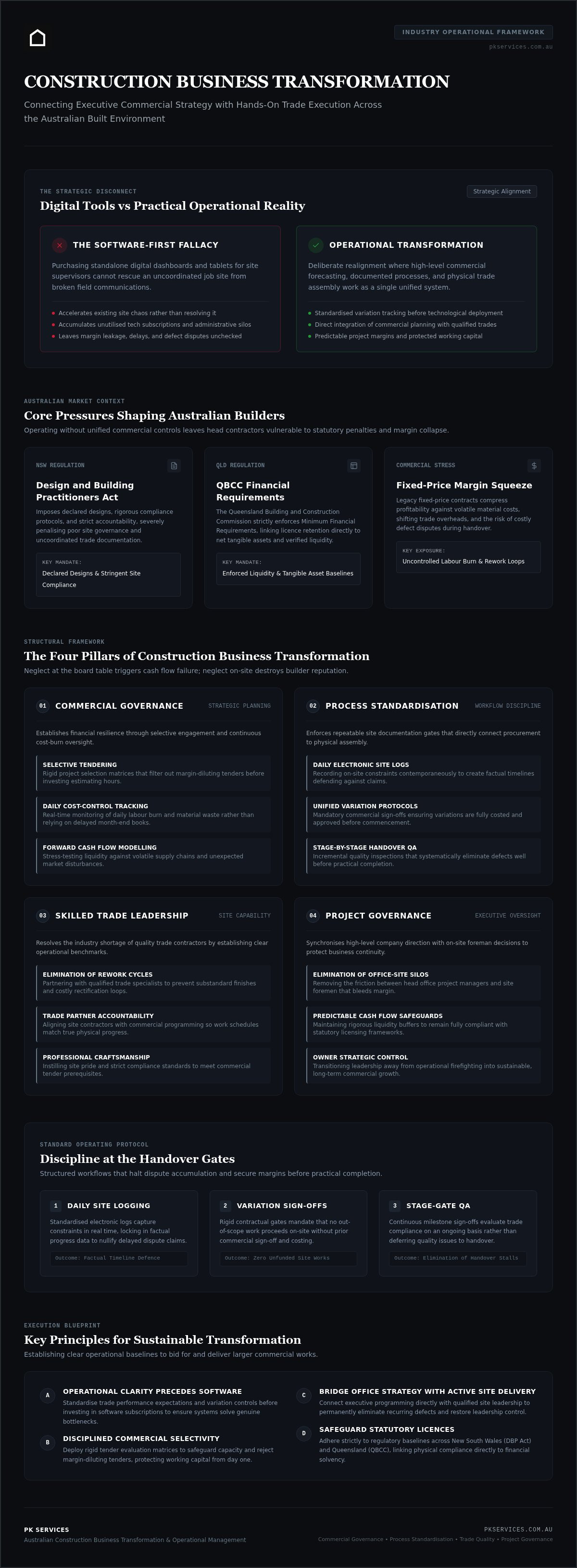
True construction business transformation is not a cosmetic software rollout or a marketing refresh. It represents the deliberate, end-to-end realignment of executive commercial strategy, operational workflows, and physical trade execution. While generic digital transformation often focuses on digitising existing paper records, real operational restructuring rewires how a building firm operates. Purchasing tablets for site supervisors will not rescue a business from broken communications, margin leakage, or unchecked project disputes.
The Core Pressures Shaping Australian Construction
Building companies across New South Wales and Queensland face acute commercial pressures. Legacy fixed-price contracts continue to squeeze cash flow against unpredictable trade overheads and volatile material prices. At the same time, regulatory oversight has reached unprecedented levels.
In New South Wales, the Design and Building Practitioners Act demands rigorous compliance protocols, declared designs, and stringent accountability that penalise poor site governance. Across the border, the Queensland Building and Construction Commission (QBCC) strictly polices minimum financial requirements, tethering licensing directly to actual liquidity and net tangible assets. Status quo building models simply cannot absorb these strains. Operating without unified commercial controls leaves builders exposed to sudden financial penalties and project insolvencies.
Beyond Software: The Operational Reality Check
Many construction leaders attempt to solve these issues with software subscriptions. Yet, expensive enterprise platforms fail repeatedly when forced onto broken site communication lines. Technology merely accelerates your existing habits. If your field communication is chaotic, digital tools only produce faster chaos.
Administrative silos between head office project managers and site foremen quickly destroy job margins through unapproved variations, scheduling delays, and protracted defect disputes. Lasting construction business transformation demands operational clarity before technological investment. You must first standardise trade expectations, formalise variation tracking, and bridge the stubborn gap between high-level commercial forecasting and hands-on trade execution.
The Four Pillars of Construction Business Transformation
Sustainable expansion requires harmony between corporate governance and physical operations. If you neglect the board table, cash flow collapses. If you ignore the job site, rework destroys your reputation. A balanced construction business transformation relies on four interdependent pillars: strategic commercial management, process standardisation, skilled trade quality, and project governance. Weakness in any single pillar destabilises the entire enterprise, leaving head contractors vulnerable to margin erosion and crippling defect claims.
Commercial Governance and Strategic Planning
Disciplined growth begins with selective tendering. Leading builders deploy rigid project selection frameworks to reject margin-diluting tenders before investing estimating hours. This pillar demands active cost-control systems that monitor daily labour burn alongside material waste rather than relying on delayed month-end accounting reports. Forward-looking cash flow modelling ensures ongoing financial resilience against volatile supply chains and sudden sector shocks.
Process Standardisation and Workflow Discipline
Repeatable systems protect margins. Operational discipline requires structured handover gates that link procurement directly to physical assembly. Clear documentation workflows stop disputes early:
- Daily site logging: Standardised electronic logs record real-time site constraints, establishing factual timelines that protect your business against baseless delay claims.
- Unified variation protocols: Mandatory sign-offs prevent unauthorised works on-site, ensuring variations are fully costed before execution.
- Handover quality assurance: Stage-by-stage inspections verify completed works long before practical completion, virtually eliminating last-minute defect disputes.
Skilled Trade Leadership and Site Capability
Flawless project management plans mean little without trade excellence on the ground. Chronic shortages of qualified labour force builders into accepting sub-par finishes, sparking endless rectification loops. Establishing high standards requires working with reliable specialists who take genuine pride in their craft. Partnering with a team providing proven trades & contractor services ensures your physical execution matches executive milestone commitments while upholding strict safety benchmarks.
True operational resilience occurs when these pillars function as one cohesive unit. When corporate governance directly supports hands-on trade leadership, you stop fighting site emergencies and start building predictable, long-term commercial value.
Digital Tools vs Practical Operational Transformation
Buying more software licenses will not fix broken site logistics. While technology vendors promise automated profitability, the reality on active building sites tells a different story. True construction business transformation prioritises human process over digital novelty. If you digitise a chaotic workflow, you simply generate bad outcomes faster. Successful firms design technology around disciplined operational routines, not the other way around.
Evaluating Technology Through an Operational Lens
Every digital platform introduced to your business must earn its keep. Too many builders fall victim to shiny-object syndrome, paying steep monthly software subscriptions that add layers of administrative work without moving projects forward faster.
Before rolling out new software, evaluate whether it solves a genuine bottleneck. Compare surface-level software adoption against practical problem-solving:
- Tool Adoption: Forcing trades to navigate complex multi-screen apps to log simple material deliveries, leading to site resistance and missing data.
- Operational Transformation: Streamlining the physical delivery check-in process first, then adopting a one-touch mobile log that trades can complete in thirty seconds.
- Tool Adoption: Generating dense digital dashboards that head office managers view but site supervisors never read.
- Operational Transformation: Establishing daily fifteen-minute visual stand-up meetings on-site that align trade supervisors directly with weekly milestone targets.
Harmonising Digital Systems with Job Site Realities
Operational drift happens when digital inputs become detached from physical progress. Site supervisors end up spending two hours every evening tapping screens instead of supervising high-risk structural works during the day. That disconnect introduces severe safety and quality vulnerabilities.
Field protocols must remain simple enough for trades to use consistently in wet boots and bright sunlight. Office-based project managers cannot sit behind screens assuming digital tick-boxes represent completed work; they must validate system records against physical milestones on the slab. Genuine construction business transformation happens when digital records serve as an accurate reflection of verified on-site progress, preserving margin control through disciplined human execution.
A 5-Stage Roadmap for Transforming Your Construction Firm
In 2026, sustainable construction transformation hinges on synchronising commercial office strategy with verified on-site trade accountability. Mid-tier builders operating across Sydney, regional NSW, and South East Queensland cannot afford to halt live jobs while overhauling business structures. A sequential roadmap ensures you modernise operations without disrupting active cash flow or missing project deadlines.
Stage 1 to 3: Audit, System Design, and Site Alignment
Attempting structural changes without an operational baseline invites costly mistakes. These initial stages identify existing profit drains and build clear operating standards:
- Stage 1: Operational Diagnostic: Audit ongoing projects to uncover hidden margin leaks across trade subcontracts, unbilled design changes, and material waste on-site.
- Stage 2: Process Architecture: Redesign core operating workflows, establishing transparent procurement limits, standardised risk matrices, and unambiguous scopes of work.
- Stage 3: Active Site Alignment: Introduce newly designed protocols directly to site foremen and leading hands, replacing ad-hoc phone calls with structured, daily coordination routines.
Stage 4 to 5: Capability Scaling and Ongoing Performance Governance
Once internal systems stabilise, your focus turns to controlled commercial expansion. Stage 4 integrates specialised, qualified trades to handle technical finishes, lifting build quality while reducing defect liabilities. Stage 5 introduces post-handover commercial reviews. Analysing labour burn and subcontractor performance after practical completion turns actual site data into smarter tendering decisions on future tenders.
Executing this roadmap transforms an unstable building company into a predictable commercial operation. If you need experienced guidance to structure and execute this shift, book our expert business consulting to align your board strategy directly with active site delivery.
Executing Transformation: Integrating Strategy with Site Delivery
Theoretical strategy rarely survives first contact with an active job site. Traditional management consultants often deliver thick binders of recommendations that gather dust in the site shed, completely detached from the daily realities of concrete pours and subcontractor disputes. Genuine construction business transformation demands advisory support rooted in the dust and steel of real projects. Strategic planning only delivers value when it is backed by hands-on operational leadership on the ground.
The Advantage of End-to-End Operational Advisory
Choosing an advisory partner requires looking beyond corporate credentials. You need partners who read a balance sheet as fluently as a structural drawing. With over 15 years of industry experience across New South Wales and Queensland, PK Services bridges the divide between executive vision and active site delivery.
Our approach manages the entire process from start to finish. We combine high-level commercial guidance with practical site governance, ensuring process improvements don't get lost in translation. This direct oversight stops operational slippage in its tracks, enforcing strict contractor discipline, tighter site coordination, and uncompromised commercial margins across your building portfolio.
Partnering for Sustainable Business Evolution
Overcoming persistent project delays and quality shortfalls requires more than strategic advice; it demands qualified capability. By integrating strategic business consulting directly with reliable trades and contractor services, we provide the leadership and execution needed to eliminate critical site bottlenecks.
This integrated delivery model elevates your company from a reactive builder caught in endless dispute firefighting to a high-performing commercial enterprise. You protect your hard-won margins, satisfy stringent state building regulations, and secure the track record required to bid for larger commercial projects with confidence.
If you're ready to achieve comprehensive construction business transformation, partner with an advisory team that understands both commercial strategy and physical site delivery. Connect with PK Services today to redefine operational excellence across your active projects.
Take Control of Your Operational Future
Scaling sustainably in today's market demands complete harmony between boardroom planning and physical site delivery. Software subscriptions alone won't protect your project margins. Long-term commercial stability comes down to robust governance, repeatable site workflows, and uncompromising trade quality on the slab. That cohesive balance forms the core of authentic construction business transformation.
You don't have to navigate these structural operational shifts alone. Backed by over 15 years of dedicated Australian construction industry expertise, PK Services bridges high-level strategic advisory and hands-on site trade support across Queensland and New South Wales. By managing the process from start to finish, we eliminate site friction, protect your bottom line, and lay the groundwork to secure higher-value contracts. Partner with PK Services to transform your construction operations and build a more resilient, profitable enterprise today.
Frequently Asked Questions
What is construction business transformation?
Construction business transformation is the systematic realignment of an enterprise's commercial strategy, back-office processes, and physical site delivery. Rather than relying on simple software updates or surface-level rebranding, it rebuilds operational fundamentals. This approach establishes clear tendering controls, structured site reporting, and dependable trade execution, turning unpredictable project delivery into a sustainable, scalable building business that protects margins across all active works.
How long does operational transformation typically take for a mid-tier builder?
Most mid-tier builders complete a core operational turnaround within six to twelve months. Initial diagnostic reviews and workflow design take around six to eight weeks, followed by staged site rollouts. Because improvements roll out across live projects in structured phases, firms capture early wins in variation control and defect reduction within the first ninety days, while deeper commercial stability matures over subsequent build cycles.
Why do technology-only transformation initiatives frequently fail on construction sites?
Technology fails when deployed over chaotic manual processes and disjointed communication channels. Forcing field supervisors and subcontractors to navigate clunky applications without clear operational protocols triggers resistance and poor data entry. When off-site platforms aren't grounded in practical site routines, they create administrative friction rather than productivity. Effective transformation solves workflow bottlenecks first, using software simply to support established, disciplined site habits.
How does operational standardisation directly protect construction profit margins?
Standardisation protects project profits by closing the communication gaps where unapproved variations and rework occur. Enforcing uniform daily site logs, mandatory scope confirmations, and staged quality sign-offs stops margin slippage before costs compound. It ensures all site variations are priced, approved, and documented prior to execution, preventing the protracted client disputes and surprise write-downs that erode commercial margins at practical completion.
Can an active building firm transform its operations without disrupting current job sites?
Yes, successful firms implement operational changes through phased, modular rollouts rather than sudden overhauls. Starting with targeted adjustments to procurement vetting, variation approvals, or handover checklists protects live project timelines. New protocols are tested on select upcoming stages before expanding company-wide. This methodical approach ensures on-site productivity remains steady while management builds robust operational capabilities in the background.
What role do skilled trade contractors play in business transformation?
Skilled tradespeople are the foundation of physical delivery and site accountability. High-level strategic plans fail if site execution produces poor workmanship or safety violations. Integrating reliable, professional trades ensures milestone schedules are met, rework cycles drop, and quality benchmarks satisfy client expectations. Aligning strategic business consulting with verified trade execution bridges executive goals with active job sites, driving genuine operational change.
How do Australian building regulations in NSW and Queensland impact transformation plans?
Regulatory frameworks dictate the governance benchmarks builders must meet to stay licensed and solvent. In New South Wales, the Design and Building Practitioners Act enforces detailed documentation trails and design compliance declarations. In Queensland, QBCC minimum financial requirements tie ongoing operations to strict liquidity and net asset thresholds. Sustainable construction business transformation builds these statutory compliance obligations directly into daily site and accounting workflows.


