

In the Australian construction industry, the gap between a boardroom risk register and a live site is where margins go to die. It's a hard truth that every project lead in NSW and QLD understands. Between the supply chain volatility of 2026 and the constant hunt for reliable trades, staying on budget often feels like a moving target. You likely feel the weight of stricter WHS compliance and the pressure of the new NCC 2025 standards every single day.
Mastering construction project risk management Australia requires more than just a spreadsheet; it demands a strategy that breathes with the project. This guide shows you how to bridge the divide between high-level consulting and on-site execution. We'll help you protect your financial and legal liabilities while keeping your project timeline intact.
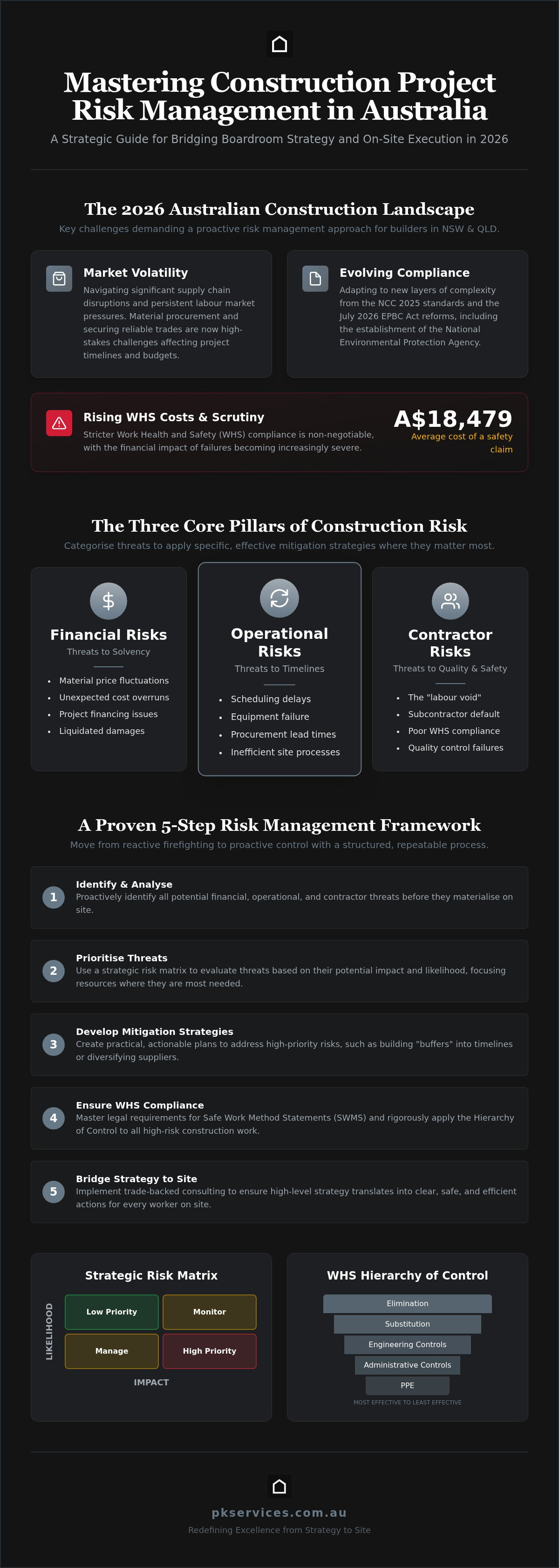
We'll explore the impact of the July 2026 EPBC Act reforms and the establishment of the National Environmental Protection Agency. You'll learn how to navigate the A$18,479 average cost of safety claims with practical, trade-backed insights. We're moving beyond theory to deliver a redefined approach to project safety and profitability.
Key Takeaways
- Learn to navigate the 2026 Australian construction landscape by identifying proactive mitigation strategies for supply chain and labour market volatility.
- Master the three core pillars of construction project risk management Australia to protect your financial stability and operational flow.
- Implement a proven five-step framework that uses a strategic risk matrix to prioritise threats based on their potential impact on site.
- Ensure total WHS compliance in NSW and QLD by mastering the legal requirements for Safe Work Method Statements and the Hierarchy of Control.
- Bridge the gap between boardroom strategy and site execution with trade-backed consulting that fills essential gaps and reduces project friction.
Understanding Construction Project Risk Management in Australia
Risk management isn't just a safety checklist or a compliance hurdle. It's the proactive identification and mitigation of any threat that could derail your project success. In its purest form, Risk management involves balancing potential downsides against the strategic goals of your business. For Australian builders, this means moving beyond reactive firefighting. You need to spot the fire before the first spark flies. It's about total project visibility.
The 2026 Landscape for Australian Builders
The construction environment in 2026 is defined by volatility and rapid regulatory change. Supply chain shifts have made material procurement a high-stakes game where lead times can make or break a budget. Meanwhile, labour market pressures remain a constant hurdle for firms in NSW and QLD. These regions require bespoke risk strategies because their regulatory and economic climates are unique. New South Wales builders face complex urban density issues, while Queensland firms are navigating a massive infrastructure boom that stretches local resources thin. The introduction of the NCC 2025 standards and the establishment of the National Environmental Protection Agency on July 1, 2026, add layers of complexity that didn't exist a few years ago. Modern risk management is a competitive advantage for AU firms. You either plan for the disruption or you pay for it later in liquidated damages.
Why a "Strategy to Site" Approach is Essential
A plan that lives only in a boardroom is useless on a rainy Tuesday on a job site. Effective construction project risk management Australia requires a bridge. High-level advisory must translate directly into on-site trade actions. This is where construction business consulting Australia makes the difference. It ensures that strategic oversight isn't just talk; it's a practical tool for site-level performance. When strategy meets the site, the results are immediate. You protect your margins through accurate forecasting and better procurement. Site morale improves because your trades have clear, safe directions. Most importantly, you build client trust through consistent, predictable delivery. Redefining excellence means closing the gap between the plan and the hammer. It's about ensuring every person on site understands their role in the broader risk framework. This synergy protects your project from the ground up, turning potential liabilities into managed assets.
The Core Pillars of Construction Risk: Financial, Operational, and Contractor
Effective construction project risk management Australia relies on a clear structure. You can't treat every threat as a generic problem. Instead, categorise them into three pillars: Financial, Operational, and Contractor. This clarity allows you to apply specific mitigation strategies where they matter most. Financial risks threaten your solvency. Operational risks eat your time. Contractor risks compromise your quality and safety. By breaking these down, you transform a mountain of uncertainty into a series of manageable tasks.
Financial and Operational Vulnerabilities
Material price fluctuations continue to plague the AU market. A sudden spike in timber or steel costs can instantly evaporate your margin. This is why improving construction business profitability NSW is no longer just about winning more work; it's about managing the costs you've already committed to. Cost overruns don't just hurt one project. They impact your long-term business stability and your ability to secure future bonding or finance.
Operational risks are equally dangerous. Scheduling delays and equipment failure create a domino effect. One late delivery can stall three different trades. Robust process management reduces this downtime by building "buffers" into your timeline. It's about ensuring the site never goes quiet. If you're looking to tighten these processes, our team at PK Services can help refine your operational flow and protect your bottom line.
Mitigating Contractor and Labour Risks
The "labour void" is a critical risk on complex sites in 2026. If a specialist trade pulls out or fails to show up, the entire project loses momentum. This makes vetting construction subcontractors Australia a non-negotiable part of your strategy. You need partners who don't just talk about quality but deliver it consistently under pressure. Reliability is the ultimate hedge against site delays.
Relying on unverified labour is a gamble with your reputation and your legal liability. PK Services brings 15 years of industry experience to the table, specifically in supplying skilled trades to fill these site gaps. We understand that a project is only as strong as the hands building it. By integrating reliable trades into your risk framework, you eliminate the uncertainty of the open market. This ensures that even when the broader industry struggles with sourcing, your site stays active and compliant. Refining these three pillars is the foundation of modern construction project risk management Australia, turning site uncertainty into a controlled, profitable environment.
Developing a Robust Risk Management Framework for Australian Sites
A framework provides the structure your project needs to survive high-pressure environments. It transforms vague worries into actionable data points. For effective construction project risk management Australia, you must implement a five-step cycle: Identification, Assessment, Mitigation, Monitoring, and Reporting. This isn't a one-off task. It's a continuous loop that keeps your team focused on emerging threats before they impact your progress.
Success starts with a risk matrix. You must prioritise threats by measuring their likelihood against their potential impact. A high-probability delay in material delivery requires a different response than a low-probability equipment failure. By categorising these, you allocate resources where they're needed most. This structured approach is the backbone of full cycle construction project management. It ensures your strategy evolves alongside the project lifecycle, from the first sod turn to the final handover.
Step-by-Step Risk Identification and Assessment
You can't manage what you haven't identified. Conduct site-wide risk workshops with every key stakeholder, from project engineers to site foremen. These sessions uncover the "on-the-ground" realities that boardroom spreadsheets often miss. Use historical data to predict future hurdles. For instance, knowing the construction industry has an incidence rate for serious claims of 16.9 per 1,000 workers helps you assess safety risks with precision. Data beats guesswork every time. Once identified, clear and punchy reporting is essential. Executive decision-making relies on knowing exactly which risks are trending upwards and what the mitigation plan looks like in real-time.
Implementation and On-Site Monitoring
A risk plan is useless if it sits in a drawer. Accountability is the anchor of site safety and efficiency. You must define who is responsible for risk on a daily basis. Usually, this falls to the site manager, but every trade lead must own their specific work area. Monitoring shouldn't be passive. It requires active, visible leadership. Regular site audits are vital for performance management and ensuring compliance with the latest standards. These audits verify that your mitigation strategies are actually working. If a control measure fails, you need to know immediately, not after an incident occurs. This proactive stance keeps your site moving and your reputation secure.
Navigating WHS Compliance and High-Risk Construction Standards
Safety isn't a secondary objective. It's the absolute foundation of your legal and ethical standing. In Australia, Safe Work Method Statements (SWMS) are a non-negotiable requirement for any high-risk construction work. These documents aren't just administrative hurdles. They are live blueprints that dictate how your trades interact with hazards. Effective construction project risk management Australia means ensuring these statements are understood by every person on the tools, not just filed away in a site office.
The Hierarchy of Control on Modern Sites
Managing site safety requires a disciplined approach. The Hierarchy of Control is your primary tool for this. It starts with Elimination: removing the hazard entirely. If you can't eliminate it, you move to Substitution, Engineering, and Administration. Personal Protective Equipment (PPE) is always the last line of defence, never the first. Fostering a safety-first culture means your team looks for ways to eliminate risks before they even reach for a hard hat. Leadership is the driver here. When management prioritises safety over speed, compliance follows naturally. It's about setting a standard that refuses to compromise on human life.
Managing High-Risk Construction Work (HRCW)
High-risk tasks like working at heights, demolition, or handling asbestos demand rigorous oversight. These activities carry the highest potential for serious injury or fatality. In 2022, the construction industry saw 27 worker deaths, a figure that highlights the stakes of poor oversight. For HRCW, you must have specific emergency plans in place and notify relevant authorities when required. This level of detail is where construction quality control management services become invaluable. Safety and quality are two sides of the same coin. A project built to the highest standards is inherently safer for everyone involved.
The 2026 regulatory environment in NSW and QLD is particularly demanding. With the National Construction Code (NCC) 2025 now in full effect, firms must navigate a complex transition period. Strategic oversight prevents accidents by identifying these regulatory shifts early. It ensures your site remains compliant and your business stays protected from legal liability. If you need to strengthen your site's compliance framework, you can partner with PK Services for expert guidance and skilled trade support. We help you manage the details so you can focus on the build.
Redefining Excellence: How Strategic Oversight Mitigates Site Risks
Excellence in the Australian building sector isn't an accident. It's the result of reducing the friction between the boardroom and the site. When your high-level strategy aligns perfectly with daily site actions, project delays vanish. Professional construction project risk management Australia ensures that every stakeholder moves in the same direction. This end-to-end oversight protects your reputation and your revenue. It turns a volatile project into a predictable success story. Strategic oversight is the invisible thread that holds a complex build together from inception to handover.
Investing in professional consultancy offers a tangible ROI by protecting your business from the "hidden costs" of construction. These costs include the administrative burden of compliance, the financial sting of rework, and the legal risks of site incidents. By integrating risk management into the entire project lifecycle, you create a shield around your profit margins. You aren't just paying for advice; you're buying the certainty that your project will meet its milestones without compromising on quality or safety.
The PK Services Advantage: Strategy Meets Execution
We bring 15 years of trade expertise to the consulting table. We don't just offer abstract advice; we provide solutions that work in the mud and the dust. Our approach to construction business growth strategy NSW integrates risk management into the very core of your operations. We understand that growth is impossible without stability. By supplying skilled trades to fill essential site gaps, we act as a bridge between your vision and the finished build. This dual perspective allows us to spot logistical hurdles that a traditional consultant might miss. If you're managing a complex project in Sydney or Queensland, now is the time to organise a consultation. We help you identify the blind spots before they become liabilities.
Taking the Next Step in Project Excellence
Acting early in the project lifecycle is the only way to lock in your risk strategies. Waiting until you're on site to address safety or financial vulnerabilities is a recipe for disaster. You need a framework that is active before the first shovel hits the ground. This proactive stance allows you to transition from managing chaos to leading a high-performance project. It builds immense client confidence and ensures your business is seen as a leader in the field. Redefining excellence means refusing to settle for "good enough" when it comes to site oversight. Partner with PK Services for end-to-end project excellence. Let's start the dialogue today and secure the future of your next build.
Securing the Future of Your Next Build
Mastering construction project risk management Australia is about more than just avoiding mistakes; it's about building a foundation for sustainable growth. We've explored how a robust framework and strict WHS compliance protect your margins and your people. The real difference lies in bridging the gap between boardroom strategy and the daily reality of the site. By identifying financial, operational, and contractor risks early, you move from managing chaos to leading a high-performance project. This proactive approach ensures your business remains resilient against supply chain shifts and labour voids.
Success in the 2026 landscape requires a partner who understands both the tools and the spreadsheets. PK Services brings over 15 years of industry expertise across Sydney and Queensland to every engagement. We provide the specialised trades and end-to-end process management needed to fill site gaps and maintain superior standards. It's time to stop reacting to disruption and start controlling your project's destiny. Redefine your project excellence with PK Services today. Let's build something exceptional together. Your next successful handover starts with a single strategic conversation.
Frequently Asked Questions
What are the most common risks in Australian construction projects?
The most common risks include material price volatility, labour shortages, and evolving regulatory standards like the NCC 2025. In the current climate, supply chain delays can stall projects for months if they aren't managed proactively. Financial risks from cost overruns and operational risks from equipment failure also remain high. Addressing these through construction project risk management Australia ensures that your site stays productive even when external market pressures mount.
How does a risk management plan improve project profitability in NSW?
A robust plan protects your bottom line by reducing liquidated damages and preventing expensive rework on site. In New South Wales, where urban density and complex compliance are standard, accurate forecasting is vital. By identifying potential bottlenecks before they happen, you can allocate resources more efficiently. This strategic foresight directly translates to higher margins and more predictable project outcomes for your business, ensuring every dollar is used effectively.
Do I need a separate risk manager for my Queensland construction site?
While a dedicated risk manager isn't always a legal requirement, specialised oversight is essential for large-scale Queensland projects. Many firms rely on their site managers, but the complexity of modern infrastructure builds often demands a deeper strategic focus. Engaging a consultant to manage this layer allows your site team to focus on the build. It ensures that compliance and financial risks are monitored without slowing down construction progress.
What is the difference between a hazard and a risk on a construction site?
A hazard is something with the potential to cause harm, while a risk is the likelihood that harm will actually occur. For example, a pile of loose rubble is a hazard. The risk is the probability of a worker tripping on it and the severity of the resulting injury. Understanding this distinction allows you to apply the Hierarchy of Control effectively, focusing on eliminating hazards to reduce overall project risk.
How often should a construction risk assessment be updated?
You should update your risk assessment whenever the site environment or project scope changes significantly. At a minimum, daily site walkthroughs should identify immediate hazards, while weekly reviews track broader strategic threats. Major milestones, such as transitioning from demolition to structural work, also require a formal assessment refresh. Keeping the document dynamic ensures it remains a useful tool rather than just a piece of paper in the office drawer.
Can strategic consulting help with supply chain risks in 2026?
Strategic consulting provides the market intelligence needed to navigate 2026 supply chain disruptions. Consultants help you diversify supplier networks and build realistic buffers into your project timelines. By analysing global and local trends, you can secure long-lead items well in advance. This proactive planning reduces the friction of procurement and ensures your trades aren't left waiting for materials that should have been ordered months ago to maintain momentum.
What legal requirements exist for high-risk construction work in Australia?
High-risk construction work (HRCW) requires the preparation of a Safe Work Method Statement (SWMS) before any tasks begin. You must also have comprehensive emergency plans in place and, in some cases, notify state regulators like SafeWork NSW or Workplace Health and Safety Queensland. These legal obligations are designed to manage activities like working at heights or demolition. Failure to comply can result in significant fines and immediate project shutdowns.
How does PK Services help manage contractor-related risks?
PK Services mitigates contractor risks by providing vetted, skilled trades that meet superior industry standards. We fill site gaps that could otherwise lead to delays or safety breaches. Our end-to-end process management ensures that every contractor on your site is aligned with your broader risk strategy. This trade-backed approach reduces the uncertainty of the open labour market and protects your project's quality and timeline from start to finish.


