

With building material costs up 38.3% since 2020, every skip bin leaving your site is essentially a bucket of lost profit. It's a harsh reality for Australian builders facing a record year of insolvencies and 4.6% inflation. You're likely exhausted by the constant juggle of labour gaps and trade schedules that never quite align. It's frustrating to watch margins thin while projects slip behind. We understand the pressure of maintaining a high standard in a market that feels increasingly volatile. This guide helps you master lean construction principles Australia wide to turn those challenges into a competitive edge. You'll learn the exact methodologies needed to eliminate waste and create a high-efficiency site environment. We'll walk through a strategic framework for 2026 that improves trade flow, boosts productivity, and protects your bottom line.
Key Takeaways
- Define value from the client’s perspective to ensure every hour on site contributes directly to project delivery.
- Master lean construction principles Australia wide to create a seamless flow between trades and eliminate costly downtime.
- Transition from traditional management to a collaborative culture that improves site safety and reduces trade friction.
- Identify hidden bottlenecks on your project through practical 'Waste Walks' and visual management techniques like the 'Big Room'.
- Bridge the gap between strategy and execution by integrating skilled trades into a redefined, high-performance workflow.
What is Lean Construction? Redefining Value for the Australian Site
To understand What is Lean Construction?, you must look past traditional project management. It's a production-based system designed to deliver projects by maximising value and minimising waste. In the current climate, it's the difference between a profitable handover and a project that bleeds cash. We don't just build; we optimise. We focus on the flow of the entire site rather than isolated tasks. This approach ensures that every action taken on your project contributes directly to the final outcome.
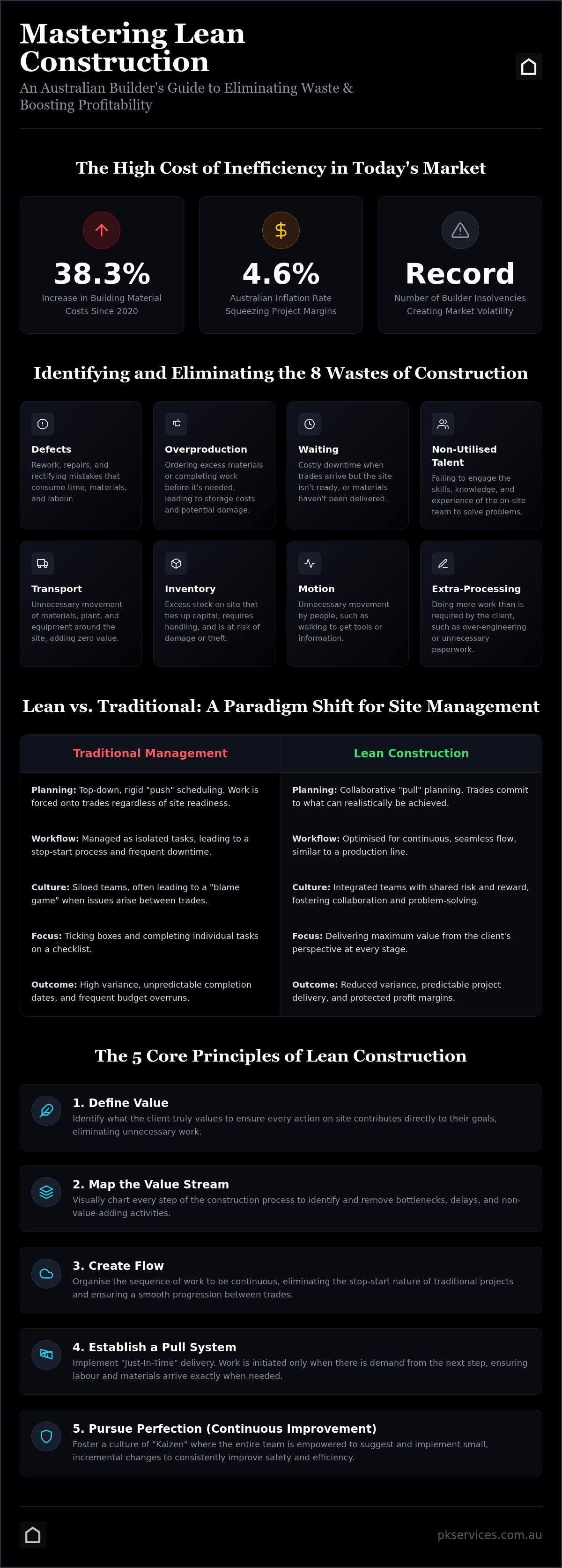
By mid-2026, reactive management has become a liability. With building material costs up 38.3% since 2020 and inflation sitting at 4.6%, you can't afford to "fix it on the day." Leading firms are adopting lean construction principles Australia wide to regain control over their margins. This shift isn't just about spreadsheets. It's built on a foundation of "Respect for People," ensuring every subbie and site manager is empowered to work safely and efficiently. When people feel respected and their time is valued, site safety and productivity naturally improve.
The 8 Types of Waste in Australian Construction
Waste isn't just the rubble in a skip bin. It's often invisible. Overproduction looks like ordering excess concrete that ends up as a garden path for no one. Waiting times occur when the tiler arrives but the screed isn't dry. Transport logistics waste involves moving plant and equipment across a site multiple times for no reason. These inefficiencies compound quickly. Perhaps the most critical waste in 2026 is non-utilised talent. In a tight labour market, failing to use the skills of your workforce is a massive missed opportunity. Professional construction business consulting Australia helps you identify these hidden leaks before they drain your budget.
Value Through the Eyes of the Stakeholder
Value is only defined by the person paying the bill. For a developer, business value might mean a faster path to market to beat interest rate hikes. For the builder, project value is about quality and trade coordination. Value Stream Mapping is a visual tool used to chart every step in a process to see where value is added and where it stalls. Strategic advisory helps redefine what excellence looks like on a NSW site. It ensures your processes align with the client's actual goals rather than just ticking boxes on a checklist. By focusing on what the stakeholder truly values, you eliminate unnecessary steps and improve your ROI.
The Core Principles of Lean Construction for 2026
Mastering lean construction principles Australia wide requires a move away from rigid, top-down command. It's about creating a system where work flows and waste is systematically removed. The Core Principles of Lean Construction focus on delivering what the client values through a reliable production process. In 2026, this means navigating the transition between NCC 2022 and NCC 2025 with absolute precision. You can't afford the luxury of trial and error when margins are this tight.
Standardisation is your first line of defence. It creates a "new normal" for site processes to reduce error rates. When every trade knows exactly how a task should be performed, quality becomes predictable. This is followed by Flow. We aim to eliminate the stop-start nature of traditional Aussie subbie schedules. Work should move forward like a production line. Pull scheduling ensures materials and labour arrive exactly when needed. This Just-In-Time approach is vital when material price volatility makes over-ordering a massive financial risk. Finally, Continuous Improvement, or Kaizen, empowers your site team to suggest small, impactful changes that boost daily efficiency.
The Last Planner System (LPS) Explained
Traditional scheduling "pushes" work onto trades regardless of site readiness. The Last Planner System flips this. It uses "Pull" planning, where those doing the work commit to what they can actually achieve. In Queensland, where cost escalation is returning due to major infrastructure projects, identifying site constraints early is essential. Weekly "Look-ahead" meetings allow site managers to clear hurdles before the subbies arrive. By measuring the Percentage of Plan Completed (PPC), you reduce variance and make your completion dates predictable. If you're looking to refine your site operations, we can help you organise a strategic review of your current workflows.
Integrated Project Delivery (IPD) in the Aussie Context
IPD breaks down the silos that typically exist between architects, builders, and trades. It moves away from the "blame game" and toward shared risk and reward. This collaborative approach is the backbone of full cycle construction project management. Trust becomes a functional tool rather than a buzzword. When every stakeholder is aligned on the project goals from day one, you avoid the design revisions that plague traditional contracts. This integration is particularly effective for managing the complex trade logistics required on modern Australian sites.
Lean vs Traditional: Why Australian Firms are Making the Switch
Traditional construction management relies on a "command and control" hierarchy. In this old model, instructions flow down from the top, often arriving too late to prevent site errors. This reactive style is failing in 2026. With material costs having surged 38.3% since 2020, you can't afford the rework that traditional silos create. Lean leadership is different. It's collaborative. By implementing lean construction principles, you empower the people actually doing the work to flag issues before they become expensive mistakes. It moves the site culture from "who is to blame?" to "how do we fix the flow?"
Site safety is another major driver for the switch. A traditional site is often cluttered, with materials delivered weeks too early and left in the way. This chaos leads to higher Lost Time Injuries (LTI). Lean sites are inherently cleaner and more organised. When you only have the materials you need for the day, you reduce trip hazards and manual handling risks. A clean site isn't just a professional look; it's a safer work environment for every subbie on the tools.
In Sydney, where margins are under immense pressure from a 4.35% cash rate, Lean firms are outperforming the market. They don't just work harder; they work smarter by breaking down the silo mentality. Traditional subbie management treats each trade as an isolated unit. This creates a "stop-start" rhythm that kills productivity. Lean integrates these trades into a single, cohesive workflow. This alignment is the only way to protect your ROI when inflation is hovering at 4.6%.
Operational Performance and Margin Protection
Modern operational performance construction firms rely on real-time data rather than gut feeling. They track the "Cost of Quality" with precision. Doing a job right the first time is significantly cheaper than a second attempt, especially with current labour rates. For example, a Lean-managed high-rise in Queensland can often see a 10-15% reduction in delivery times simply by eliminating waiting waste. This efficiency provides a vital buffer against the cost escalation currently affecting the QLD market.
Solving the Labour Gap with Efficiency
The 2026 labour shortage is a reality we all face. Lean construction principles Australia wide allow you to achieve more with a smaller, more focused team. When skilled trades for construction sites aren't stuck waiting for instructions or moving materials twice, their output increases. Better site leadership removes the administrative friction that slows trades down. It ensures your most expensive assets—your people—are focused on high-value tasks that move the project toward completion.
How to Implement Lean Construction on Your Project Site
Implementing lean construction principles Australia wide requires more than a policy shift. It demands a boots-on-the-ground transformation. You can't change your site culture from a boardroom. It happens in the mud and the dust. Start with a 'Waste Walk' on your current NSW or QLD site. Walk the floor. Look for the bottlenecks. Watch for trades waiting for materials or moving gear twice. These are your profit leaks. Identifying these physical inefficiencies is the first step toward reclaiming your margins.
Establish a 'Big Room' next. This is a dedicated space for visual management. It's where daily huddles happen. It brings every lead subbie together to coordinate the next 24 hours. You must align this with 'Just-in-Time' delivery schedules. With building material costs having risen 38.3% between March 2020 and March 2026, you don't want capital sitting idle in a stockpile. Train your site supervisors to move from policing to facilitating. Finally, measure your progress. Review the site performance data. Adjust your plan based on what actually happened on site yesterday rather than what you hoped would happen.
The 5S Methodology for an Organised Site
The 5S methodology; Sort, Set in order, Shine, Standardise, and Sustain; is your foundation. In a Sydney build, this means clearing the deck of anything not needed for the current phase. It's about having a place for everything. An organised site has a massive psychological impact on trade morale. People work better when they aren't fighting for space or searching for tools. Crucially, 5S reduces the risk of on-site accidents by eliminating clutter and trip hazards. It creates a new normal where high standards are the baseline, not the exception.
Visual Management Tools for Site Supervisors
Visual tools keep the project moving. Use Kanban boards to show work in progress and upcoming tasks. Conduct 'Gemba' walks to see the reality of the site first-hand. These tools simplify complex data. They ensure every trade on site understands the daily goal without needing a 30-page manual. This is where construction quality control management services become vital. They verify that your Lean outcomes meet the high standards required in 2026. If you're ready to see these results on your project, book an operational audit with our team today.
Strategic Lean Transformation with PK Services
Execution is where most Lean initiatives fail. High-level theory is useless if it doesn't translate to the site floor. At PK Services, we bridge this gap between strategic consulting and physical delivery. With over 15 years of industry experience, we understand the friction points of modern Australian construction. Our model is unique. We provide the expert consulting advice to design your workflow and the skilled trades to execute it. This ensures lean construction principles Australia wide are actually lived on your project, not just written in a manual.
Redefining excellence requires a partner who understands the stakes. We don't just offer surface-level fixes. We look at your operational performance from the ground up. By integrating our skilled workforce with advanced process management, we eliminate the coordination gaps that drain your budget. This approach turns a complex build into a streamlined production environment. We invite you to start this journey with a professional business health check to identify your immediate opportunities for growth.
Tailored Solutions for NSW and QLD Builders
Local knowledge is your greatest asset in a volatile market. Navigating the logistics of a Sydney build is vastly different from managing a project in regional Queensland. We leverage our deep roots in these regions to solve local labour and supply chain challenges. Our focus is on improving construction business profitability NSW and QLD wide through targeted interventions. We deliver a new standard of service that is elite in its results but approachable in its delivery. It’s about making high-end operational strategy accessible to every builder who wants to evolve.
Partnering for Long-Term Excellence
Strategic transformation isn't a one-off event. It's a commitment to continuous evolution. We move beyond individual projects to help you build a more resilient business. Having a partner who manages the entire process from start to finish reduces your administrative burden and ensures consistency. We take ownership of the outcomes, from the first waste walk to the final handover. This long-term alignment is what creates a truly high-efficiency, zero-waste environment. Ready to redefine your site performance? Contact PK Services today.
Redefining Your Project Performance for 2026
The Australian construction landscape demands a move from traditional, reactive management toward a disciplined production system. You now have the framework to identify hidden waste and implement visual tools that keep your site moving. Protecting your margins is critical, especially with material costs having risen 38.3% over the last six years. Adopting lean construction principles Australia wide is the most effective way to navigate these pressures while improving trade productivity. It's about working smarter to ensure your projects stay on schedule and under budget.
PK Services offers a distinct advantage in this transition. We bring 15+ years of industry experience and an expert trade supply network to every project. We don't just provide strategy; we provide the boots on the ground to execute it. As full-cycle project management specialists, we bridge the gap between high-level consulting and site-level results. Book a Strategic Consultation with PK Services to begin your operational transformation. Let's redefine what excellence looks like on your next build.
Frequently Asked Questions
What are the 5 basic principles of Lean construction?
The five core pillars involve identifying value from the client's perspective, mapping the value stream, creating flow, establishing pull, and seeking perfection. These lean construction principles Australia wide help firms move from reactive management to a structured production system. It ensures every action taken on site adds specific value to the final project delivery.
Is Lean construction suitable for small residential projects in Australia?
Absolutely. While often associated with major infrastructure, Lean is highly effective for small residential builds. Minimising material waste and coordinating subbie schedules is just as vital on a duplex as it is on a high-rise. It helps smaller builders maintain margins in a market currently facing 4.6% inflation and rising interest rates.
How does Lean construction reduce material waste on site?
It reduces waste by aligning deliveries with actual site needs through Just-in-Time (JIT) logistics. Instead of stockpiling materials that might get damaged or stolen, you only bring what's required for the immediate phase of work. This approach is essential when building material costs have risen 38.3% since March 2020.
What is the difference between Lean construction and Agile project management?
Lean focuses on the physical production flow and the systematic elimination of waste in a production process. Agile is an iterative approach often used in design or software to manage rapidly changing requirements. While they share a collaborative DNA, Lean is specifically tuned for the physical constraints and trade logistics of a construction site.
Can Lean construction help with the current Australian labour shortage?
Yes. By removing "waiting for instructions" and "moving materials twice" waste, your existing team becomes significantly more productive. This allows you to achieve more with fewer people on the ground. It's a strategic way to manage labour gaps without compromising on the quality of the build or site safety.
How long does it take to see an ROI from Lean implementation?
You'll see an immediate impact on site culture, safety, and cleanliness within the first few weeks. Financial ROI usually becomes clear by the end of the first project cycle through reduced rework and faster delivery times. Lean construction principles Australia provide a vital buffer against the rising costs of labour and materials seen in 2026.
Do I need special software to start using Lean principles?
No special software is required to begin your transformation. Physical visual management tools like Kanban boards and daily huddles in a "Big Room" are often more effective for gaining trade buy-in. While digital tools can support the process later, the focus should always be on the workflow rather than the technology.
How do I get my sub-contractors and trades to buy into Lean methods?
Focus on how it makes their daily lives easier. Subbies generally hate waiting for other trades to finish or working in a cluttered, dangerous mess. When you prove that Lean methods mean they can get in, do their job efficiently, and get out on time, the buy-in follows naturally. It turns the site into a high-performance environment they want to be part of.


