

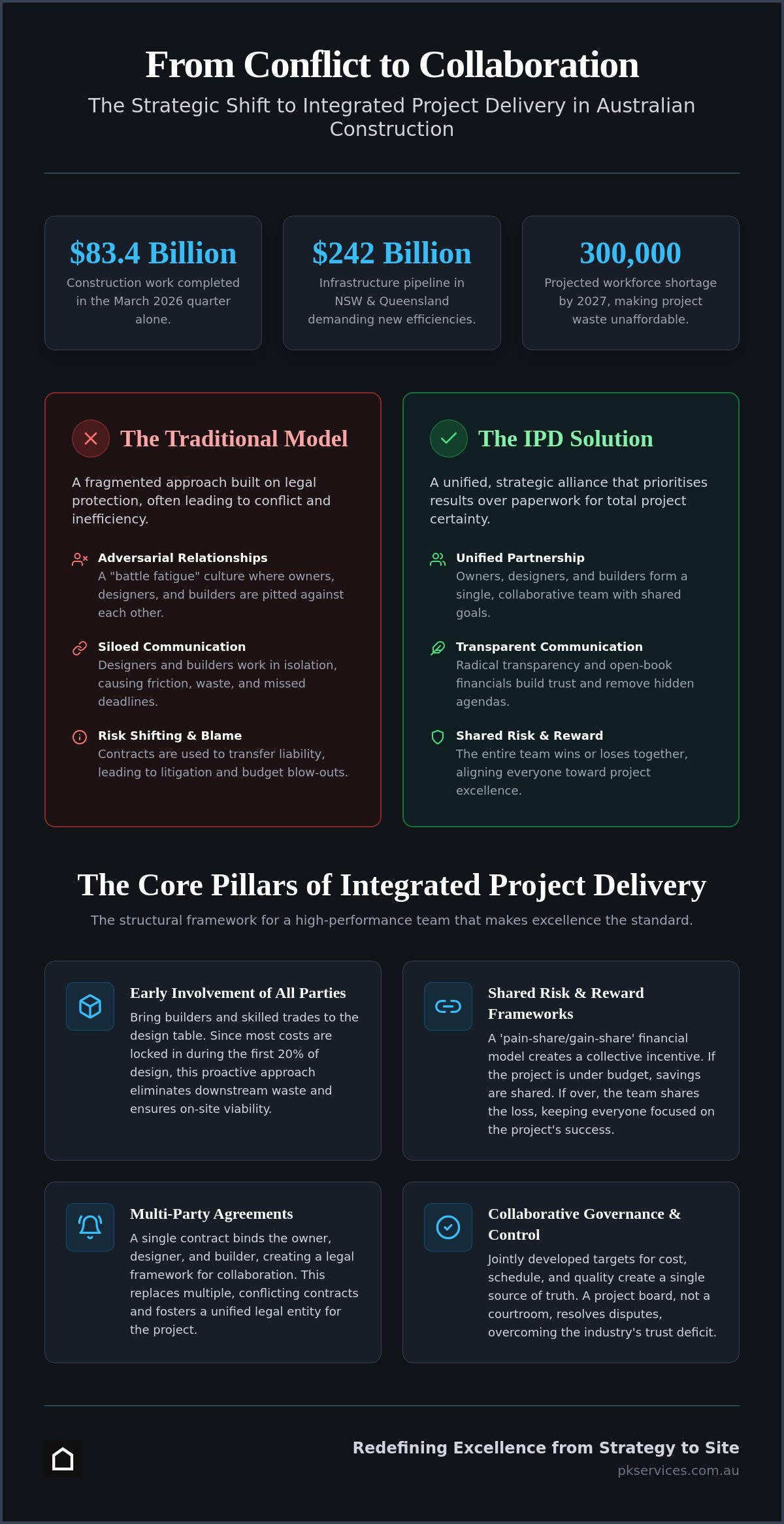
Traditional construction contracts are often built for legal protection rather than project perfection. With $83.4 billion of construction work completed in the March 2026 quarter alone, the stakes for your business have never been higher. Adopting integrated project delivery Australia wide is the most effective way to move past the culture of blame that causes budget blow-outs and threatens company solvency. It's about redefining excellence through a unified, strategic approach that prioritises results over paperwork.
You likely know the stress of poor communication between designers and builders all too well. It's a common pain point that leads to unnecessary waste and missed deadlines. This article explains how a collaborative IPD framework replaces friction with flow. We will preview how to bridge the gap between high-level strategy and on-site trade management, helping you achieve total cost certainty and superior operational performance on every build.
Key Takeaways
- Understand why traditional contracting models fail and how integrated project delivery Australia offers a strategic alternative for project certainty.
- Learn the core pillars of shared risk and reward that align designers, builders, and owners toward a single, unified goal.
- Discover practical ways to reduce project waste and improve operational performance within the NSW and Queensland construction sectors.
- Gain insights into overcoming the industry's trust deficit and navigating the legal landscape of multi-party agreements.
- See how integrating skilled trades early in the process creates a seamless bridge between high-level strategy and site execution.
The Evolution of Project Delivery in the Australian Construction Industry
The Australian construction sector is undergoing a necessary transformation. For decades, the industry relied on rigid, siloed models. Design-Bid-Build was the default standard. It often resulted in "battle fatigue" for everyone involved. Contractors fought for margins. Owners fought for quality. Lawyers were often the only ones who truly won. This adversarial approach led to constant litigation and budget blow-outs that threatened the solvency of even established firms.
Today, the focus is shifting toward Integrated Project Delivery (IPD). In the modern Australian context, integrated project delivery Australia represents a strategic alliance. It brings owners, designers, and builders together from the very start. This isn't just a different way to sign a contract. It's a complete rethink of how we build. By aligning with expert construction business consulting Australia, firms are moving from risk-shifting to collective responsibility. The goal is simple: project excellence through shared accountability.
From Zero-Sum to Win-Win: The IPD Philosophy
Successful outcomes require a collaborative mindset. The old "every man for himself" mentality on-site is a recipe for failure. IPD replaces this with shared goals. When the team wins, everyone wins. This philosophy relies on radical transparency. Open books and honest communication build trust between owners and contractors. It removes the hidden agendas that typically plague large-scale projects. Trust isn't just a nice-to-have; it's a core project requirement for modern delivery.
Why the 2026 Market Demands a New Standard
The 2026 market is exceptionally demanding. New South Wales and Queensland are managing a massive infrastructure pipeline valued at $242 billion. However, the workforce shortage is projected to peak at 300,000 by 2027. Labour is scarce and costs are volatile. Traditional models can't handle this level of complexity or the 1.6% deferral rates currently seen in the industry.
Strategic partnerships are the only way to mitigate these risks. Redefining excellence is no longer a marketing slogan. It's a survival strategy. By integrating skilled trades into the design phase, projects avoid the waste that usually occurs when strategy and site execution are disconnected. This new standard ensures that projects remain viable and profitable despite a tightening market.
The Core Pillars of Strategic Construction Partnerships
Successful implementation of integrated project delivery Australia wide relies on four structural pillars. These aren't just suggestions. They are the framework for a high-performance team. When designers and builders work in isolation, the project suffers. When they work as a single entity, excellence becomes the standard. This shift requires a move away from the traditional siloed approach to a unified delivery model.
Early Involvement: The Key to Cost Certainty
Early involvement is the first pillar. Most project costs are locked in during the initial 20% of the design phase. Waiting for a tender to involve trades is a mistake. By bringing managers and skilled trades to the concept table, you eliminate downstream waste. This proactive approach often prevents the need for expensive construction project recovery services later. We draw on 15 years of site experience to ensure that what looks good on paper actually works on-site. It's about getting the strategy right before the first shovel hits the ground.
Shared Risk and Reward Frameworks
The second pillar is the financial framework. Traditional contracts encourage hoarding profit. IPD encourages sharing it. A 'pain-share/gain-share' model creates an incentive pool. If the project finishes under budget, the savings are shared. If it goes over, the team shares the loss. This keeps everyone focused on the finish line, not their own individual bottom line. A Comparative Analysis of Alliancing and IPD shows that these shared reward systems are the strongest drivers of innovation in complex builds. It aligns individual firm profitability with the overall project outcome.
Partnerships also require jointly developed targets. Cost, schedule, and quality are validated by the whole team. This creates a single source of truth for all stakeholders. Decision-making is collaborative. If a dispute arises, it's settled by the project board, not a courtroom. It's a faster, cleaner way to build that removes the need for constant legal intervention. This model ensures that every participant is an active contributor to the project's success.
If you want to see how these pillars support your next project, you can explore our strategic approach to end-to-end management. We bridge the gap between high-level theory and practical site execution.
Benefits of IPD for NSW and Queensland Construction Firms
The shift toward integrated project delivery Australia wide is more than a legal pivot. It's a performance multiplier. For firms in NSW and Queensland, the benefits are immediate and measurable. By removing the traditional "us versus them" barriers, projects experience a significant drop in non-value-added activities. Waste isn't just discarded material. It's the time lost in redundant emails, the cost of redesigns, and the friction of mismanaged handovers. IPD cleans up the workflow.
Stable, integrated site teams are safer and more efficient. When trades know they are part of a long-term strategic partnership, quality increases naturally. They aren't just "subbies" for a day; they are project stakeholders. Whether executing complex warehouse fitouts Australia or commercial office upgrades, having experts who understand the long-term vision is vital. Decision-making is streamlined because the experts are already in the room. This leads to faster delivery times and creates a project environment where excellence is a collective standard, not just a contractual obligation. You avoid the "stop-start" nature of traditional builds where every change requires a mountain of paperwork.
Driving Operational Excellence on Local Sites
Productivity on Sydney and Brisbane sites often stalls due to the "labour gap." With an estimated shortage of 141,000 infrastructure workers as of late 2025, you can't afford to waste the hands you have. IPD fosters long-term relationships with skilled trades, ensuring you have reliable access to talent when the market is tight. This stability directly impacts the operational performance construction firms can achieve. Better communication means fewer defects and hazards. Fewer defects mean less rework. It's a simple equation that keeps your site moving at pace and keeps your workers safe. When the team understands the strategy, they execute with precision.
Protecting Reputation and Profitability
Your brand is only as good as your last build. In a market where project deferral rates sit around 1.6%, staying on track is a competitive advantage. Delayed or over-budget projects cause lasting brand damage. By using a collaborative framework, you protect your track record. This consistency is the foundation for improving construction business profitability NSW firms need to survive 2026. High-value clients look for reliability. When you prove you can deliver excellence without the usual litigation, you become the preferred partner for the state's major infrastructure pipeline. You aren't just building structures; you're building a reputation for certainty.
Overcoming Barriers to Integrated Project Delivery Adoption
Adopting integrated project delivery Australia wide isn't just about changing a contract. It's about changing a culture. The biggest hurdle is the "Trust Deficit." For decades, the industry operated on a foundation of suspicion. Moving to a "We win" model requires a level of transparency many firms find uncomfortable. It's a steep climb for businesses used to protecting their own margins at the expense of the project. Breaking this cycle is essential for long-term success.
Legal frameworks also pose a challenge. Multi-party agreements are the backbone of IPD. They require all major stakeholders to sign a single document. While this can feel daunting for mid-market firms, it's the only way to lock in collective responsibility. It moves the focus from finger-pointing to active problem-solving. The goal is to settle issues at the project board level before they ever reach a courtroom. It requires a commitment to the project that transcends individual corporate interests.
The Cultural Shift: Leading from the Top
Change must start with leadership. A successful construction business growth strategy NSW firms implement must include a fundamental shift in mindset. Project managers need to be retrained. They are no longer just enforcers of a rigid contract. They are facilitators of a collaborative team. This shift sets a new standard for professional conduct on-site. It replaces traditional confrontation with proactive coordination. When your team sees you value partnership over litigation, they will follow suit.
Choosing Your Strategic Partners Wisely
In an IPD model, your choice of partner is everything. Don't just look at the lowest bid. A cheap partner who doesn't understand collaboration is the most expensive mistake you can make. You need firms with deep local experience in NSW and Queensland. They understand the specific regulatory landscape and labour challenges of 2026. For mid-market firms, the massive Tier 1 approach can feel disconnected. A boutique consulting approach bridges this gap. It provides the high-level strategy needed for IPD while staying grounded in the practicalities of a local site.
If you want to move past traditional barriers and start building with certainty, talk to us about our strategic partnership models. We help you select and manage the right team from start to finish.
Implementing IPD: How PK Services Redefines the Process
Adopting integrated project delivery Australia wide requires more than just a mindset shift. It requires a partner who can bridge the gap between high-level strategy and daily site execution. We don't just advise from the sidelines. We manage the entire project lifecycle. From the first concept meeting to the final construction project closeout process Australia firms rely on, we ensure every stage is aligned. This end-to-end oversight removes the friction that typically occurs when project phases are siloed.
Strategic partnerships only work when they are backed by practical resources. We integrate skilled trades and contractors directly into the IPD model. This ensures that the people doing the work understand the project's broader goals. It's about providing the strategic advisory needed to optimise operational performance while maintaining professional site management. We don't just plan for excellence. We deliver it on the ground.
End-to-End Integration: Strategy to Site
Our consulting services translate boardroom goals into daily site actions. We understand that a strategy is only as good as its execution. By filling labour voids with tradespeople who are trained in collaborative models, we solve the industry's most pressing problem. This integration ensures that everyone from the project director to the site foreman is moving in the same direction. We act as the bridge between the boardroom and the building site. It’s a seamless flow that eliminates the communication breakdowns common in traditional builds.
Redefining Excellence in 2026
With 15 years of industry expertise, we have seen every challenge the NSW and Queensland markets can throw at a project. We don't believe in one-size-fits-all solutions. We tailor IPD principles to fit the specific needs of modern Australian firms. Whether you are navigating complex regulatory changes or managing volatile material costs, our approach provides the certainty you need. We are committed to redefining excellence in every partnership we form. It’s about building a future where projects are defined by their success, not their setbacks.
Ready to evolve your approach to construction? Partner with PK Services for your next project and experience the difference of true strategic integration.
Secure Your Competitive Edge Through Strategic Partnership
The shift toward integrated project delivery Australia wide is no longer just an option for firms wanting to lead the market. It's a necessary evolution. By moving past adversarial contracts, you protect your bottom line and your brand's reputation. You've seen how shared accountability and early trade involvement eliminate the friction that usually stalls projects. It's about aligning your high-level strategy with practical site execution to ensure every build is defined by excellence rather than litigation.
We bring 15 years of industry expertise to your side. Our proven track record in NSW and Queensland demonstrates our ability to manage the entire process, from strategic advisory to providing skilled labour. We help you move past the trust deficit and start building with total certainty. The future of construction is collaborative, and your business is ready to lead the way.
Redefine your project excellence with PK Services today. Let's set a new standard for your next project together.
Frequently Asked Questions
What is the main difference between IPD and traditional project delivery in Australia?
The primary difference lies in the integration of stakeholders from day one. Traditional Design-Bid-Build models are siloed; they encourage risk-shifting and often lead to adversarial relationships. In integrated project delivery Australia, the owner, designer, and builder operate as a single team with shared goals. This collaborative approach replaces the culture of blame with collective accountability for the project's success.
Is Integrated Project Delivery suitable for smaller construction projects in NSW?
Yes, IPD principles are highly effective for mid-market firms and smaller builds. You don't need a billion-dollar infrastructure budget to benefit from reduced waste and faster decision-making. While the scale of the agreement might change, the core benefits of early trade involvement and shared risk remain the same. It's about applying a strategic framework that fits your project's specific level of complexity.
How do multi-party agreements work under an IPD model?
A multi-party agreement is a single contract signed by all primary project participants. It replaces the complex web of individual contracts that typically lead to finger-pointing and legal disputes. This legal structure binds everyone to a shared financial outcome. If the project finishes under budget, the savings are distributed among the team; if it goes over, the risk is shared according to pre-agreed terms.
Does IPD actually reduce the total cost of construction?
IPD reduces total costs by eliminating non-value-added activities and expensive rework. By involving skilled trades during the design phase, you identify and solve potential site issues before they become costly delays. While the initial planning phase requires a greater time investment, the overall project lifecycle is typically shorter. This efficiency removes the hidden costs of litigation and budget blow-outs common in traditional models.
What are the biggest risks when entering a strategic construction partnership?
The most significant risk is a cultural mismatch between the partners. If one firm reverts to an "I win" mentality, the entire collaborative framework can break down. Success depends on radical transparency and mutual trust from the top down. Selecting partners who aren't fully committed to the integrated project delivery Australia model can jeopardise your financial targets and site productivity.
How do I find reliable partners for an IPD project in Queensland?
Can IPD help with the current skilled labour shortage in Sydney?
IPD is an excellent tool for managing Sydney's current workforce gap. By integrating trades early in the process, you secure labour commitments well before the build begins. This stability creates a more attractive site environment for skilled workers. It transforms tradespeople from temporary contractors into project stakeholders who are invested in the long-term outcome, which helps retain talent in a tight market.
What role does technology play in Integrated Project Delivery?
Technology provides the "single source of truth" that an integrated team needs to function. Digital tools like Building Information Modelling (BIM) allow all parties to collaborate on a shared model in real-time. This ensures that the owner, designer, and builder are always working from the same data. It prevents communication gaps and allows the team to simulate the build virtually, catching errors before they reach the site.


