

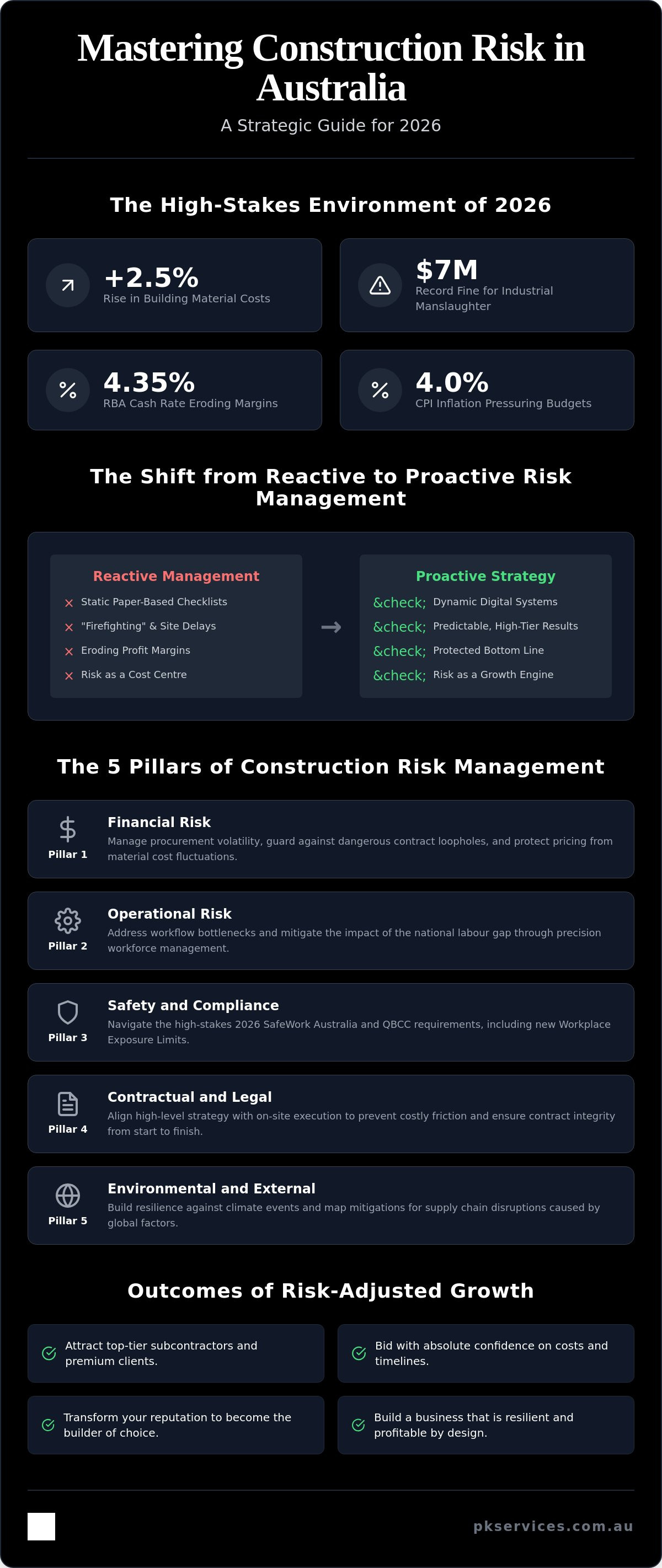
With building material costs rising 2.5% in early 2026 and a record $7 million fine for industrial manslaughter recently issued in Queensland, the margin for error on Australian sites has vanished. Implementing robust construction risk management strategies Australia wide is no longer just about ticking boxes. It's about survival. You likely feel the pressure of every SafeWork update and the sting of every unforeseen delay that eats into your bottom line.
You know that a single site delay shouldn't be enough to erode your hard-earned profit, yet staying ahead feels like a constant battle against the clock. This guide provides the frameworks you need to master risk and protect your business in an increasingly high-pressure environment. We'll explore how to navigate the new Workplace Exposure Limits coming in December 2026 and implement digital systems that turn site safety into a genuine commercial advantage that attracts better subbies and clients.
Key Takeaways
- Move beyond static paper-based checklists to dynamic risk systems that integrate directly into your daily site workflows.
- Discover how modern construction risk management strategies Australia relies on can neutralise financial volatility and close dangerous contract loopholes.
- Learn why business systems optimisation is the ultimate mitigator for protecting margins against the current labour gap and regulatory pressure.
- Execute a "Strategy to Site" alignment audit to ensure your high-level planning translates into elite execution on the ground.
- Transform risk management from a necessary cost into a powerful growth strategy that attracts top-tier subbies and premium clients.
Beyond the Risk Register: Redefining Construction Risk in 2026
Excellence isn't an accident. It's a choice. In 2026, we define construction risk as any variable that threatens your standard of "Redefined Excellence." This includes everything from material price hikes to the subtle impact of the national labour gap. True redefining construction risk involves looking beyond the obvious. We must look at the systemic health of your entire operation. Effective construction risk management strategies Australia wide demand a shift from passive checklists to active business design.
Traditional risk registers are often where good intentions go to die. They sit in office folders while site reality moves at a different pace. If your risk strategy isn't integrated into daily site workflows, it's essentially invisible. This gap is dangerous. With the RBA holding the cash rate at 4.35% as of June 2026 and CPI inflation sitting at 4.0%, your margins have no room for "invisible" risks. We see risk management as the most effective tool for improving construction business profitability in NSW.
The Cost of Reactive Management
Reactive management is a profit killer. It's the "firefighting" that exhausts your team and erodes your reputation. Ad-hoc decisions made in the heat of a site delay are rarely the most cost-effective. In QLD and NSW, systemic gaps often lead to rework or heavy compliance penalties. These hidden costs can easily exceed your original project margin, but firms can look to expert resources like Site Wiz Surveys to understand how high-accuracy as-built data prevents these errors. Real business transformation replaces this chaos with predictable, high-tier results.
Risk as an Opportunity for Competitive Advantage
Modern construction risk management strategies Australia leaders use are actually growth engines. Tight systems allow you to bid with absolute confidence. You know your costs. You know your timelines. This level of reliability attracts the highest quality tradespeople. Elite subbies prefer sites that run like clockwork. They want safety and efficiency. Risk maturity isn't just about avoiding trouble; it's about becoming the builder everyone wants to work with. This is how you scale in a crowded market.
The 5 Pillars of Construction Risk Management Strategies in Australia
Margins don't disappear overnight. They erode through unmanaged variables. Effective construction risk management strategies Australia wide rest on five foundational pillars. These aren't isolated silos; they're interconnected systems that dictate your project's health. When one pillar weakens, the entire structure of your profit margin is at risk. Mastering these pillars allows for risk-adjusted growth that remains sustainable even in a volatile market.
- Financial Risk: This includes procurement volatility and the danger of contract loopholes. With building material costs rising 2.5% in the year to March 2026, price protection is vital.
- Operational Risk: Workflow bottlenecks often stem from the national labour gap. Managing a workforce of over 1.36 million people requires precision.
- Safety and Compliance: Navigating 2026 SafeWork Australia and QBCC requirements is now a high-stakes game.
- Contractual and Legal: This involves managing the friction between high-level strategy and site execution.
- Environmental and External: Climate resilience and supply chain disruptions from global events must be mapped and mitigated.
Implementing these construction risk management strategies Australia wide ensures your team stays safe and your projects stay profitable. It's about building a business that is resilient by design.
A critical component of this design is a robust insurance strategy that covers complex liabilities. To understand how tailored protection works in a commercial context, discover Paterson Insurance Brokers and their independent approach to risk management.
Financial and Economic Safeguards
Protecting your bottom line requires more than just a sharp quote. You need active strategies to manage material price fluctuations. Documenting every site variation is critical. Undocumented changes are essentially gifts to the client at your expense. We recommend using construction performance management to track financial health in real time. This ensures procurement volatility doesn't turn into a profit drain. It's about maintaining visibility over every dollar from start to finish.
Safety, Health, and Environment (SHE) Standards
The era of jargon-heavy, 50-page SWMS is over. In 2026, site inductions are moving toward digital, task-focused documents that workers actually use. You must also prepare for new Workplace Exposure Limits (WELs) for airborne contaminants, which take effect on 1 December 2026. Beyond physical safety, regulators like SafeWork NSW are now deploying specialist inspectors for psychosocial hazards. Mental health is a core risk factor that requires a systemic response. Managing these complexities is simpler with refined business consulting that aligns your site with modern standards.
Construction Business Systems Optimization: The Ultimate Risk Mitigator
Systems are the silent guardians of your profit. Most builders treat risk as a static folder on a shelf. We see it as the natural byproduct of your daily operations. When your business systems are optimised, risk management becomes automatic. It's no longer a separate chore or a compliance hurdle. It's simply how you work. Effective construction risk management strategies Australia firms adopt in 2026 rely on this systemic foundation. Without it, you're just guessing.
A major risk factor is the disconnect between back-office strategy and front-line execution. If your site manager is working from a different set of assumptions than your estimator, your margin is already under threat. Full-cycle project management closes these loops. It ensures every decision made on-site reflects the strategic goals of the business. This alignment is the only way to protect your bottom line in a market where the construction industry is expected to add 99,100 new jobs by 2033. Rapid growth requires rigid systems.
Streamlining Workflows for Predictability
Friction points in the project lifecycle are breeding grounds for risk. Delays in approvals, poor material tracking, and miscommunication with subbies all lead to schedule blowouts. By optimising construction workflows, you create a predictable environment. Predictability is the enemy of risk. Real-time data allows site leaders to make informed choices instantly. They don't have to rely on "gut feel" when they have the facts in front of them. This is especially critical as the industry prepares for the Work Health and Safety Amendment (Digital Work Systems) Bill 2025, which demands better management of digital risks and AI integration.
The Role of Strategic Consulting in Risk Reduction
You can't see your own blind spots. An external health check provides the clarity needed to identify systemic weaknesses before they become costly failures. We help you move from reactive "firefighting" to evidence-based risk assessment. This isn't about adding more paperwork. It's about redefining excellence through bespoke process management. By standardising your approach, you reduce the "human error" factor. You build a culture where everyone knows exactly what a "good" site looks like. This level of systemic maturity is a fundamental part of the modern construction risk management strategies Australia requires for sustainable growth.
5 Proactive Strategies to Mitigate Site Risks in 2026
Theory is cheap. Site execution is where profit lives or dies. Most risk management plans fail because they are too theoretical to survive a Monday morning on-site. Implementing proactive construction risk management strategies Australia leaders trust requires a move from "paper safety" to "active leadership." We don't just want to avoid accidents; we want to design a workflow where errors are impossible. These five strategies turn high-level strategy into tangible site results.
- Execute a "Strategy to Site" alignment audit: Regularly check if your office-level risk assumptions match the reality of your site managers.
- Deploy skilled trades with embedded safety leadership: Don't just hire hands; hire people who understand the commercial and safety implications of their work.
- Implement a "Zero-Gap" documentation culture: Ensure every variation, safety check, and site instruction is recorded digitally and instantly.
- Leverage full-cycle oversight: Manage the process from start to finish to ensure no risk factors fall through the cracks during handovers.
- Conduct regular performance reviews: Use the "Redefined Excellence" benchmark to measure site success beyond just the completion date.
Bridging the Labour Gap with Quality Trades
Your subbies are your biggest risk or your greatest asset. With the industry expected to add 99,100 new jobs by 2033, the competition for quality is fierce. Lower-tier labour often leads to rework, safety breaches, and margin erosion. We believe that using experienced tradespeople is the ultimate form of risk mitigation. They spot problems before they happen. They know how to maintain standards without constant hand-holding. To secure your project's success, you can partner with our skilled trades team to fill essential site gaps with reliable professionals.
Continuous Monitoring and Site Oversight
The era of the "monthly audit" is over. In 2026, the focus has shifted to continuous oversight. This involves using site leadership to mentor junior staff and reduce safety incidents in real time. As of early 2026, there have already been 20 workplace fatalities in Australia. This statistic is a sobering reminder that safety requires constant vigilance. Practical oversight is also vital for managing site logistics in congested Sydney and Brisbane corridors. Moving materials and managing waste in these tight urban environments demands precision. It's not just about safety; it's about maintaining a rhythm that protects your timeline and your profit. Elite site leadership ensures that even the most complex logistics don't become a bottleneck for your progress.
Redefining Excellence: Partnering for Risk-Adjusted Growth
Risk management is often viewed as a defensive play. This is a mistake. In the current Australian climate, implementing elite construction risk management strategies Australia wide is the ultimate offensive move. It's a business growth strategy. When you successfully mitigate site delays and regulatory friction, you protect your margins. This financial stability allows you to bid more aggressively and scale with confidence. You're no longer just surviving the project; you're mastering it.
PK Services brings 15+ years of experience to the NSW and QLD markets. We've seen the industry evolve through various economic cycles and regulatory shifts. We understand that "Redefined Excellence" isn't just a slogan. It's a systemic requirement. By partnering with an expert who understands both high-level business strategy and the grit of on-site execution, you set a new standard for your business. This is how you move away from the "firefighting" culture and toward a future of predictable, high-tier results.
The PK Services Difference: Strategy Meets Site
We eliminate risk silos by managing the entire process from start to finish. Most consulting firms stop at the strategy phase. They leave you to figure out the execution. We don't. We provide the business consulting required to optimise your systems and the trades required to execute on-site. Our tradespeople actually understand site standards. They aren't just filling a gap; they're upholding your reputation. As a boutique firm, we offer an agile response to risk that global firms simply can't match. We're on the ground with you, ensuring your construction risk management strategies Australia are working where it matters most.
Next Steps for Your Construction Business
Transformation doesn't happen by accident. It starts with a choice to move beyond the status quo. A one-size-fits-all risk plan is useless on a live site with complex logistics and tight margins. You need a tailored solution that addresses your specific friction points. Whether you're navigating the 4.35% cash rate pressure or preparing for the December 2026 WELs changes, we can help. Your business transformation journey begins with a simple conversation about your current site needs. Contact PK Services today to discuss how we can help you redefine excellence and secure your profit margins for the long term.
Secure Your Future Through Redefined Excellence
Predictable growth in the Australian construction sector isn't built on luck. It's built on the systemic integration of strategy and site reality. We've explored how moving beyond static registers and optimising your internal workflows can transform risk from a liability into a competitive edge. By focusing on high-tier site leadership and zero-gap documentation, you protect your margins and build a reputation that attracts the best in the business.
Mastering construction risk management strategies Australia wide requires a partner who understands the grit of the site and the precision of the boardroom. PK Services brings 15+ years of industry expertise specifically to the NSW and QLD landscapes. We specialise in end-to-end project lifecycle management, ensuring your standards never slip from first break to final handover. It's time to move past reactive firefighting and embrace a professional standard that guarantees results.
Redefine your site excellence—partner with PK Services today. Let's build a business that is resilient, profitable, and ready for whatever 2026 brings. Your next tier of success is just a conversation away.
Frequently Asked Questions
What are the most common construction risks in Australia for 2026?
Material procurement volatility, psychosocial hazards, and the new digital work system duties are the primary risks facing builders. While material costs have stabilised slightly, supply chain disruptions persist due to global events. Compliance with the new digital work systems legislation also adds a layer of technical risk that requires specialised management to avoid heavy penalties.
How does construction business systems optimisation reduce project risk?
Systems optimisation eliminates the disconnect between boardroom planning and site-level execution. By standardising workflows, you remove "gut feel" decision-making and replace it with data-driven protocols. This ensures every team member follows the same high standard; it drastically reduces the likelihood of human error or safety oversights that lead to rework.
Why should I hire a construction consultant for risk management instead of doing it in-house?
An external consultant identifies blind spots that internal teams often overlook due to operational familiarity. Consultants bring a fresh perspective and specialised expertise in construction risk management strategies Australia firms need to navigate complex state regulations. This allows your team to focus on delivery while we ensure your systems are robust enough to protect your margins.
What is the difference between a risk register and a risk management strategy?
A risk register is a static list of potential problems; a strategy is the active system used to prevent them. While a register tracks what might happen, a strategy defines how your business operates to ensure those risks are designed out of the project lifecycle. One is a document; the other is a culture of site excellence.
How do skilled trades impact the overall risk profile of a construction site?
Skilled trades act as the final line of defence against site-level failures. Experienced professionals spot technical errors or safety hazards before they escalate into costly delays or incidents. Investing in elite tradespeople reduces the need for constant supervision and rework; it directly lowers your project’s overall risk profile and improves site morale.
What are the specific construction risk requirements for NSW and QLD?
NSW focuses heavily on psychosocial risk enforcement and digital work system duties, while QLD maintains strict industrial manslaughter laws and expanded union rights. Both states demand rigorous officer due diligence and updated Workplace Exposure Limits coming in late 2026. Navigating these requires a tailored approach that respects the specific legal nuances of each jurisdiction.
Can risk management strategies actually improve my project profitability?
Yes, effective construction risk management strategies Australia wide directly protect your bottom line by preventing margin erosion. By eliminating unforeseen delays and rework, you ensure that the profit you quoted at the start of the project is the profit you bank at the end. It turns risk from a cost into a driver for sustainable growth.
How often should a construction firm review its risk management processes?
Reviews should occur quarterly or whenever a significant regulatory change is announced. Waiting for a yearly audit is too slow in a market where SafeWork requirements and material costs shift rapidly. Constant monitoring ensures your site remains compliant and your business systems stay ahead of the curve, protecting you from sudden enforcement actions.


