

Treating safety as a bureaucratic hurdle might be the biggest risk to your project's timeline. In an environment where a single SWMS oversight can result in corporate fines of $44,885, the old way of managing compliance is a liability. You likely understand the frustration of balancing complex SafeWork NSW regulations against the need for speed. It's a high-stakes game where inefficient processes don't just cost time; they threaten your entire operation.
This guide helps you master construction site risk management NSW to protect your team and optimise project performance. We'll explore the 2026 landscape, covering everything from the new industrial manslaughter offences to the latest silica registration and hearing test requirements. You'll learn how to move beyond basic compliance to build a zero-harm culture that actually accelerates your success. It's about turning regulatory obligations into a foundation for site excellence and seamless delivery.
Key Takeaways
- Understand how the latest WHS Act amendments and the role of the Principal Contractor impact projects valued over $250,000.
- Identify high-risk construction work and develop SWMS that protect your team while ensuring seamless regulatory compliance.
- Master a five-step execution strategy for construction site risk management NSW that balances zero-harm goals with project speed.
- Build a robust WHS Management Plan that organises site-specific rules and induction processes to foster a proactive safety culture.
- Discover how merging professional consulting with direct trade services can solve labour shortages and elevate your site performance.
Navigating the NSW Construction Risk Landscape in 2026
The construction environment in New South Wales has shifted. In 2026, construction site risk management NSW is no longer just a compliance exercise; it is a pillar of project delivery. SafeWork NSW has intensified its oversight, aiming for a 50% increase in risk-based prosecutions. This regulatory climate demands more than just basic adherence. It requires a sophisticated understanding of how safety impacts your bottom line. If you're still using generic safety plans, you're likely missing the specific hazards that lead to costly delays. Modern projects require a strategy that reflects global construction safety standards while addressing the unique pressures of the Sydney and regional NSW markets.
The Legal Framework: WHS Act and Regulations
The Work Health and Safety Act 2011 provides the core structure, but the 2025 Regulation has introduced stricter enforcement. For the 2025-2026 financial year, the value of a penalty unit is set at $123.31. This indexation directly impacts the cost of non-compliance. On-the-spot fines for failing to prepare a SWMS can now reach $44,885 for corporations. Perhaps most significant is the industrial manslaughter offence. With maximum penalties of $20,000,000 for companies and 25 years' imprisonment for individuals, the message is clear. SafeWork NSW is prioritising accountability at the highest levels. Proactive risk management is the only way to safeguard your business and your people.
Principal Contractor Responsibilities in NSW
When a project exceeds the $250,000 threshold, your responsibilities as a Principal Contractor become mandatory. You must ensure a written WHS Management Plan is in place before any work commences. This document isn't a static folder on a shelf. It must outline site-specific rules, induction processes, and clear arrangements for managing incidents. Your site signage must be visible and include your contact details for 24-hour communication. Beyond these basics, your role involves the complex coordination of multiple trades. Misalignment between contractors is where most risks emerge. Effective construction site risk management NSW involves bridging these gaps through clear communication and strategic oversight.
The expectations for 2026 have evolved beyond physical safety. There is now a heavy focus on environmental obligations and specialised health monitoring. For instance, high-risk silica work now requires mandatory registration on the Silica Worker Register within 28 days. Compulsory hearing tests are also required for workers exposed to hazardous noise. These specific requirements mean that generic, one-size-fits-all safety plans are essentially obsolete. They fail to address the granular details that regulators now scrutinise. Excellence on site comes from a plan that is as dynamic as the build itself, ensuring every worker returns home safely every day.
High-Risk Construction Work (HRCW) and the SWMS Framework
High-risk construction work isn't just a label. It's a legal trigger that changes how you operate on the ground. In New South Wales, the regulator identifies 19 specific activities that demand a higher level of scrutiny. These range from working near energised electrical installations to any task where a person could fall more than two metres. If your project involves these triggers, a Safe Work Method Statement (SWMS) is mandatory. It's the bridge between theoretical safety and the reality of a busy site. Failing to prepare one doesn't just risk lives. It risks on-the-spot fines of $44,885 for your company.
Effective High-Risk Construction Work requirements dictate that safety controls must be practical. You can't achieve this in a vacuum. True construction site risk management NSW relies on consultation. You must talk to the tradespeople actually performing the work. They understand the nuances of the equipment and the environment better than any office-based planner. When you involve your team in identifying hazards, they take ownership of the controls. This collaborative approach turns a compliance document into a genuine safety tool.
Identifying High-Risk Activities on Your Site
Sydney sites present unique challenges. Residential builds often involve demolition or asbestos disturbance, especially in older suburbs. These tasks require specialised licences and strict adherence to 2026 standards for hazardous material removal. On commercial projects, working in trenches deeper than 1.5 metres or near mobile plant operations are common HRCW triggers. Confined spaces also demand rigorous monitoring and rescue plans. Every one of these activities requires a dedicated SWMS that addresses the specific site conditions, not just a generic overview of the task.
Crafting an Effective SWMS
Generic templates are a liability. They often contain irrelevant information that clutters the message and obscures real dangers. Your SWMS should be a concise, actionable document that a worker can read and understand in minutes. It must be reviewed and updated the moment site conditions change or a new hazard is identified. If you find yourself overwhelmed by the paperwork, PK Services can help by managing the entire process from start to finish. A Safe Work Method Statement is a live document that translates complex safety obligations into practical, on-site actions for every worker.
Execution is everything. You can have the best safety plan in the world, but it's worthless if it stays in a folder in the site shed. The goal is to move beyond "paper safety" and create a culture where every person on site understands the risks and the controls. This level of site excellence ensures that your project stays on track, your team stays safe, and your business remains compliant with the evolving NSW landscape.
Developing a Robust WHS Management Plan for NSW Projects
A WHS Management Plan is the operational heart of any major project. In New South Wales, this document is mandatory for any build valued at $250,000 or more. It serves as a central repository for safety expectations, responsibilities, and emergency protocols. However, its true value lies in its ability to synchronise a diverse workforce. Without a clear plan, site-wide risks grow exponentially as more trades arrive. Effective construction site risk management NSW requires this plan to be accessible, understood, and strictly followed by every person who walks through the gate.
Integrating construction quality control management services into your safety strategy is a smart move. High standards in quality naturally lead to safer outcomes. When work is done correctly the first time, you eliminate the need for rushed rework. Rework is often where accidents happen due to frustration and tight deadlines. By prioritising excellence in execution, you automatically mitigate a significant portion of your site's risk profile. Safety isn't a separate task. It's the way we build.
Site Rules and Induction Strategies
Inductions are your first opportunity to set the standard. By 2026, digital standards for site inductions have become the norm across NSW. Paper forms are out; mobile-first platforms and QR code registrations are in. These digital systems ensure that every worker has read the site-specific rules before they start. Clear rules regarding exclusion zones, PPE, and mobile plant operations reduce confusion. When everyone knows the boundaries, operational downtime drops. You create a site that moves with purpose and safety. It's about setting expectations from minute one.
Coordinating Subcontractors and Skilled Trades
Site congestion is a silent killer of productivity and safety. Managing multiple SWMS from different trade groups requires active oversight. This is where construction site supervision Sydney plays a critical role. A supervisor ensures that an electrician isn't working directly under a plumber, or that heavy machinery isn't operating in a high-traffic pedestrian zone. Coordination ensures every contractor understands their specific role within the broader WHS plan. It's about maintaining a rhythm that respects both the schedule and the lives of the workers.
A robust plan also includes clear arrangements for incident management and consultation. It specifies who is responsible for what, leaving no room for ambiguity. In a high-pressure environment, clarity is your best defence. Your WHS Management Plan should be a living document that evolves as the project progresses from excavation to fit-out. By maintaining this strategic focus, you ensure that your site remains a benchmark for safety and efficiency in the NSW market. A plan without execution is just paper. Excellence requires action.
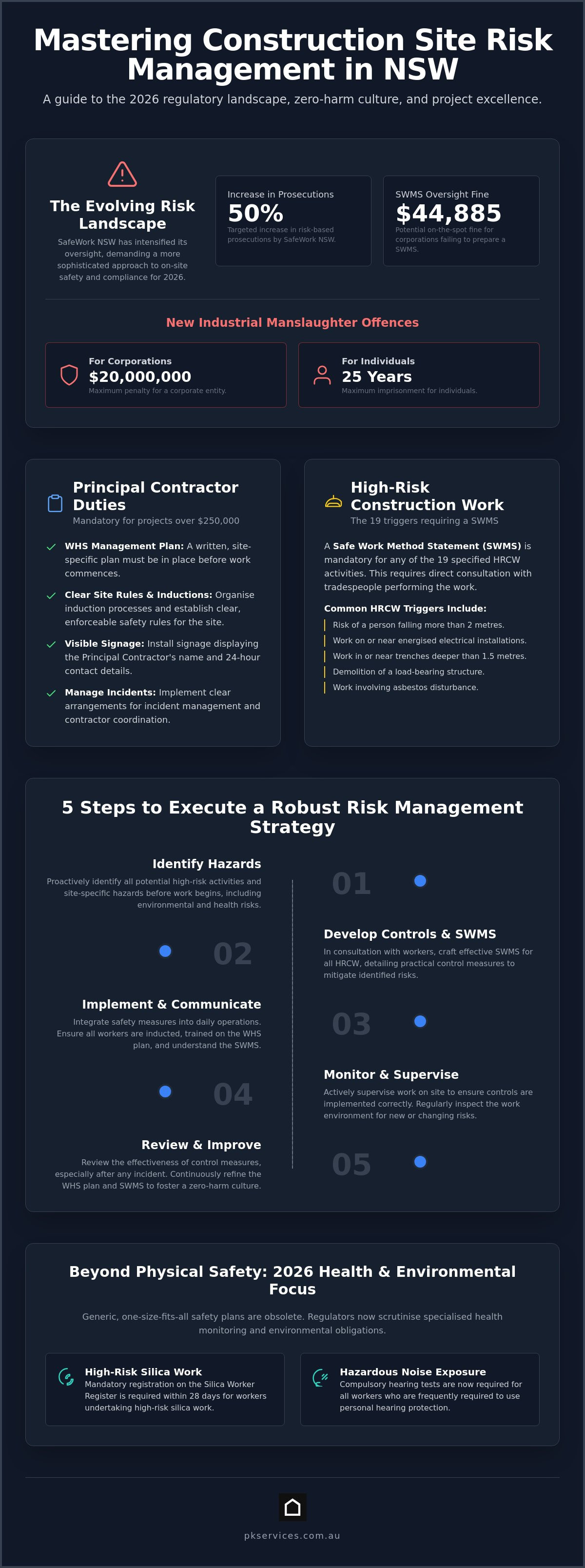
5 Steps to Execute a Construction Site Risk Management Strategy
Execution is where strategy meets the reality of a live site. Many firms treat safety as a hurdle to be cleared before the real work begins. This is a mistake. Effective construction site risk management NSW integrates safety into the build sequence itself. It transforms a list of rules into a competitive advantage. When your site is organised and your team is clear on the controls, projects move faster and with fewer interruptions. Follow these five steps to turn your WHS Management Plan into a strategic tool for success.
- Step 1: Conduct a thorough pre-start site hazard assessment. Walk the ground before any plant or trades arrive. Identify overhead lines, underground services, and access constraints early.
- Step 2: Consult with skilled trades to identify practical control measures. Theoretical controls often fail in the field. Talk to your contractors to ensure the proposed safety methods are actually workable.
- Step 3: Implement the hierarchy of control. Always aim for elimination first. If you can't remove the hazard, isolate it or use engineering solutions before relying on PPE.
- Step 4: Monitor site execution through consistent project oversight. Safety isn't a "set and forget" task. It requires active, daily supervision to ensure standards don't slip as the project gains momentum.
- Step 5: Review and refine strategies based on real-time site data. Use your findings from site walks and incident reports to improve your next project. Continuous refinement is the mark of a high-performance builder.
From Hazard Identification to Control Implementation
The hierarchy of control is your most powerful tool. Elimination is always the gold standard in NSW. If you can design out a risk, do it. Engineering solutions, such as physical barriers or scaffolding, are far more effective than administrative controls like warning signs. While signs and training are necessary, they rely on human behaviour, which is inherently variable. By focusing on higher-level controls, you build safety into the site infrastructure. This approach reduces the burden on your workers and creates a more resilient environment. It's about removing the possibility of error rather than just managing it.
Monitoring and Continuous Improvement
Consistency is key to maintaining a zero-harm culture. Regular site audits and safety walks shouldn't feel like a cold inspection. They are an opportunity to engage with the team and solve problems together. In 2026, mobile technology allows you to track risk trends across the project lifecycle in real time. This data helps you identify recurring issues before they lead to an incident. Encourage a culture where tradespeople feel empowered to report hazards immediately. When your team knows their safety is the priority, they become your best eyes and ears on the ground. For those looking to streamline this entire process, PK Services can manage the entire process from start to finish, ensuring your strategy is executed with precision.
Redefining Site Excellence with PK Services
Achieving a zero-harm culture requires more than just knowing the rules. It requires a partner who can bridge the gap between high-level advisory and on-site reality. PK Services provides a fresh approach to construction site risk management NSW by integrating business consulting with direct trade execution. We don't view safety as a separate department. It's a fundamental part of how we manage every build from inception to completion. Our goal is to ensure your project doesn't just meet regulatory standards but sets a new benchmark for excellence. We value results and the simplicity of a direct, personal connection.
Effective risk mitigation is the backbone of full cycle construction project management. By identifying potential bottlenecks and hazards before they manifest, we protect your timeline and your budget. We leverage 15 years of industry expertise to navigate the complexities of the Sydney and regional NSW markets. This isn't just about avoiding fines. It's about creating a seamless flow where safety and productivity work in tandem. This forward-thinking mindset turns risk management into a strategic performance advantage rather than a compliance burden. We help you stay ahead of the curve.
Strategic Advisory for NSW Builders
Operational performance often hinges on how well you manage your risks. We help NSW builders optimise their processes through tailored strategic advisory. Our solutions aren't pulled from a generic template. They are designed for the specific challenges of your project, whether it's a high-density residential build or a complex commercial development. We redefine excellence by aligning your safety protocols with your broader business growth objectives. It's about building a resilient operation that can handle the pressures of the 2026 construction landscape. We provide the clarity you need to lead with confidence.
Providing Skilled Trades and Contractor Services
A plan is only as good as the people executing it. We provide skilled trades and contractor services that prioritise safety at every step. In an era where the Master Builders Association estimates a need for 90,000 additional workers by 2026, we fill labour voids with experienced professionals. These are people who respect site rules and understand their obligations. We manage the entire process from start to finish, maintaining superior standards across every trade group. This hands-on oversight ensures that your site remains safe, productive, and compliant. We take the guesswork out of contractor management. You get a reliable partner who cares about the result as much as you do. Ready to elevate your project delivery? Organise a strategic consultation with PK Services today to secure your site's future.
Secure Your Site’s Future
The 2026 construction landscape demands more than basic compliance. It requires a proactive mindset where safety and productivity are inseparable. By mastering the essentials of construction site risk management NSW, you protect your people and your reputation. You’ve seen how site-specific SWMS and robust WHS Management Plans serve as the foundation for excellence. Now is the time to move beyond the paperwork and focus on strategic execution.
PK Services brings over 15 years of Australian construction expertise to your project. We specialise in NSW and QLD site management, offering end-to-end project lifecycle integration. We don't just consult; we manage the entire process from start to finish. Our team ensures your site remains a benchmark for safety while maintaining a brisk operational pace. We turn complex regulatory requirements into a clear path for project success.
It’s time to elevate your standards. Redefine your site excellence with PK Services today. Let’s build something safer and more successful together.
Frequently Asked Questions
What is considered high-risk construction work in NSW?
High-risk construction work (HRCW) includes 19 specific categories defined by SafeWork NSW. Common triggers include tasks where there is a risk of falling more than two metres, working in trenches deeper than 1.5 metres, or the demolition of load-bearing structures. Work involving energised electrical installations, asbestos disturbance, or confined spaces also falls under this classification. Identifying these triggers early is a fundamental part of construction site risk management NSW.
When is a WHS Management Plan mandatory for a construction site?
A written WHS Management Plan is mandatory for any construction project in New South Wales valued at $250,000 or more. This document must be prepared by the Principal Contractor before any work commences on site. It serves as the master guide for site-specific rules, induction processes, and emergency protocols. Keeping this plan accessible to all workers ensures everyone understands their safety obligations from day one.
What are the penalties for not having a SWMS in NSW?
For the 2025-2026 financial year, the on-the-spot fines for failing to prepare a SWMS for high-risk work are substantial. A corporation can be fined $44,885, while an individual faces a penalty of $9,002. These fines also apply if work is not carried out in accordance with the prepared statement. Maintaining accurate and site-specific documentation is the only way to avoid these significant financial liabilities.
How often should a construction site risk assessment be updated?
Risk assessments must be updated whenever site conditions change or new hazards are identified. This includes the arrival of new heavy plant, changes in weather, or shifts in the build sequence that introduce new risks. It is a live process rather than a one-time task. Regular safety walks and team consultations help ensure your risk management strategy reflects the current reality of the ground.
Who is responsible for site safety: the builder or the subcontractor?
Safety is a shared duty of care under the WHS Act. Subcontractors are responsible for preparing their own SWMS and ensuring their team follows safe work practices. The builder, as the Principal Contractor, must ensure these documents are in place and that the overall site environment is managed safely. Both parties must consult, cooperate, and coordinate activities to ensure no worker is put at risk.
What is the role of a Principal Contractor in NSW risk management?
The Principal Contractor acts as the central authority for safety on projects over the $250,000 threshold. Their role includes providing mandatory site signage, managing the WHS Management Plan, and coordinating various trades to prevent site congestion. They must ensure that all subcontractors are compliant and that site-specific inductions are conducted. Effective oversight by the Principal Contractor is essential for maintaining a zero-harm culture.
How does risk management improve construction site productivity?
Strategic construction site risk management NSW reduces the likelihood of accidents that cause project shutdowns and investigations. By identifying hazards early, you avoid the high cost of rework and the delays associated with damaged equipment or materials. Clear safety protocols also improve trade coordination, leading to a smoother workflow and more predictable timelines. For example, you can explore Pallet Resale and Repair Services to see how professional pallet management can keep your site clear and safe. A safe site is a high-performing site.
Can I use a generic SWMS template for my NSW project?
Generic SWMS templates are not considered compliant by SafeWork NSW. A SWMS must be site-specific and reflect the actual hazards and conditions of the work being performed. While a template can provide a starting point, it must be modified to include the specific equipment, environment, and control measures used on your site. Consultation with the workers who will perform the task is a mandatory part of this process.


