

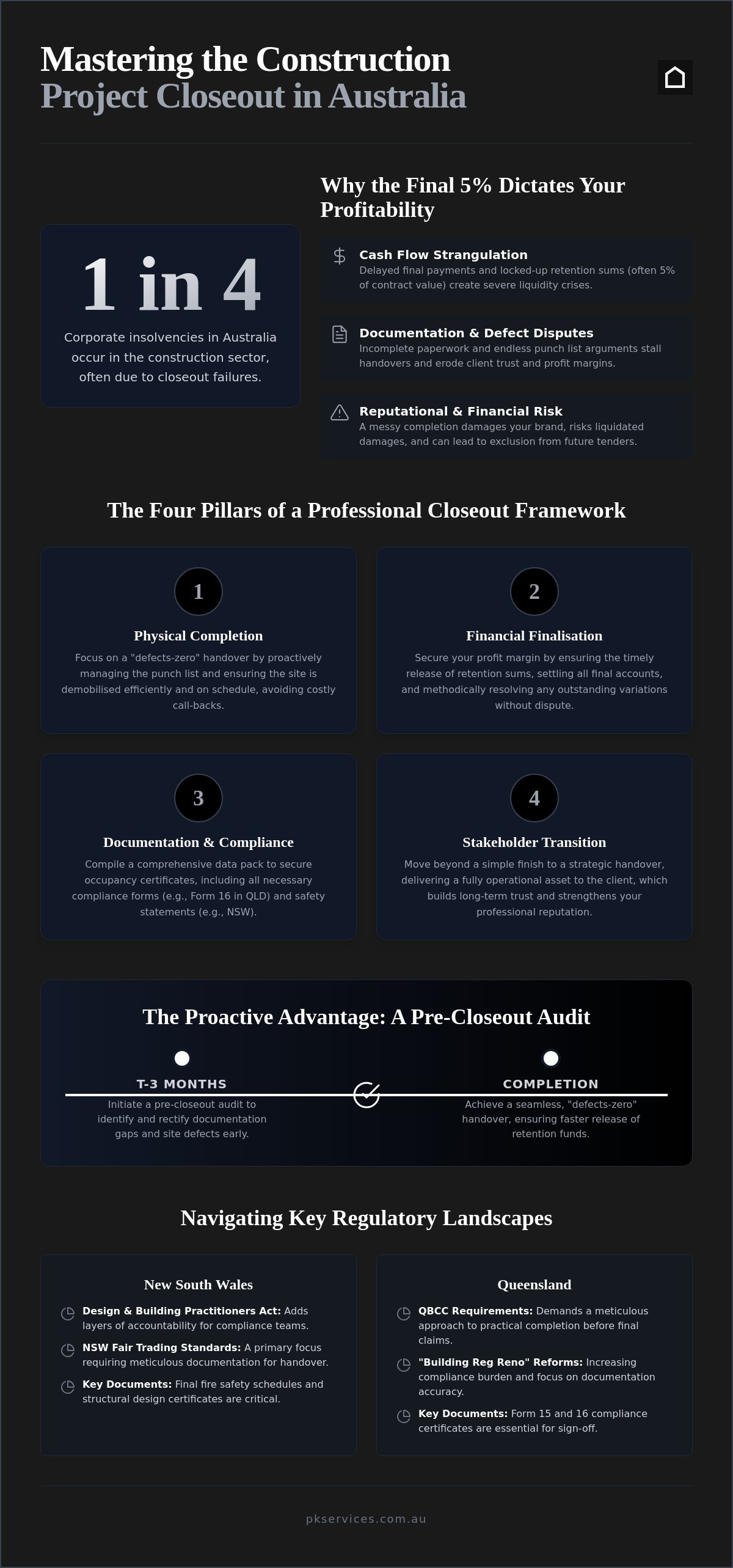
Nearly a quarter of all corporate insolvencies in Australia occur within the construction sector, often triggered by the cash flow strangulation of delayed final payments. It's a sobering reality. You've delivered a quality build, yet your retention sums remain locked away due to documentation gaps or endless punch list disputes. Perfecting the construction project closeout process Australia is no longer just a site task. It's a high-stakes business operation that dictates your firm's liquidity and reputation.
We know the final phase of a project often feels like the most volatile. Between the 2026 NSW Fair Trading amendments and Queensland's "Building Reg Reno" reforms, staying compliant while managing subcontractors is a complex balancing act. This article provides a professional framework to master that transition. You'll learn how to implement a strategic template that secures faster handovers and reduces defect claims. We'll explore the critical regulatory shifts in NSW and QLD to ensure your team moves to the next project with confidence and a clear balance sheet.
Key Takeaways
- Protect your cash flow by mastering the final 5% of your build, ensuring retention sums are released without unnecessary delays.
- Navigate the construction project closeout process Australia using a 2026 strategic template tailored for the evolving regulatory demands of NSW and QLD.
- Identify when to use digital automation versus professional consulting to manage complex financial finalisation and variations.
- Adopt a proactive pre-closeout audit three months before completion to catch documentation issues and site defects early.
- Learn how integrating high-level strategy with reliable trade services creates a "defects-zero" handover that builds long-term client trust.
The Australian Construction Closeout Landscape: Why the Final 5% Matters
Profit isn't just made on the tools. It's secured in the final weeks of the Project Management Lifecycle. For many Australian builders, the final 5% of a project represents the difference between a successful year and a liquidity crisis. This phase is where retention sums, often totalling 5% of the entire contract value, are either released or held hostage by incomplete documentation and lingering defects. A disorganised construction project closeout process Australia creates a vacuum where cash flow stops and disputes begin.
The 2026 market demands a higher standard of discipline. In New South Wales and Queensland, firms are shifting toward a "defects-zero" handover model to avoid the rising costs of post-completion call-backs. With labour shortages making it difficult to send trades back to finished sites, getting it right the first time is a financial necessity. When you leave a site with unresolved punch list items, you aren't just risking your reputation; you're actively eroding your margins through high-cost remedial work and potential liquidated damages.
Common bottlenecks often stem from a lack of coordination between certifiers and subcontractors. Whether it's a delay in receiving a Form 16 in Brisbane or a missing fire safety statement in Sydney, these small gaps stall the entire handover. The cost of a poor closeout extends beyond the balance sheet. In a market where developers and financiers are increasingly risk-averse, a messy completion can lead to long-term brand damage and exclusion from future tender lists.
Regulatory Milestones in QLD and New South Wales
Navigating the QBCC requirements in Queensland requires a meticulous approach to practical completion, ensuring all contractual obligations are met before the final claim is submitted. In New South Wales, the Design and Building Practitioners Act has added layers of accountability, making NSW Fair Trading standards a primary focus for compliance teams. Securing an Australian occupancy certificate requires a comprehensive data pack, typically including Form 15 and 16 compliance certificates in Queensland or the final fire safety schedule and structural design certificates in New South Wales.
Defining Excellence in the Handover Phase
Excellence in closeout means moving beyond the "just finished" mindset. It requires a strategic transition where the building is handed over as a fully operational asset. Implementing full cycle construction project management ensures these administrative threads are pulled together months before the site fences come down. By integrating strategic business advice into your completion phase, you can shorten the closeout cycle, release retention funds faster, and move your team to the next project without the weight of past defects.
The Four Pillars of a Professional Closeout Framework
Closing a project requires more than a final sweep of the site. It demands a structured framework that addresses physical, financial, and administrative loose ends. Aligning your construction project closeout process Australia with industry best practices ensures that you transition from site works to final payment without the usual friction. A professional framework is built on four distinct pillars: Physical Completion, Financial Finalisation, Documentation and Compliance, and Stakeholder Transition.
Pillar 1 & 2: Site Standards and Financial Security
Physical completion is the most visible phase, yet it often drags on the longest. The primary challenge is clearing the punch list without chasing subbies for weeks. In the context of Australian standards, a punch list is a formal register of minor defects or incomplete works that must be rectified before the project is deemed fit for practical completion. Successful builders don't wait for the final week to start this process. They use construction quality control management services to catch issues as they arise, ensuring the site is demobilised on schedule.
Financial finalisation is where the build's success is measured. This pillar covers the release of retention sums, the settlement of final accounts, and the resolution of any outstanding variations. Retention sums represent your profit margin. Managing them requires a proactive approach to timeline optimisation and legal protections under the Security of Payment Act. You must ensure all contractual milestones are documented to trigger these payments. If your internal team is stretched thin, you might engage a professional consultant to manage these financial negotiations and protect your cash flow.
Pillar 3 & 4: The Paperwork and the People
The third pillar focuses on documentation and compliance. This includes as-builts, warranties, and Operation and Maintenance (O&M) manuals. For Australian commercial projects, O&M manuals must be comprehensive and organised to meet strict facility management standards. Gaps in this paperwork are a leading cause of delayed occupancy certificates. You should begin collating these documents at the 70% completion mark rather than scrambling at the 99% mark.
The final pillar is the stakeholder transition. This is the human element of the handover. It involves client training and the final walk-through. A professional walk-through is a strategic opportunity to demonstrate quality and confirm client satisfaction. It moves the relationship from builder and client to partners in a finished asset. When handled with precision, this transition reduces the likelihood of post-completion defect claims and secures your reputation for the next project.
Closeout Strategies: Software Efficiency vs. Consulting Nuance
The rise of digital tools has fundamentally changed how we manage the construction project closeout process Australia. In 2026, approximately 60% of Australian construction businesses rely on management cloud software to track completion. These platforms are excellent for hosting O&M manuals and providing real-time visibility on punch lists. However, software has its limits. It can track a problem, but it cannot negotiate a complex contract dispute or physically rectify a defect. For high-stakes projects in NSW and QLD, the most successful firms use a hybrid model that pairs tech-enabled data with expert human oversight.
Comparing the ROI of software subscriptions versus specialist advisory services reveals a clear distinction. Software is a recurring operational cost for data organisation. Specialist consulting is a strategic investment in cash flow. While an app might flag that a retention sum is due, a consultant ensures the documentation meets the specific legal threshold required to trigger that payment. This "human-in-the-loop" approach is particularly vital for complex NSW projects governed by the Design and Building Practitioners Act, where the cost of a compliance error far outweighs the price of expert advice.
When to Engage Specialist Construction Advisory Services
Identifying "Red Flag" projects early is the key to protecting your margins. If a project suffers from stalled variations, a high volume of unresolved defects, or deteriorating client communication, it's time for an external closeout audit. Integrating a construction business growth strategy NSW helps you build these audit points into your project lifecycle from the start. A third-party perspective often provides the clarity needed to resolve final account disputes that have reached a stalemate, allowing both parties to move forward without litigation.
The Impact of Skilled Trades on Closeout Speed
Software cannot pick up a paintbrush or fix a misaligned join. The "tail end" of project costs often balloons because builders struggle to get original subcontractors back to site for minor rectifications. This is where the gap between strategy and execution becomes most apparent. Having reliable trade partners who prioritise completion is essential for maintaining your momentum.
We bridge this gap by supplying skilled trades to fill the essential voids during the final push. Whether it's clearing a lingering punch list, meeting specific Australian standards for finish quality, or choosing to explore Energy Efficient Upgrades with Edmund Parks Electrical, having the right hands on deck is non-negotiable. The true cost of unclosed defects isn't just the repair bill; it's the damage to your business reputation and the loss of future opportunities. Excellence in the final 5% requires a partner who understands both the high-level strategy and the reality of site work.
The 2026 Strategic Closeout Template: Step-by-Step
A successful construction project closeout process Australia requires a shift from reactive fixes to proactive management. Waiting until the final week to address defects is a recipe for delay. By following a structured template, you can ensure that site work, administration, and financial reconciliation move in lockstep toward a clean completion. This systematic approach transforms the final phase from a source of stress into a competitive advantage.
Step 1 & 2: Proactive Site Management
The process begins with a Pre-Closeout Audit exactly three months before the scheduled completion date. This early identification of punch list items prevents "handover fatigue," where teams rush to finish while quality standards slip. In the competitive Brisbane and Sydney markets, organising trade schedules for rectification work early ensures you aren't competing for labour when the deadline looms. It's about clearing the path before the final push begins.
Site demobilisation is the final physical hurdle. It isn't just about removing the site sheds; it involves a rigorous check of all site safety requirements. You must ensure the environment is safe for the client and the public. We recommend a final safety sweep to confirm that all temporary works are removed and permanent safety features are fully operational. This step protects your liability and ensures a smooth transition to the building's new occupants.
Step 3 & 4: Compliance and Capital Protection
Compiling the "Closeout Pack" is an administrative marathon that dictates your payment timeline. For Australian certifiers and local councils, this pack must be flawless. It includes everything from structural certifications to fire safety statements. Any missing document can delay the occupancy certificate, which in turn stalls your final payment. Start this compilation early to avoid the last-minute scramble for certificates from subcontractors who have already moved on to other sites.
Financial reconciliation is the final pillar of capital protection. You must negotiate final variations and secure the final payment claim with precision. This is where many builders lose their margin through uncaptured costs. Using a construction business profitability consulting QLD framework allows you to evaluate the project's financial success and identify exactly where costs ballooned. This data is vital for refining your estimating process for future tenders.
The final step is the Handover and Post-Occupancy Review. This is your opportunity to gather feedback and ensure the client is comfortable with the building's operations. It closes the loop on the current project while opening the door for future work. If you're looking to standardise these steps and protect your margins, you can engage our consulting team to implement a custom closeout strategy tailored to your firm's specific needs.
Redefining Excellence: The PK Services Approach to Project Completion
Success in the construction project closeout process Australia requires more than a software subscription. It requires a partner who understands the friction between high-level project strategy and the gritty reality of site execution. At PK Services, we bridge this gap by offering a unique blend of business consulting and direct trade supply. We don't just identify the hurdles standing between you and your final payment. We provide the resources to clear them. Our approach is built on fifteen years of hands-on experience in the Australian market, ensuring that your project finishes with the same momentum it started with.
Managing the final transition of a build is a high-stakes operation. We understand that the final 5% of a project often dictates the profitability of the entire venture. By providing end-to-end management, we ensure that every administrative thread is tied and every site defect is rectified. Our commitment to the Queensland and New South Wales construction sectors is personal. We live and work in these markets, and we've seen first-hand how a disorganised handover can cripple a promising firm.
Business Consulting and Process Management
We focus on optimising your operational performance through refined closeout systems. Many builders have the technical skill to build, but they lack the administrative framework to close. Our tailored solutions protect your margins by identifying documentation gaps before they become payment delays. We've assisted Sydney-based residential developers in significantly reducing their handover times by implementing a "defects-zero" culture from the mid-point of the project. This shift in strategy ensures that when the final walk-through occurs, it's a formality rather than a negotiation. We turn your closeout phase into a repeatable, efficient system that supports long-term business growth.
Your Partner for Site Execution and Trade Supply
One of the greatest challenges in the construction project closeout process Australia is the "tail end" trade gap. Getting original subcontractors to return for minor punch list items is notoriously difficult in the current market. We solve this by supplying the skilled trades you need to fill these essential labour voids. Our local presence in NSW and QLD ensures faster response times, allowing you to clear defects and demobilise your site on schedule. We provide the trades who actually care about the finish, ensuring your project meets the highest professional standards. Don't let your reputation stall at the finish line. Take the next step and partner with PK Services for your next project closeout to ensure a strong, profitable completion.
Secure Your Build's Legacy and Your Firm's Liquidity
Mastering the construction project closeout process Australia is the final hurdle between a finished site and a profitable business. We've explored how a proactive three-month audit prevents handover fatigue; we've also seen why navigating the specific regulations of NSW and QLD requires more than just a digital checklist. It's about integrating high-level strategy with the physical reality of clearing punch lists to ensure every retention sum is released on time.
You don't have to manage this complex transition alone. With over 15 years of Australian construction industry expertise, PK Services provides the full-cycle project management you need to finish strong. We leverage a specialised trade and contractor network across NSW and QLD to fill essential labour gaps and meet every regulatory standard. From strategic consulting to site execution, we ensure your margins are protected and your reputation remains elite.
Redefine your project excellence with PK Services, contact our specialists today.
Let's turn your next handover into your smoothest transition yet.
Frequently Asked Questions
What is the most common cause of project closeout delays in Australia?
The primary cause of delays is a lack of documentation readiness combined with lingering minor defects. Builders often scramble for compliance certificates at the last minute, which stalls the occupancy permit and pushes back the release of retention sums. A disorganised handover process creates a bottleneck that prevents the final transition to the client.
How does the QBCC define practical completion for Queensland projects?
The QBCC defines practical completion as the stage where the works are substantially complete and reasonably fit for use and occupation. It requires all major defects to be rectified before the builder can claim this milestone. While minor omissions are permitted, all necessary compliance forms, such as Form 15 and 16, must be ready for submission to the certifier.
What is a retention sum, and how can I ensure its timely release?
A retention sum is a portion of the contract price, typically 5%, held by the client as security for the rectification of defects. To ensure its release, you must strictly follow the contractual notice periods and provide a flawless closeout pack. Proactive defect management throughout the build is the most effective way to trigger this final payment without dispute.
How do NSW Fair Trading standards affect the closeout of residential builds?
NSW Fair Trading standards impose strict statutory warranties, requiring builders to rectify major defects for up to six years after completion. The Design and Building Practitioners Act also demands that practitioners provide regulated designs and compliance declarations during the handover. These standards make administrative accuracy a critical component of the construction project closeout process Australia.
Can I use software to manage my entire project closeout process?
Software is a powerful tool for tracking data, but it isn't a complete solution for project completion. While it organises O&M manuals and punch lists, it cannot physically rectify a defect or negotiate a complex contract variation. A hybrid approach that pairs digital tracking with professional consulting ensures that both the paperwork and the site work meet required standards.
What should be included in a standard Australian O&M manual?
A standard Australian O&M manual must include as-built drawings, equipment warranties, and detailed maintenance schedules. It should also contain all certificates of compliance, such as fire safety statements, structural certifications, and pest management records from ABC Pest Control Sydney, along with a contact list for all subcontractors. This document serves as the essential operational guide for the facility manager once you leave the site.
How do I manage subcontractors who refuse to return for defect work?
Managing unresponsive subcontractors requires clear contract clauses that allow you to engage alternative labour if they fail to return. If a subbie is unavailable, you should partner with a reliable trade supply service to clear the punch list and maintain your schedule. This prevents minor defects from escalating into long-term financial liabilities or client disputes.
Is it worth hiring a construction consultant for project closeout?
Hiring a consultant is a strategic investment that often pays for itself through faster cash flow and reduced defect claims. For complex projects in NSW and QLD, an external expert identifies compliance risks that internal teams might overlook. They provide the professional oversight needed to close the project with confidence while your team moves to the next tender.


