

A failing construction project isn't just a budget leak; it's a direct threat to your professional reputation and your QBCC licence. You likely recognise the mounting pressure of watching costs climb while the build program slips further away. It's a stressful cycle of unreliable subcontractors and the looming shadow of a 'Direction to Rectify'. This guide shows you exactly how to fix a failing construction project QLD by moving beyond panic and into a structured recovery phase.
We understand that the current market, with new dwellings now averaging over $787,000, leaves zero room for operational waste. You'll learn the exact steps to stabilise your site, re-engage the right trades, and manage payment claims under the BIF Act with confidence. We provide a clear roadmap to help you avoid QCAT litigation and deliver a high-standard build that protects your name in the Queensland market. It's time to stop the bleeding and start the turnaround.
Key Takeaways
- Identify the critical tipping points where budget creep and missed milestones transition into serious legal liabilities.
- Learn how to handle QBCC 'Directions to Rectify' professionally to protect your licence and project timeline.
- Follow a proven 5-step roadmap on how to fix a failing construction project QLD, beginning with a rigorous site audit.
- Shift from basic supervision to strategic site leadership to address the root causes of project failure.
- Discover how end-to-end lifecycle management bridges the gap between boardroom strategy and on-site execution.
What Defines a Failing Construction Project in QLD?
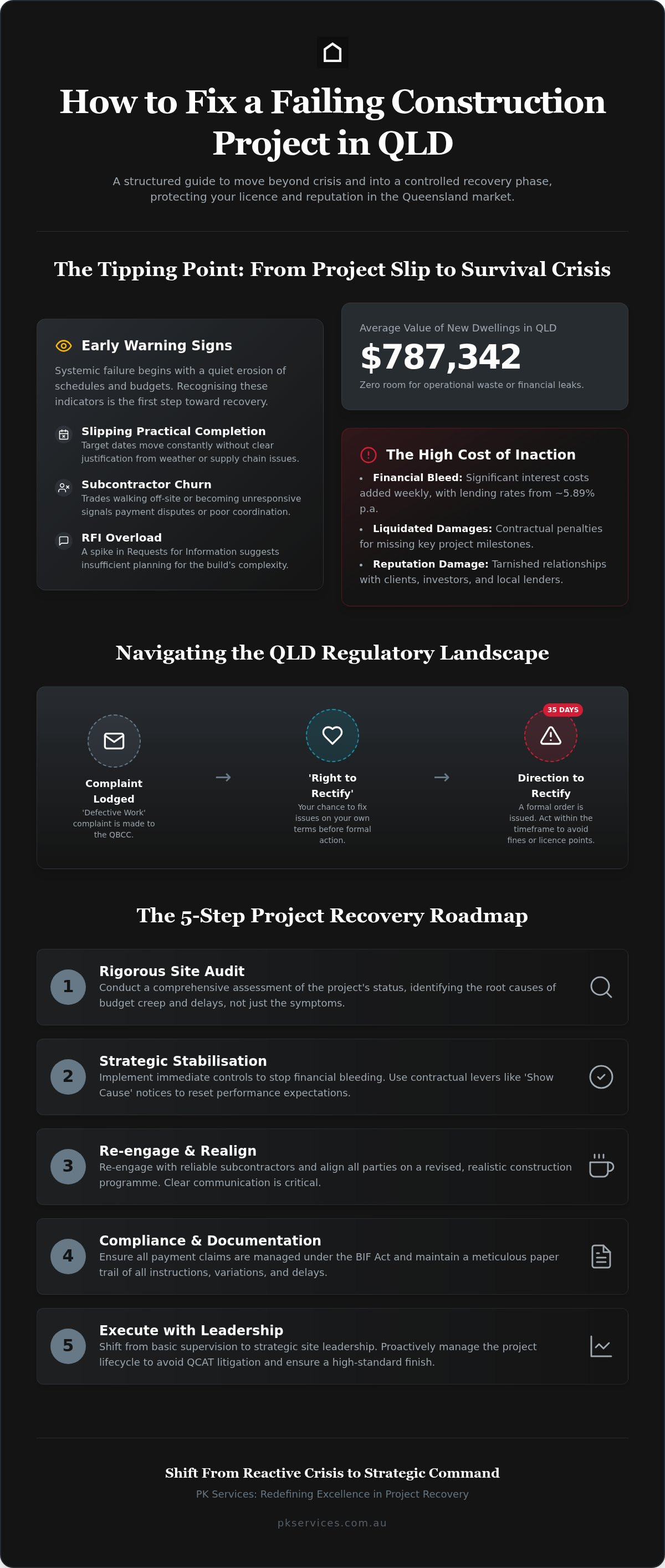
A failing project rarely starts with a bang. It begins with a quiet erosion of the schedule and a slow leak in the budget. In Queensland, where the construction pipeline is forecast to hit $77 billion by 2027, the pressure to perform is immense. Many developers mistake minor site hiccups for the natural flow of building. However, systemic failure occurs when the fundamental principles of construction management are ignored or misapplied. Knowing how to fix a failing construction project QLD requires you to first acknowledge when your site is no longer under your control.
The tipping point usually arrives when delays transition from manageable to a legal liability. This is especially true in our unique climate. A missed roofing milestone before the summer wet season isn't just a delay. It's a catalyst for water damage and mould disputes. When operational slippage meets Queensland’s strict regulatory framework, the project moves from a business challenge to a survival crisis. Distinguishing between a few bad days on-site and a project in freefall is the first step toward recovery.
Early Warning Signs on QLD Sites
Detecting failure early saves millions. You need to look for specific indicators that the project has lost its rhythm. These signs are often visible long before the QBCC gets involved.
- Slipping Practical Completion: If your target dates move every fortnight without a clear weather or supply chain cause, the construction programme is broken.
- Subcontractor Churn: Tradies walking off-site or refusing to return calls often signals payment disputes or poor site coordination.
- RFI Overload: A sudden spike in Requests for Information usually means the initial planning or design phase was insufficient for the build's complexity.
The Cost of Inaction
Waiting for things to self-correct is a high-risk strategy. With owner-occupier variable rates currently starting around 5.89% p.a., every week of delay adds significant interest costs. The average value for new construction in Queensland has jumped to $787,342 per dwelling. This means your margins are tighter than ever. Beyond the immediate financial bleed, you face liquidated damages and a tarnished reputation with local lenders.
The most severe consequence is the escalating risk of QBCC intervention. Once a Direction to Rectify is issued, you generally have 35 days to act before facing fines or licence points. Addressing how to fix a failing construction project QLD now is the only way to protect your long-term viability. It's about moving from a reactive state to a position of strategic command.
Navigating the QLD Regulatory and Contractual Landscape
Managing a project turnaround in Queensland requires a sharp understanding of the local regulatory environment. It's not enough to simply work harder on-site. You must align your recovery strategy with the rules set by the Queensland Building and Construction Commission (QBCC). Knowing how to fix a failing construction project QLD involves mastering these administrative hurdles before they become insurmountable legal barriers.
The QBCC plays a dual role as both a regulator and an adjudicator. If your project is flagging, you may face a 'Direction to Rectify' (DTR). Under current 2026 regulations, you typically have 35 days from the date of the direction to address the specified issues. Failing to act within this window doesn't just invite fines; it puts your licence at risk. Professionalism during this period is your best defence. Treat every interaction with the commission as an opportunity to demonstrate your commitment to quality and compliance.
Your contract is your most powerful tool for stabilisation. Whether you're working under an AS4000 standard form or a bespoke agreement, you need to identify the levers available to you. Documenting every site instruction, delay, and variation is non-negotiable. This paper trail protects your position if a dispute escalates to QCAT. If you're feeling overwhelmed by the paperwork, our team can help you organise your project recovery strategy with precision.
The QBCC Complaint Process
When a 'Defective Work' complaint is lodged, the QBCC will investigate. Don't view this as an attack. Instead, use the 'Right to Rectify' period to your advantage. It's your chance to fix issues on your own terms before a formal direction is issued. Engaging proactively with QBCC inspectors shows that you're managing the site with integrity. This transparency often leads to more favourable outcomes and prevents the situation from spiralling into a public dispute.
Contractual Leverages for Recovery
Recovery often starts with resetting your relationship with subcontractors. If performance has dipped, use 'Show Cause' notices as a formal reset button. These notices aren't just threats; they're a structured way to demand a return to the agreed standard. Identifying 'Breach of Contract' triggers early allows you to replace underperforming teams before they cause permanent damage to your programme. For a deeper look at managing these complexities, explore our guide on Full Cycle Construction Project Management. This lifecycle approach ensures you're prepared for every stage of the build, from the first sod turn to the final handover.
The 5-Step Project Recovery Roadmap
Rescuing a site requires more than just enthusiasm; it demands a clinical, phased approach. When you are looking at how to fix a failing construction project QLD, you need a strategy that addresses both the boardroom financials and the site-level execution. This roadmap provides the structure to stop the drift and regain momentum.
- Step 1: Immediate Site Audit. This is your reality check. You must assess the physical progress against the documented programme and identify every latent defect.
- Step 2: Financial Re-baselining. With investor variable rates currently at 5.85% p.a., capital is too expensive to waste on inefficient workflows. Find exactly where the budget is leaking.
- Step 3: Stakeholder Realignment. Open, honest dialogue with lenders and owners is essential. Transparency builds the trust needed to secure continued funding.
- Step 4: Operational Reset. If the current systems aren't working, change them. This might involve new site leadership or introducing more rigorous reporting processes.
- Step 5: Quality Control Implementation. Establish a strict inspection regime to ensure that once a problem is fixed, it stays fixed.
Auditing for Operational Excellence
A project audit is the rigorous, objective examination of every site element that serves as the foundation for any recovery strategy.
You need to look past the superficial progress. Compare the actual on-site milestones against the original programme of works to find the true variance. Assessing the quality of completed work now prevents expensive rework during the final stages of practical completion. It's about establishing a baseline of truth before you commit more resources to the build. This level of detail is what separates a professional recovery from a temporary patch-up job.
Re-engaging the Workforce
A failing project often suffers from a toxic site culture. When productivity drops, it's usually because the trades have lost faith in the leadership or the schedule. Re-engaging the workforce starts with clear, achievable KPIs for the recovery phase. You must communicate a new standard of excellence to every subcontractor on-site. By setting firm expectations and providing the support they need to meet them, you transform the site from a place of frustration into a high-performance environment. Strong leadership at this stage is the difference between another delay and a successful handover.
Optimising Site Performance and Leadership
Most project failures in Australia aren't caused by bad weather or material shortages. They're caused by poor site management. When leadership falters, the entire build loses its rhythm. Many firms struggle with how to fix a failing construction project QLD because they focus on the physical bricks rather than the management of the people. Traditional site supervision is often too passive. It involves checking off a list and hoping for the best. Strategic site leadership is about foresight. It means identifying a bottleneck in the schedule three weeks before it happens and pivoting the team to maintain flow.
Implementing robust systems is the only way to bridge the gap between boardroom strategy and on-site execution. Without these systems, quality slips and costs escalate. We specialise in Construction Quality Control Management to ensure every milestone meets the highest standards. This level of oversight reduces the friction that typically leads to delays. It creates a culture where every trade knows exactly what is expected and when it must be delivered. If you need a fresh perspective on your build, you can optimise your site performance with PK Services today.
Strategic Site Management Services
An external project recovery consultant provides an objective lens that internal teams often lack. When you're in the middle of a crisis, it's difficult to see the systemic issues. Professional site management identifies these gaps early, significantly reducing the risk of QBCC complaints. Consider a stalled site where progress has ground to a halt. While a strategic leader re-sequences the programme to restore productivity, ensuring the physical site remains protected by Tupper Security Services prevents further loss from theft or vandalism. This proactive approach turns a liability into a high-performing asset.
Filling the Labour Void
Queensland is currently facing a massive workforce challenge. Construction Skills Queensland forecasts a peak demand of 156,000 workers in 2026–27. This shortfall makes finding and keeping skilled trades incredibly difficult. During a high-pressure recovery phase, you cannot afford to hire the wrong people. Vetting is your primary defence against further delays. You must ensure every new subcontractor has the capacity and the track record to deliver under pressure. For a structured approach to this process, see our guide on Vetting Construction Subcontractors in Australia. Getting the right boots on the ground is the final piece of the recovery puzzle.
PK Services: Redefining Excellence in Project Recovery
A failing project needs a partner, not just a consultant. PK Services brings 15 years of industry expertise to every recovery mission. We don't just provide reports; we provide results. Our approach bridges the critical gap between high-level boardroom strategy and the daily realities of the building site. This is how to fix a failing construction project QLD with precision and confidence. We move with a sense of purpose to stop the financial bleed and restore your professional reputation.
Our end-to-end management style ensures that no detail is overlooked. We understand that a recovery plan is only as good as the people executing it. Unlike traditional consultancies that offer advice from a distance, we stay connected to the site. We provide a minimalist, direct approach to solving complex operational problems. This removes the clutter of traditional firm processes and gets straight to the core of the issue. We value efficiency and modern professionalism above all else.
We solve the labour shortfall problem directly. We maintain a vetted network of skilled trades and contractors ready to fill site gaps. This ensures that your project doesn't stall while you search for reliable help. By providing both the strategy and the boots on the ground, we maintain high standards across the entire lifecycle. This integrated model is what sets us apart as a leader in Australian construction consulting. We turn stagnant sites into productive environments through superior standards and a forward-thinking mindset.
Our Tailored Recovery Solutions
We offer bespoke consulting for QLD firms facing operational decline. Every project has unique challenges that require a customised response. Our team provides full-cycle oversight to ensure your project reaches practical completion without further delays. We have a proven track record in Improving Construction Business Profitability in NSW & QLD by identifying and removing operational waste. We focus on the metrics that matter to your bottom line.
Partner with a Bold Innovator
PK Services is the modern alternative to traditional, stagnant consulting firms. We are bold innovators who value the simplicity of a direct, personal connection. When you work with us, you aren't just another file. You are a partner in excellence. The 'PK Standard' is our commitment to quality, efficiency, and transparency. It's a promise that we will protect your project as if it were our own. You don't have to manage this crisis alone. Contact us to start your project health check today and regain control of your build.
Reclaiming Your Project Momentum
Turning a site around requires more than just more hands on deck. It's about implementing a structured recovery roadmap that addresses both the contractual obligations and the operational rhythm. You've seen that the path forward involves a clinical site audit, a reset of site leadership, and a firm commitment to quality standards that exceed QBCC requirements. Understanding how to fix a failing construction project QLD is the first step toward protecting your reputation and your bottom line.
PK Services brings over 15 years of industry experience to these complex turnarounds. We are specialists in QLD and NSW construction, offering end-to-end project lifecycle management that ensures every milestone is met with precision. We don't just advise; we partner with you to deliver the results your stakeholders expect. Our team provides the strategic oversight and the skilled trades needed to bridge the gap between boardroom goals and on-site reality.
Redefine your project's success with PK Services. Contact our recovery specialists today.
Your project still has the potential for excellence. Let's start the turnaround together.
Frequently Asked Questions
What is the first thing I should do if my construction project is failing in QLD?
The first step is to pause site activities and conduct a comprehensive site audit. You must establish exactly where the project stands regarding physical progress, budget expenditure, and quality defects. This baseline of truth allows you to identify the root causes of the failure. Without this data, any recovery attempt is just guesswork. It's about gathering facts before making high-stakes decisions.
Can the QBCC help me if my builder stops work on-site?
Yes, you can lodge a formal complaint with the QBCC if your builder abandons the site or stops work without a valid reason. The commission will investigate the matter and may issue a 'Direction to Rectify' if work is defective or incomplete. This is a critical step in protecting your legal position and potentially accessing the Queensland Home Warranty Scheme if the builder is insolvent.
How do I fire a subcontractor on a failing project without breaching contract?
You must strictly follow the default and termination clauses in your construction contract. This usually involves issuing a 'Show Cause' notice that outlines the specific breaches of performance or quality. Ensure you document all failures and provide the agreed timeframe for the subcontractor to respond. Jumping straight to termination without these steps often results in a costly breach of contract claim against you.
How much does construction project recovery consulting cost in Australia?
Costs depend on the complexity of the build, the state of the site, and the level of management required. Recovery specialists generally offer bespoke pricing because every failing project has unique requirements. You should view these costs as an investment in site stabilisation and risk mitigation. Most firms find that professional recovery management pays for itself by preventing liquidated damages and costly QCAT disputes.
What is a 'Direction to Rectify' and is it a legal order?
A 'Direction to Rectify' is a formal notice issued by the QBCC requiring a contractor to fix defective or incomplete work. It is a legal order under the Queensland Building and Construction Commission Act. Contractors typically have 35 days to comply with the direction. Failing to act can result in fines, demerit points on your licence, or even licence suspension if the issues are systemic.
Can a failing project still be profitable after a recovery plan?
Yes, a project can return to profitability if you act quickly to stop the financial leak. Profitability hinges on how to fix a failing construction project QLD through rigorous financial re-baselining and operational resets. By removing underperforming trades and tightening quality control, you can protect your remaining margins and avoid the compounding interest costs of a stalled site. Early intervention is the key to financial recovery.
How long does it typically take to turn a construction project around?
The turnaround timeframe varies based on the build's scale and the severity of the issues. Generally, the initial site audit takes one to two weeks, followed by a stabilisation phase of four to six weeks. Regaining full momentum requires honest stakeholder communication and a new schedule. Most projects start showing significant operational improvement within the first 30 days of implementing a professional recovery roadmap.
Should I go to QCAT or hire a project recovery specialist first?
You should consider hiring a project recovery specialist before escalating to QCAT. Litigation is often slow, expensive, and adversarial, which can further delay your build. A specialist focuses on how to fix a failing construction project QLD through operational and contractual solutions that keep the project moving. It's often more efficient to resolve issues on-site than to wait months for a tribunal hearing while the site sits idle.


