

A dependable industrial construction budget starts with a clear project scope. In NSW, account for materials, labour, permits and contingencies, and connect those costs to development decisions and construction delivery. Industrial construction advisory services in NSW can bring planning, risk management and delivery into a coordinated view.
It’s easy to focus on the build itself, but decisions made during development also shape project requirements and how the budget is managed. A useful plan considers the full process, not just the construction estimate.
This guide explains how to define the scope, plan development, organise cost estimates and manage risks as decisions evolve. You’ll also learn how development and construction management can keep the budget aligned with the work, and how PK Services’ business consulting, trades and contractor services, and end-to-end project management fit into that process.
Key Takeaways
- Define the project scope, sequence key decisions and identify risks early so planning stays connected to delivery.
- Coordinate development and construction activities to keep responsibilities, timing and project changes visible.
- Build the budget around materials, labour, permits and contingencies, then revisit estimates as the scope develops.
- Understand how NSW consultant prequalification works, including the ABN and scheme conditions for organisations applying to join.
Construction project planning and risk mitigation
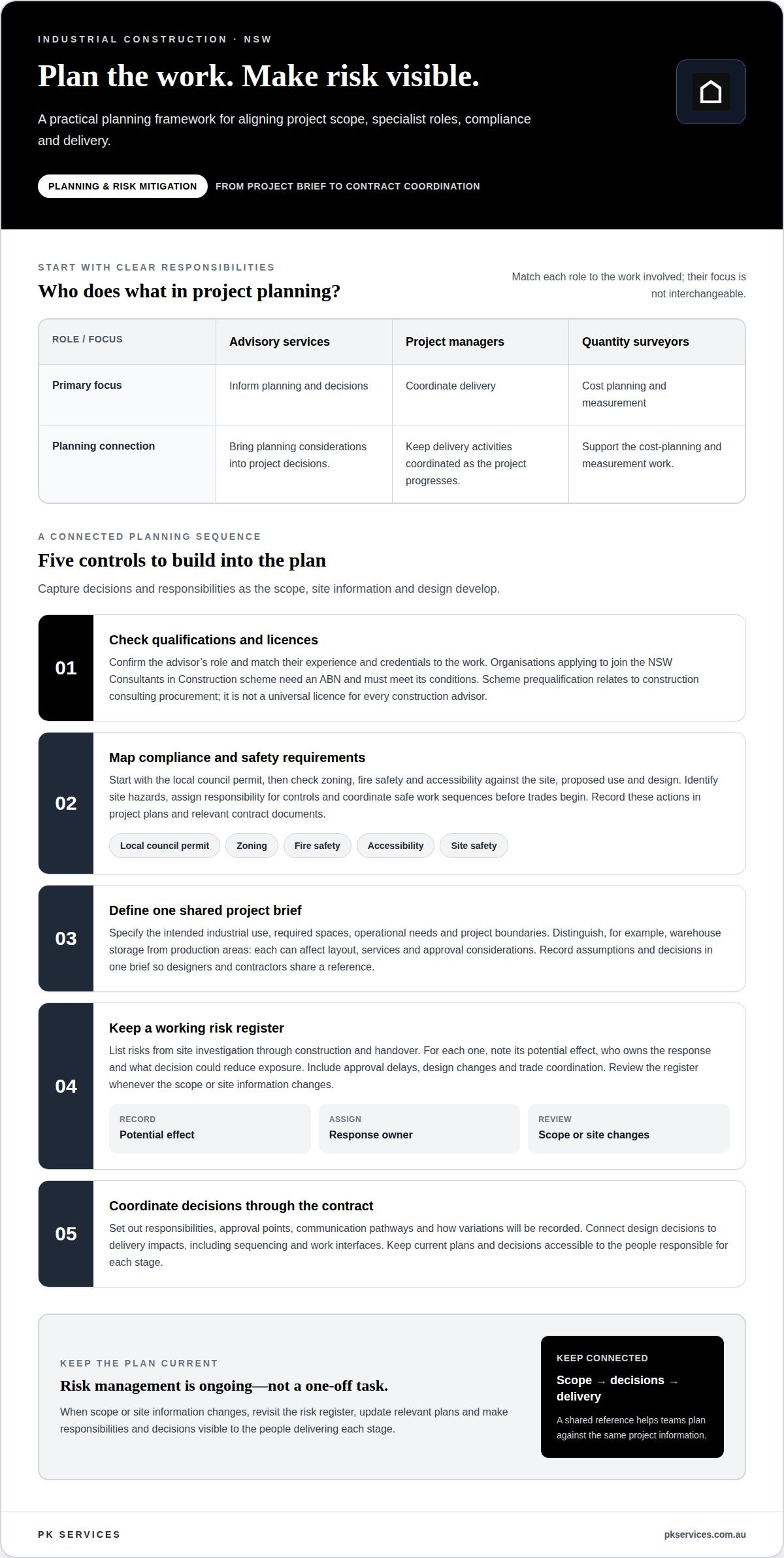
Advisory services inform planning and decisions; project managers coordinate delivery, while quantity surveyors focus on cost planning and measurement. NSW building regulations require a local council permit for any building or renovation project. Check zoning, fire safety, accessibility and site safety requirements against the proposed industrial use and design.
-
Check qualifications and licences
Confirm an advisor’s role before relying on their qualifications or licence. Organisations applying to join the NSW Consultants in Construction scheme need an ABN and must meet its conditions. Scheme prequalification relates to construction consulting procurement; it is not a universal licence for every construction advisor. Match experience and credentials to the work involved.
-
Confirm compliance and safety requirements
Map approval and compliance requirements against the site, proposed use and design. Start with the local council permit, then identify how zoning, fire safety and accessibility standards affect the plans. For construction safety, identify site hazards, assign responsibility for controls and coordinate safe work sequences before trades begin. Record these actions in project plans and relevant contract documents.
- Define the project brief. Specify the intended industrial use, required spaces, operational needs and project boundaries. For example, distinguish warehouse storage from production areas, as each can affect layout, services and approval considerations. Record assumptions and decisions in one brief. A clear scope gives designers and contractors a shared reference.
- Build a risk register. List risks at each project stage, from site investigation through construction and handover. Note each risk’s potential effect, who owns the response and what decision could reduce exposure. Include approval delays, design changes and trade coordination. Review the register whenever the scope or site information changes, rather than treating it as a one-off planning document.
- Coordinate decisions through the contract. Set out responsibilities, approval points, communication pathways and how variations will be recorded. Connect design decisions to delivery impacts, including changes to sequencing or work interfaces. This helps make emerging issues visible before they affect later tasks. Keep current plans and decisions accessible to the people responsible for each stage.
Construction and development management
Manage development as a sequence of connected decisions, not a handover from planning to construction. At each step, clarify who decides, what information they need and how changes affect the next stage.
- Map the development stages. Set out the path from site assessment and concept design through approvals, detailed design, procurement, construction and handover. For an industrial facility, identify when operational needs, such as vehicle access or production layouts, must inform design decisions. This sequence helps teams identify dependencies before one decision delays another.
- Assign decision owners. Record who leads each workstream, who provides technical input and who approves changes. A design lead may coordinate drawings, while the owner confirms operational requirements. Use a responsibility schedule to clarify handovers. If an access layout changes, identify which drawings, approvals and construction activities need updating.
- Set decision gates. Agree on the information needed before the project moves forward. A design review, for example, can test the proposed layout against equipment needs, circulation and planned construction sequencing. Record decisions and outstanding actions in a central log, with an owner assigned to each action. This helps prevent confusion between development and delivery teams.
- Coordinate consultants and interfaces. Give each consultant a defined scope and access to shared project information. Check where design packages meet, such as the building structure and services, so gaps or overlaps become visible. Schedule reviews around key design releases rather than waiting until construction. Clear interface management helps teams resolve clashes while there is still time to adjust the design.
- Choose a procurement pathway. For NSW Government agencies buying infrastructure advisory services, use the relevant framework guidance. From 1 August 2023, agencies were recommended to use the infrastructure advisory contract framework, except Transport for NSW, which should continue using Professional Services Contracts templates. Private industrial projects should establish procurement responsibilities through their own project arrangements.
- Control changes during delivery. Require each proposed change to state its reason, design effect, schedule impact and approval status. For example, a revised production layout may affect service coordination and work sequencing. Keep current drawings aligned with decisions so contractors aren’t working from superseded information.
- Connect development decisions to delivery. Review progress against agreed milestones and outstanding decisions at regular project meetings. Use coordinated construction planning to keep development choices and on-site work connected as the project advances.
Construction budgeting
Build the budget from the project scope, then update it as design decisions develop. Industrial construction advisory services in NSW can support feasibility reviews and cost control through structured estimates, approvals and change tracking.
-
Assess project feasibility
Test whether the proposed facility’s scope and intended use align with the available project information. Compare design options with operational needs, site constraints and construction requirements before choosing an approach. For example, assess whether a warehouse layout supports planned vehicle movement. Advisors can identify assumptions affecting the estimate and decisions that need more detail before the budget is relied upon.
-
Set budgets and control costs
Prepare a cost plan that separates materials, labour, permits and contingencies. Track each item against its scope, estimate basis and approval status rather than relying on one headline figure. As design details develop, record estimate changes and their causes. Industrial construction advisory services in NSW can help compare updates with the approved budget and identify how scope or sequencing affects spending.
- Break costs into work packages. Group the estimate into sections such as site preparation, structure, building services and fit-out. For the primary structural package, factoring in pre-engineered framing solutions from suppliers such as Bradberry Steel can help establish firm component pricing early. This shows which items depend on design information and which can be priced more clearly. Keep assumptions beside each package so reviews can distinguish a change in scope from updated pricing information.
- Set estimate checkpoints. Refresh the budget at key design and procurement stages. Compare each revision with the previous estimate, explain cost movements and record approvals. If a production area needs different services, show the design change alongside its budget effect. This creates a clear decision trail.
- Monitor commitments and changes. Track approved work, pending decisions and proposed variations in one cost report. Separate committed amounts from forecast costs, then flag changes that affect scope or sequencing. Review the report with the project team, assign actions and keep the forecast aligned with approved plans.
What qualifications and licences are required for construction advisors in NSW?
Check the advisor’s role and the procurement pathway before assessing qualifications. NSW scheme prequalification applies to specific consulting engagements; it is not a universal licence requirement for every construction advisor.
- Define the advisory work. Specify whether the role covers design advice, cost planning, project coordination or another construction consulting task. Match the experience and qualifications you review to that scope. For example, an advisor assessing an industrial project’s cost plan needs relevant cost-planning capability, while design advice calls for expertise suited to that design scope.
- Check scheme entry conditions. An organisation applying to join the NSW Consultants in Construction scheme must have an ABN and meet the scheme conditions. These are entry requirements for the scheme, not a requirement for every private-sector advisor to join. Confirm which procurement process applies to the engagement before using prequalification as a selection criterion.
- Match the engagement value to the scheme category. The NSW Consultants in Construction scheme covers construction-related consulting procurements below A$9 million, excluding GST. NSW Government uses its above-A$9-million Procurement List for procurements over A$9 million, excluding GST. These thresholds describe procurement pathways, not an individual advisor’s licence.
- Check the prequalification level. Under the scheme, registered consultants are prequalified for engagements up to A$250,000, excluding GST. Certified consultants are prequalified for engagements above A$250,000 and below A$9 million, excluding GST. Compare the engagement’s value and scope with the relevant category rather than assuming one status covers every contract.
- Review the work category and entity. Procurement Board Direction PBD 2022-02 applies to all scheme work categories except consulting arborists. Prequalification doesn’t extend to a consultant’s related, associated or subsidiary businesses. Check the named entity and work category against the engagement, especially when a group has several operating companies.
- Document your selection basis. Record the role, relevant experience, applicable scheme category and entity being engaged. This creates a clear rationale for choosing an advisor and distinguishing scheme status from professional capability. For support coordinating construction delivery, discuss your project requirements.
PK Services: Business Consulting
PK Services supports projects when planning, coordination or site resources need a clearer connection. Its Business Consulting helps construction businesses address operational challenges and make practical decisions about project delivery.
For industrial construction, this support can help when delivery responsibilities span multiple stages or skilled trades and contractors are needed on site. PK Services also manages the entire process from start to finish, bringing project activities together rather than treating each task in isolation.
Consider this support when organising construction work, addressing operational gaps or coordinating delivery from planning through completion. A useful next step is to discuss your project’s needs and where support could make a difference.
Contact PK Services to discuss your industrial construction project.
Turn the project brief into a clear next move
Make your project brief decision-ready by setting out the operational outcome you need, the constraints shaping the site and the decisions that remain open. This gives your team a practical basis for discussing priorities and sequencing without treating every early assumption as settled.
For industrial construction advisory services in NSW, connect development decisions to the facility’s intended operation. Changes to layout, access or construction sequence can affect how well the finished site serves its purpose. Keep those outcomes in view as the scope becomes more detailed.
Bring your current project priorities and key questions to a discussion with PK Services. A focused conversation can clarify what needs attention first and how to move forward with greater direction.
Contact PK Services about your project and take the next step with confidence.
Frequently Asked Questions
What services do industrial construction advisors provide in NSW?
Industrial construction advisors provide specialist input to help owners make informed project decisions. Depending on the engagement, this can include technical advice, design coordination, commercial planning or delivery support. For example, an advisor can help clarify how a facility’s operational requirements affect its layout and construction approach. The scope should match the decisions the project team needs help making.
How do I choose an industrial construction consultant in NSW?
Choose support that addresses the gap in your project team. If you need operational advice, business consulting may be the priority; if site delivery is the pressure point, focus on contractor services and delivery management. PK Services supports construction businesses through business consulting, trades and contractor services, and end-to-end project management. Define the outcome you need before agreeing on the scope of support.
What are the steps to procure and manage an industrial construction project in NSW?
Start by defining the required outcome and the work to be procured. Set evaluation criteria, compare submissions against the same scope, document responsibilities in the contract and plan mobilisation. During delivery, keep approvals, decisions and changes in a central record. At handover, confirm outstanding items, operating information and follow-up responsibilities so the facility is ready for its intended use.
What risks do industrial construction advisors help manage in NSW projects?
Advisors can help identify risks where design, construction and facility operations meet. For example, a delivery route that conflicts with planned warehouse activity can create access and sequencing issues. Advisors can also help teams surface unclear scope, delayed decisions, coordination gaps and changes that affect the project’s intended use. Assigning an owner and response to each risk makes it easier to manage through delivery.
Which industrial construction advisory firms operate in NSW?
PK Services provides business consulting, trades and contractor services, and end-to-end project management.


