

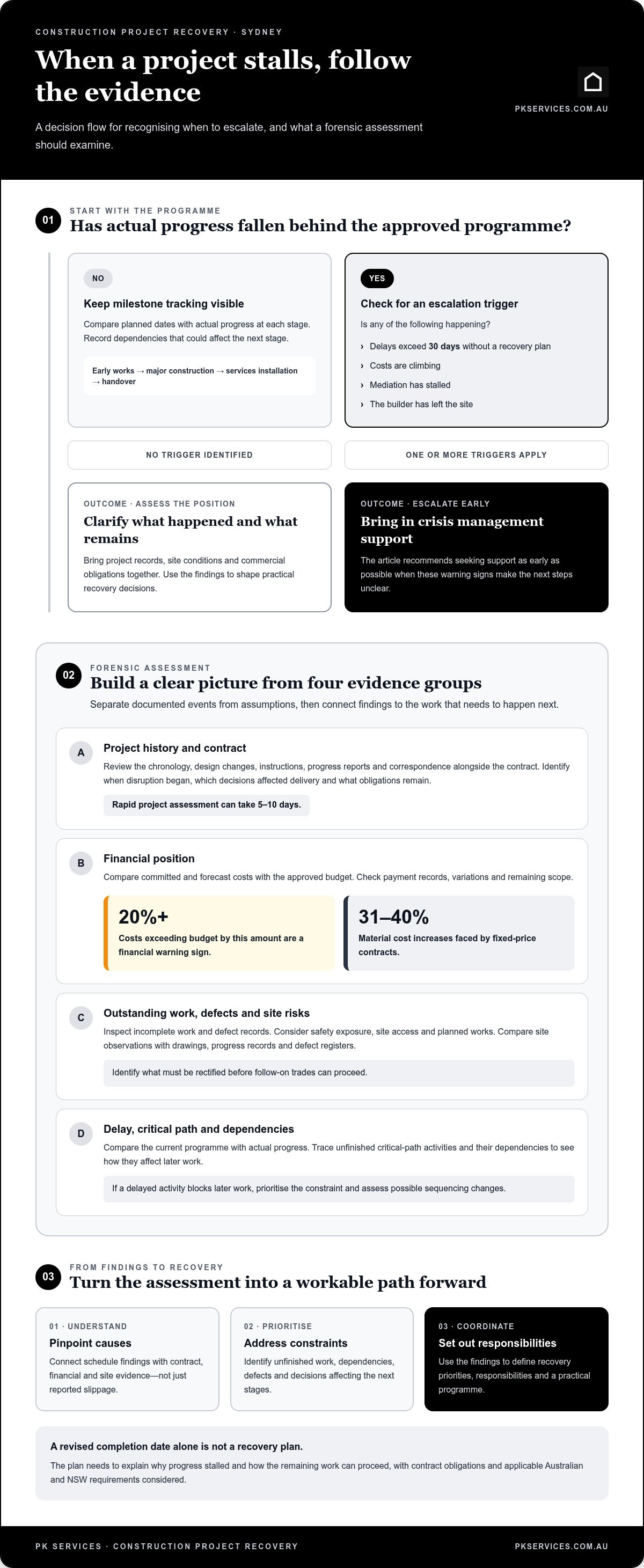
Waiting for certainty can cost a troubled construction project valuable time. Bring in a crisis management consultant as early as possible, especially when delays exceed 30 days without a recovery plan, costs are climbing, mediation has stalled or the builder has left the site. A construction project recovery plan in Sydney should start with a clear assessment of the project’s position and a practical programme for getting work back on track.
It’s understandable to focus first on the immediate disruption. But a recovery plan needs more than a new completion date: it must address why progress has stalled and set out how the remaining work can proceed.
This article explains when crisis management support may help and how a forensic assessment can clarify project history, contracts, finances and outstanding work. You’ll also learn how programme development turns those findings into recovery priorities, responsibilities and a workable path forward.
Key Takeaways
- Compare planned milestones with actual progress to pinpoint where the programme has slipped and what needs attention first.
- Bring together project records, contract obligations, financial position and outstanding works to understand the causes of distress.
- Use crisis management support when stalled mediation, rising costs or a builder leaving site make the next steps unclear.
- Turn assessment findings into a practical recovery programme, with clear priorities, responsibilities and coordinated support for the work ahead.
Construction milestones and completion dates
For a Sydney project under pressure, compare the approved programme with site progress at each stage. The gap between planned and completed work helps show where the schedule needs attention.
Location, start dates and budgets add context. They help distinguish a delayed milestone from a wider programme issue across infrastructure, hospital or transport works.
Construction milestone tracking
Track progress against defined stages, such as early works, major construction, services installation and handover. For each milestone, compare the planned date with actual progress and record dependencies that could affect the next stage. This makes slippage visible and helps teams identify work that needs coordination before it holds up other activities.
The Garden Island Critical Infrastructure Recovery Project in Sydney shows why stage-level tracking matters. Stage One construction began in October 2018 and was completed in June 2021. Stage Two construction commenced in 2019. Recording these milestones separately gives a clearer picture than treating the whole project as one continuous block of work.
Expected completion dates
A completion date should reflect remaining activities, their sequence and dependencies, not simply repeat an earlier target. Compare current progress with the programme, identify unfinished work, then assess its effect on later milestones. This can produce a more useful forecast and show which schedule changes need attention first.
The Garden Island project was expected to be completed in December 2023. That date is a historical planning expectation, not a current forecast. These figures illustrate why milestone reviews should consider each stage’s scope and progress, rather than treating the full budget or completion date as a single measure.
Location and project type also shape the review. For any construction project recovery plan in Sydney, use the project’s actual milestones, scope and dependencies to build a grounded view of completion, rather than relying on a headline date alone.
Forensic assessment of project history, contracts, finances and works
A forensic assessment builds a clear picture of what has happened and what remains. It connects project records, site conditions and commercial obligations to practical recovery decisions.
A useful assessment examines records, site risks and the contractual position, then explains the findings clearly. To assess delay, compare actual progress with the programme and trace how unfinished critical-path activities affect later work.
Project history and contract review
Review the project chronology, design changes, instructions, progress reports and correspondence alongside the contract. This helps identify when disruption began, which decisions affected delivery and what obligations remain. A rapid project assessment can take 5-10 days. The review should distinguish documented events from assumptions, so the recovery team can focus on causes rather than symptoms.
Financial assessment and outstanding defects
Compare committed and forecast costs with the approved budget, then check payment records, variations and remaining scope. Costs exceeding budget by 20% or more are a financial warning sign. Fixed-price contracts faced material cost increases of 31-40%. Pair that review with an inspection of incomplete work and defect records, identifying what must be rectified before follow-on trades can proceed.
Risk, delay and cost assessment
A useful risk assessment links each delay or cost pressure to its cause, effect and next decision. Compare the current programme with actual progress, then trace unfinished critical-path activities and their dependencies. If a delayed activity blocks later work, prioritise the constraint and assess possible sequencing changes. A western Sydney upgrade, for example, may need separate reviews of access, incomplete work and remaining costs.
Choose a consultant who can connect schedule findings with contract and site evidence, not just report slippage. The assessment should also consider safety exposure and outstanding defects before recovery actions are agreed.
Relevant laws, contracts and WHS rules
Australian and NSW legal requirements, the signed contract and applicable work health and safety (WHS) rules shape recovery decisions. Review contract notices, responsibilities, variations and dispute provisions alongside safety exposure, site access and planned works. Identify which obligations affect proposed changes, without treating a revised programme as a substitute for contract administration.
For Sydney asset surveys, compare site observations with drawings, progress records and defect registers. This helps separate visible condition issues from schedule or contract concerns. Where site capacity is the constraint, trades and contractor support may form part of the recovery response.
Recovery services for developers, lenders, contractors and insurers
Developers, lenders, contractors and insurers need a shared view of project status, obligations and immediate priorities. Recovery work can combine document review, contract administration and physical project recovery.
Contract and design documentation review
Review the contract, design documentation, correspondence, variations and progress records together. This can reveal mismatches between documented scope and work on site, clarify responsibility for unresolved items, and show where decisions or approvals have stalled. For a public facility, connect outstanding design decisions with the work sequence so proposed actions address both project delivery and contractual responsibilities.
Project costs and contract awards
Compare the awarded amount with the forecast, then examine scope, variations and remaining work. A Southern Sydney industrial redevelopment tender was awarded at 83% of its forecast amount. That gap makes it important to understand what the tender covered and whether later cost pressures relate to scope, delivery or unresolved approvals. Cost comparisons are useful only when they use consistent scope and assumptions.
Developers may need a clear route to restart stalled work. Lenders and insurers may need documented progress, risks and outstanding obligations. Contractors need coordinated decisions and a workable scope. Contract administration can help record decisions, manage correspondence and track agreed actions. Superintendent functions can support oversight of work and progress under the project arrangements.
Recovery may also bring together mediation, demarcation reports, contract administration and physical works. In the Southern Sydney example, approval processes were 24 months behind. Approvals followed six months after the recovery team took over coordination. The sequence illustrates how identifying approval dependencies can guide recovery priorities, rather than treating every delay as a site productivity problem.
For each stakeholder, define who owns the next decision, what evidence supports it and how it affects delivery. A shared action register can connect contract matters, design responses and site tasks. This helps developers, lenders, contractors and insurers work from the same project picture as recovery activities move forward.
Programme development and project recovery
A recovery programme turns assessment findings into a workable sequence of decisions and site activities. It should show what can restart, what remains blocked and how progress will be tracked.
Start with the remaining scope, then group work by location, trade and dependency. Identify approvals, design decisions, access and materials that could hold up the next task. A northern district project, for example, may need separate work fronts so available activities can progress while another area awaits a decision. Assign an owner and clear status to each constraint.
Next, build the sequence around achievable activities, not simply the original target date. The stabilisation and recovery planning stage is estimated at 10-15 days. Use that period to turn assessment findings into priorities, responsibilities and a revised programme. Link each activity to its predecessor, identify critical dependencies and agree how changes will be recorded.
- Set out outstanding work and the evidence needed to close each item.
- Sequence tasks around access, approvals, design decisions and trade availability.
- Assign responsibility for each action and identify decisions that could block progress.
- Compare actual progress with the revised programme and update constraints regularly.
Construction delays exceeding 30 days without a recovery plan are a schedule warning sign. That threshold should prompt a closer look at the cause, not an automatic assumption that every task needs acceleration. Check whether the delay affects dependent work, then focus recovery actions on the activities that control the next milestone. A changed sequence must also account for the work still outstanding.
Engage a construction crisis-management consultant as early as possible, while there is still room to coordinate decisions and work fronts. A clear programme gives developers, contractors and other stakeholders a shared view of actions and progress. For support turning project priorities into coordinated delivery, discuss construction project recovery support.
PK Services: Business Consulting
PK Services helps construction businesses turn recovery priorities into coordinated next steps through Business Consulting. This can be useful when project pressures affect operational decisions, site resources or delivery coordination.
Where a site has essential trade or contractor gaps, PK Services also provides Trades & contractor services. Coordinating these needs with project priorities can help keep the work sequence connected. PK Services can manage the wider process from start to finish.
Share the project’s current challenges and the decisions holding progress back. Contact PK Services to discuss the next step.
Make the next project decision with clarity
A stalled project needs a deliberate next move, not another date added to the programme without a clear basis. Use the assessment to identify the decision that will unlock progress, who needs to act and what information they need. Then set a review point to see whether the agreed actions are moving the work forward.
A construction project recovery plan for Sydney should be a working guide shaped around the project’s real constraints and updated as decisions are made. It gives your team a practical way to stay focused as conditions change.
PK Services can help you consider the next step for your construction project. Contact PK Services about project recovery to start a conversation. A considered next move can put your team in a stronger position to progress with purpose.
Frequently Asked Questions
When should I bring in a crisis management consultant?
Bring in support when project decisions are stalled, responsibilities are disputed or the current delivery approach no longer addresses the underlying problem. A builder leaving site, unresolved design decisions or repeated changes to the completion forecast can signal that independent coordination would help. Early involvement allows time to clarify decision-makers, organise the available evidence and focus on the issues preventing work from progressing.
What is a construction project recovery plan and when is one needed?
A construction project recovery plan in Sydney is a practical set of actions for stabilising delivery and guiding the remaining work. It’s useful when the original approach cannot address delays, resourcing gaps, defects or unresolved decisions. The plan should connect each action to an accountable person and a project outcome. For example, a delayed design decision needs an owner and a clear path to resolution.
What steps should a construction project recovery plan in Sydney include?
Start by agreeing the project’s immediate priorities with the people responsible for delivery. Then confirm outstanding work, identify needed decisions or resources, assign action owners and set review points. Record changes and unresolved constraints in a shared action register. This helps the team distinguish urgent work from issues that can wait and gives each meeting a clear purpose: resolve blockers, confirm actions and adjust priorities.
How to recover a delayed construction project under an AS 4000 or AS 2124 contract?
Begin with the executed contract and its project-specific amendments, then map the delay against relevant notice, time, variation and dispute provisions. Keep a dated record of events, instructions, impacts and mitigation actions. The standard form alone doesn’t establish the project’s full position, so relate each issue to the signed documents and actual circumstances. Seek advice from a construction contract professional before taking a step that could affect contractual rights.
How to prepare a construction project recovery schedule and realistic completion date?
Build the schedule from verified remaining work, not the original target date. Break the outstanding scope into activities, confirm dependencies and identify the access, design, approvals and trade inputs each task needs. Check the sequence with the people doing the work, then update assumptions during progress reviews. A completion forecast is more useful when it shows the constraints and decisions behind the date, not just the date itself.
What cost-control and cash-flow measures help recover a construction project?
Compare committed spending with forecast costs and separate approved scope from unresolved variations. Review upcoming payment obligations against expected receipts, then flag timing gaps that could interrupt work or supplier commitments. Track costs by work package to make emerging overruns easier to locate. Pair each proposed saving with its effect on scope, quality and delivery, rather than cutting expenditure without understanding what the change could disrupt.


