

Lean construction succeeds through changed team habits, not by introducing a new planning template. A lean construction implementation consultant in QLD can help teams build those habits through facilitated collaboration, Last Planner practices and continuous improvement. The focus is on making planning more reliable and helping people solve constraints together.
That takes more than asking site teams to adopt a process. People need to understand how new ways of working benefit their projects, contribute to planning and learn from what gets in the way. Effective facilitation matters because culture change depends on guiding these conversations and translating them into daily action.
This article explains how consulting can support cultural change, collaborative planning and ongoing improvement on construction projects across Queensland. It covers what implementation involves, how to approach the work and how experienced facilitation can help teams put lean principles into consistent practice.
Key Takeaways
- Make cultural change practical by involving teams in shaping new ways of working and addressing barriers as they arise.
- Use Last Planner collaboration to surface constraints early, agree on workable commitments and learn from missed plans.
- Build continuous improvement into project routines by reviewing outcomes and standardising practices that reduce rework.
- Choose facilitation that connects lean methods to the people, planning needs and project conditions on your site.
Change management and cultural change
Lean change takes hold when people see how new practices improve their work. Start by mapping how decisions, handovers and problem-solving currently happen on site. Then involve supervisors, tradespeople and project leaders in identifying friction points. This makes the change specific to the project, rather than a process imposed from above. Lean principles focus on maximising value and reducing waste without compromising quality or safety.
Culture shifts through repeated actions. Leaders can model the change by raising issues early, asking what is blocking work and treating missed commitments as opportunities to learn. If a late design decision delays framing, for example, the team can trace the cause, agree who will resolve it and adjust the next planning cycle. This builds shared responsibility instead of blame. Engineering and site teams need a shared view of priorities to make the change stick.
Performance measures help teams assess whether new habits are working. Choose measures tied to project goals, such as completed commitments, rework, unresolved constraints or handover delays. Review them at agreed intervals, discuss causes and assign a clear next action. Studies cited by Lean Construction Australia and New Zealand report that almost half of projects using lean construction tools and processes are completed under budget. This supports measuring outcomes, not promising the same result for every project.
Lean Visual Management makes priorities and problems visible where work happens. A site board can show upcoming tasks, owners, constraints and decisions requiring action. Keep it current, use clear labels and review it with the people doing the work. A useful sequence is to record the issue, name its owner, set the next action and update its status. This gives the team a shared reference point and helps managers address barriers before they disrupt planned work.
Christina Levinson designs, implements and evaluates strategies to help individuals, teams and organisations meet and exceed their goals, supporting purposeful change across project teams.
Collaborative Planning and Last Planner methodology
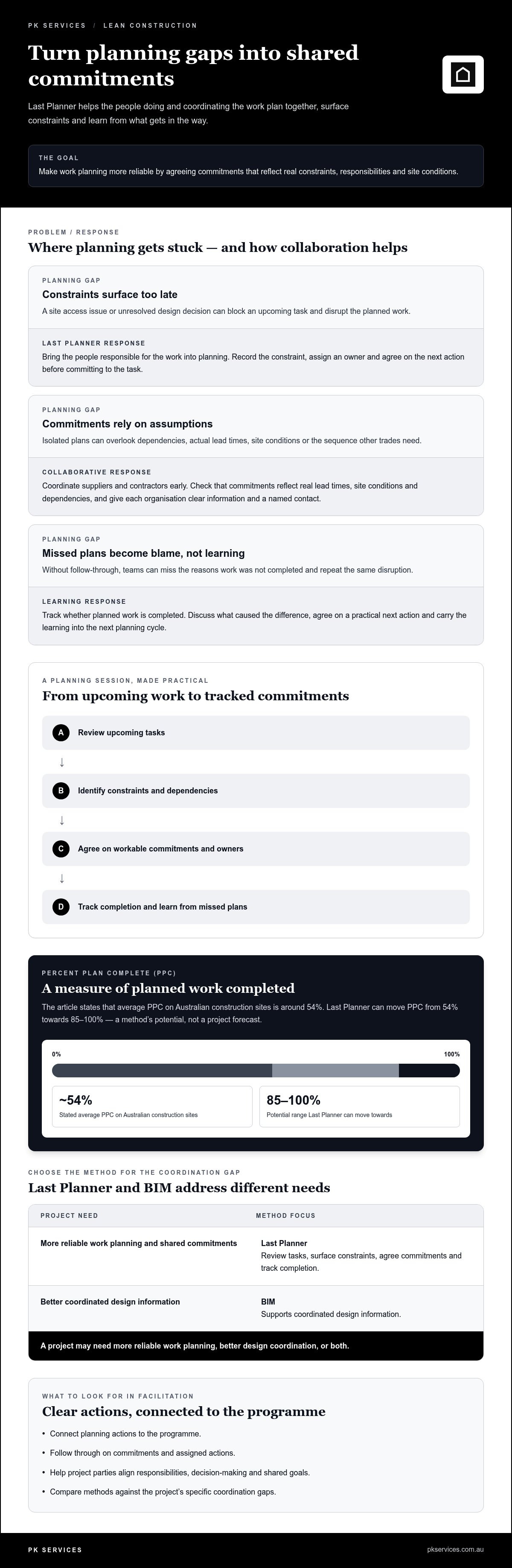
Last Planner turns project planning into shared commitments, while BIM supports coordinated design information. They can work together, but address different needs. Compare them by asking whether the project needs more reliable work planning, better design coordination or both.
Facilitating collaborative planning
Last Planner brings the people responsible for doing and coordinating work into planning. Teams review upcoming tasks, identify constraints, agree commitments and track whether planned work is completed. The stated average Percent Plan Complete on Australian construction sites is around 54%; Last Planner can move PPC from 54% towards 85-100%. Treat that range as a method’s potential, not a project forecast.
During a planning session, a contractor might flag that site access or a design decision blocks an upcoming task. The team records the constraint, assigns an owner and agrees on the next action before committing to the work. Assess facilitation by how clearly it connects those actions to the programme and follows through on commitments. Collaborative contracting facilitation can also help project parties align responsibilities, decision-making and shared goals within the contract structure. That can make collaboration more practical than relying on contract language alone.
Building supply-chain collaboration
Supply-chain collaboration brings suppliers and contractors into planning early enough to coordinate materials, deliveries and work sequences. A subcontractor might identify that a delivery plan conflicts with site access or installation timing. The team can then adjust the sequence before the issue disrupts other trades.
Look for a process that gives each organisation clear information, a named contact and a way to raise constraints. Check that commitments reflect actual lead times, site conditions and dependencies, rather than assumptions made in isolation. This helps teams find efficiencies across handovers, not just within individual work packages. A lean consultant comparison should consider Last Planner for reliable commitments, BIM for shared design coordination, and other methods against the project’s specific coordination gaps.
Where trade capacity is a planning constraint, trades and contractor support can help address workforce gaps within construction delivery.
Continuous improvement
Continuous improvement turns project experience into practical changes for the next work cycle. Start with a specific issue, such as repeated rework on a services installation. Bring the people involved together to trace its cause, agree on one change and assign responsibility. Then review whether the change improved the outcome. This keeps learning connected to site work instead of treating it as a separate technical exercise.
Lean construction tools are associated with improved profitability: 64% of projects using them report this outcome. Treat that figure as context, not a forecast for an individual project. To make progress visible, compare relevant measures over time, such as rework, material waste, task completion or delays at handover. Choose measures teams can influence, record the starting position, and review changes alongside the conditions that shaped results.
Make learning a regular part of project routines. After a work package, ask what was planned, what happened and what caused the difference. If a delivery arrives before the work area is ready, for example, identify the planning or coordination issue. Agree on a change to the sequence, update responsibilities and capture the lesson for the next team. This makes continuous improvement a shared practice across the construction sector.
Standardisation can reduce avoidable variation. Compare materials, designs and construction methods across similar work, then document the approach that supports reliable delivery. A standard should guide the task without disregarding project conditions. Review it when technical requirements, site access or sequencing change. If the same issue returns, revisit its cause rather than adding another workaround. Over time, teams can build a clear record of decisions, outcomes and improvements, making useful knowledge easier to apply to future work.
Standardising materials, designs and construction methods can help reduce inefficiencies and errors. Use this as a basis for deciding which practices should remain consistent across similar work. Keep each standard relevant to the task it supports, and reconsider it when the method or materials need to change. Recording the reason for a revision helps keep the improvement goal clear: reducing inefficiencies and errors.
Facilitator’s lean construction consulting experience
Facilitation experience helps connect lean processes with project realities and team behaviour. Assess the consultant’s practical approach, relevant experience and ability to help your team apply changes.
Consulting experience and services
Consultants may assess current processes, facilitate planning, support team learning and help track project outcomes. Christina Levinson has over sixteen years’ experience as an organisational development and lean consultant. Moein Varaei helped a government agency save A$900 million through value engineering and supported a consultancy vice president to put an A$18 billion project back on track. Consider how a lean construction implementation consultant in QLD would apply experience to your project’s needs.
Australian training options include the Lean Construction Fundamentals course, available online from 1 January to 31 December. Engineers Australia members receive a 15% discount on selected workshops and training. Training supports learning; assess certification separately from a consultant’s implementation experience.
Implementation process and typical timeline
Implementation often starts by clarifying project goals, existing processes and team constraints. A facilitator can then help select practices, introduce them into project routines and review results. Timing depends on project scope, team readiness and the changes involved, so agree on milestones that fit delivery needs rather than assume a fixed duration. A lean construction implementation consultant in QLD can structure these steps around your project.
Lean methods don’t replace Queensland approvals, safety obligations or contract responsibilities. Consulting fees depend on project scope and the support required; pricing is provided after a quote request.
Queensland case studies and results
For projects in Brisbane and regional Queensland, look for case studies that explain the challenge, intervention and measured outcome. Consider the project conditions and facilitator’s role, not just the result. The Queensland Lean Construction ANZ Council meets on the third Wednesday each month at QUT Gardens Point, providing a local industry connection.
For examples elsewhere in Australia, apply the same questions about context and evidence. To discuss how project delivery needs can be addressed, discuss your construction project requirements.
PK Services: Business Consulting
PK Services provides Business Consulting for construction businesses looking to strengthen project delivery, improve operations or put better processes into practice. Turn to the team when planning challenges connect with wider business needs, or when site delivery requires additional trade and contractor support.
From operational advice to trades and contractor services, PK Services tailors solutions to the project. The team can also manage the entire process from start to finish, helping bring the moving parts of construction delivery together. To take the next step, outline your project priorities, current challenges and the support your team needs.
To discuss your construction project, contact PK Services or visit pkservices.com.au.
Set your next project improvement in motion
Culture change becomes meaningful when a project team turns an agreed idea into a working routine. Choose a current delivery challenge, define what a better outcome would look like and decide who needs to take part. This gives your first conversation with a lean construction implementation consultant in QLD a clear focus, grounded in your project’s realities rather than broad ambitions.
PK Services can help you identify a practical next step through Business Consulting, trades and contractor services, or end-to-end project management. The right fit depends on the challenge and the support your project needs. Bring your priorities and current constraints to the discussion, then shape a way forward together.
Start a conversation with PK Services about your project. A thoughtful first step can help your team build change into the way work gets done.
Frequently Asked Questions
Where can I find lean construction implementation consultants in Queensland (QLD)?
A lean construction implementation consultant in QLD helps project teams identify avoidable delays, handover gaps, rework and excess materials, then build practical changes into daily routines. For example, they might help a builder coordinate trade sequencing and review progress during site huddles. PK Services’ Business Consulting and end-to-end project management may suit firms seeking operational advice connected to project delivery across Queensland and New South Wales.
How do I choose a lean construction consultant in Queensland?
Choose a consultant whose approach fits your project, team and workflow challenges. Ask how they’ll observe site activity, involve subcontractors and track whether changes are working. Request a clear scope that sets out responsibilities, deliverables and how knowledge will be transferred to your team. For projects in Queensland or New South Wales, PK Services’ Business Consulting can provide practical support with construction operations.
Lean construction consulting fees and project costs in Australia
Consulting fees depend on project scope and the support required. Lean construction aims to maximise value and reduce waste; cited studies report that almost half of projects using lean tools finish under budget.


