

A fixed price is only as clear as the work and documents it covers. Useful fixed-price construction contract advice in QLD starts with this distinction: the agreed price applies to the defined scope, while allowances and authorised variations can affect the final amount. A fixed price does not automatically cover every condition or change that arises during construction.
It’s reasonable to expect a fixed-price contract to make costs easier to understand. The key is to look behind the headline figure at the plans and specifications, inclusions and exclusions, prime cost items, provisional sums, and the rules for changing the work.
This guide explains what the price covers, how allowances can change the total, and which contract terms deserve close attention. It also explains how the contract documents work together, helping you spot where the scope is clear and where the wording may leave room for confusion.
Key Takeaways
- Separate prime cost items for selected goods from provisional sums for work that cannot yet be accurately priced. The allowance and how it is adjusted can affect the final amount.
- A fixed price is clearest when the design, site conditions and deliverables are well defined. Match the price to the plans and specifications before relying on the headline figure.
- Review the signed contract’s special conditions, variation process and timing terms. Written variation notices should generally come before changed work begins, except where immediate action is needed for safety.
- Check which contract documents take precedence if details conflict. A clear hierarchy can help resolve differences between the quotation, plans and specifications.
1. Prime cost and provisional sum allowances
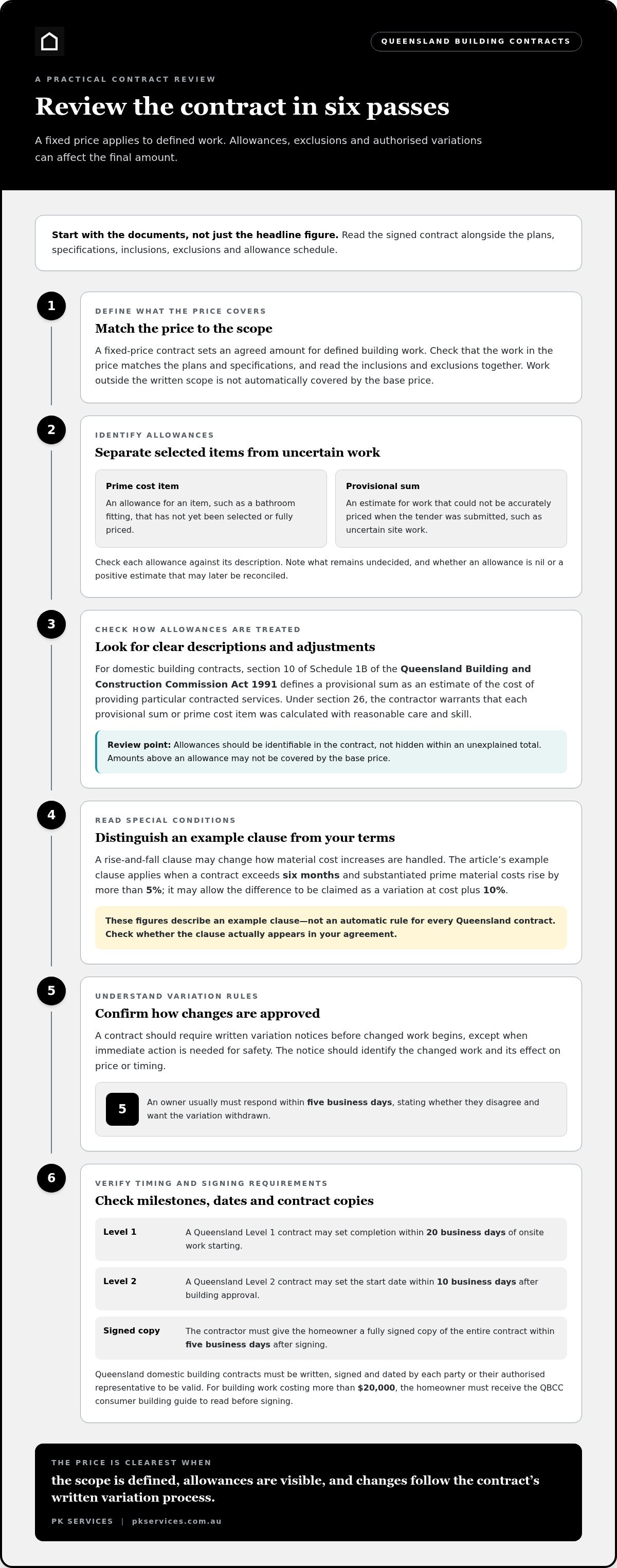
A fixed price can include allowances, so the contract total may not be the final cost for every item. A prime cost item is an allowance for an item, such as a bathroom fitting, that has not yet been selected or fully priced. A provisional sum covers work that could not be accurately priced when the tender was submitted. For example, uncertain site work may be listed as a provisional sum rather than as a firm amount.
For domestic building contracts, section 10 of Schedule 1B of the Queensland Building and Construction Commission Act 1991 defines a provisional sum as an estimate of the cost of providing particular contracted services. Under section 26 of Schedule 1B, the contractor warrants that each provisional sum or prime cost item was calculated with reasonable care and skill. These allowances should be identifiable in the contract, not hidden within an unexplained total.
What costs are excluded from a fixed-price building contract in Queensland? Costs outside the written scope, stated exclusions, and amounts above an allowance may not be covered by the base price. A change to the agreed work may also affect the total if it is handled as a variation under the contract. Read the inclusions, exclusions, and allowance descriptions together to understand what the price actually covers.
Check each allowance against its description and the item or work it relates to. The wording matters: a nil allowance differs from a positive estimate that may later be reconciled. Keep the allowance schedule with the plans and specifications, and note any item selection or work that remains undecided. This clarifies where the fixed price ends and an allowance begins.
2. What is a fixed-price contract?
A fixed-price contract sets an agreed amount for defined building work. In Queensland, a contract isn’t required for building work valued below $3,300, including labour, materials and GST. For higher-value work, a written contract can help clarify the arrangements. A fixed price suits a project with completed designs, understood site conditions and measurable deliverables.
Queensland domestic building contracts must be written, signed and dated by each party or their authorised representative to be valid. The contractor must give the homeowner a fully signed copy of the entire contract within five business days after signing. For building work costing more than $20,000, the homeowner must receive the QBCC consumer building guide to read before signing.
How do fixed-price and cost-plus building contracts compare in Queensland? A fixed price covers the defined work for an agreed amount, while cost-plus pricing adds a margin to costs. The QBCC reports that final costs under cost-plus contracts are often 50% to 100% greater than homeowners anticipated. A fixed price doesn’t, by itself, let a contractor recover unexpected cost increases from the principal.
What deposits and progress payments are permitted under Queensland building contract rules? The contract should set out the deposit and payment schedule, with progress claims tied to measurable construction milestones rather than forecasts. A fixed-price contract still carries risks: unclear scope, allowances, and changes can affect the final amount, while delays can disrupt timing and payment expectations.
What are the risks of fixed-price construction contracts for homeowners in Queensland? A price may appear firm while exclusions, allowances or changed work create additional costs; unclear milestones can also complicate payment. For disputes, compare the signed contract, plans, variation notices and payment records, then put the specific issue and requested resolution in writing. The Building Industry Fairness (Security of Payment) Act 2017 forms part of Queensland’s payment-law framework, but a contract dispute needs to be considered against its terms and the issue in dispute.
3. Contract review and special conditions
Read special conditions alongside the main terms, not as separate fine print. A rise-and-fall clause can change how material cost increases are handled. For example, one clause may apply when a contract exceeds six months and substantiated prime material costs rise by more than 5%. It may allow the difference to be claimed as a variation at cost plus 10%. Those figures describe an example clause, not an automatic rule for every Queensland contract. A review centred on fixed-price construction contract advice QLD should distinguish an example clause from a term actually included in your agreement.
What variations require written approval under Queensland building contracts? A contract should require written variation notices before changed work begins, except when immediate action is needed for safety. The notice should identify the changed work and its effect on price or timing. An owner usually must respond within five business days, stating whether they disagree and want the variation withdrawn.
Check the dates as carefully as the price. A Queensland Level 1 contract may set completion within 20 business days of onsite work starting. A Level 2 contract may set the start date within 10 business days after building approval. Compare these clauses with the construction sequence, then note how delays affect completion dates, notices and payment milestones.
How can I check a Queensland builder’s licence and contract before signing? Compare the builder’s name and licence details across the contract and related documents, then check them against QBCC records. Read the scope, exclusions, payment terms, and special conditions together. Confirm that the work described matches the project and that each party or authorised representative has signed and dated the contract. This fixed-price construction contract advice QLD approach keeps the focus on written terms, not verbal assumptions.
Before signing, mark any clause that changes the fixed price or schedule, including rise-and-fall terms. Resolve unclear wording in the contract rather than leaving it for a later conversation. Keep the final signed copy with its supporting documents. If a variation arises, retain its written notice and response with the project records.
4. Fixed-price scope and document hierarchy
A fixed price covers the work defined by the contract, not every expectation discussed during planning. The scope should describe the finished work clearly. For example, “install kitchen cabinets” leaves questions about cabinet type, handles, finishes, and installation details. A specification that names those elements gives both parties a more precise reference.
Check how the contract treats supporting documents. A quotation may form part of the contract alongside plans, specifications, and schedules. If the quotation describes one finish but the specification names another, the contract should state which document takes precedence. Without a clear hierarchy, different documents can point to different outcomes.
Review the documents as a connected set. Match each room or work area on the plans with the relevant specification and quotation item. Look for gaps, such as a plan showing an appliance while the written scope excludes its supply. Also flag descriptions like “standard finish” that do not define a specific product or result.
Make a simple comparison before signing. Note the work shown in each document, its exact description, and any conflict or omission. Ask for the contract documents to be corrected so the agreed scope is consistent throughout. Keep the final versions together, including any revised plan or quotation referred to by the contract. This helps distinguish included work from a later change.
The key takeaway is practical: don’t judge the fixed price from the quotation alone. Read the contract, quotation, plans and specifications side by side, then follow the stated precedence clause if wording conflicts. For support coordinating construction scope and delivery, discuss your construction project requirements.
PK Services: Business Consulting
PK Services supports construction businesses in Queensland and New South Wales with project coordination, practical business advice, and skilled trades and contractors to fill site gaps. Its Business Consulting can help identify operational pressures that affect delivery. Trades & contractor services can support workforce needs, while managing the entire process from start to finish helps coordinate project activities.
Turn to PK Services when the challenge goes beyond reading contract terms and involves organising people, work, and project delivery. This support complements careful contract review by helping construction businesses focus on scope, resources, and execution. For support with your construction project, contact PK Services or visit pkservices.com.au.
Make your next project decision with clarity
Use the contract review as a planning tool, not just a final check before signing. Write down the decisions that could affect delivery, who needs to make them, and when each is due. This gives your project team a practical starting point for aligning expectations before work moves ahead.
For fixed-price construction contract advice in QLD, focus your next conversation on the issues that matter most to your project. Clear priorities keep planning discussions specific and connect contract decisions with how the work will be delivered.
PK Services can help construction businesses consider project and operational needs through its consulting and construction support. Discuss your project with PK Services and take a considered next step with confidence.
Frequently Asked Questions
What is a fixed-price contract?
A fixed-price contract sets one agreed price for a clearly defined package of work. The amount is based on the contract scope, rather than a running tally of the builder’s actual costs. For example, a specified renovation can have a fixed price, while optional upgrades or changed work may need separate pricing under the contract’s variation process.
What is a fixed-price construction contract in Queensland?
In Queensland, a fixed-price construction contract is a written agreement setting the price and scope for construction work. Its practical value depends on how clearly the documents define the project. A developed design and known site conditions make it easier to price the work accurately. Check that the contract description matches the project you expect to be built.
What must a Queensland domestic building contract include by law?
Queensland domestic building contracts must be written, signed and dated by each party or their authorised representative to be valid. The contract should also clearly identify the agreed work and the documents that describe it, so the parties can understand what they signed. For work costing more than $20,000, the homeowner must receive the QBCC consumer building guide before signing.
What are Queensland contract thresholds and requirements for building work?
Contract requirements can depend on the value and nature of the building work. Work valued above $3,300 requires a contract known as a Level 1 contract. For work costing more than $20,000, the homeowner must receive the QBCC consumer building guide before signing. The builder must provide the fully signed contract within five business days.
How do provisional sums and prime cost allowances work in QLD contracts?
A prime cost allowance covers an item awaiting selection or final pricing; a provisional sum estimates particular contracted services that could not be accurately priced at tender. Section 26 of Schedule 1B of the Queensland Building and Construction Commission Act 1991 requires reasonable care and skill in calculating either allowance. Compare each allowance with its description before deciding whether it reflects the planned work.
Can a Queensland builder increase a fixed contract price, and when?
A builder cannot recover an unexpected cost increase from the principal solely because the builder’s costs rose. The contract may allow a price change through an agreed variation or a specific rise-and-fall clause. For changed work, written variation notices should generally be issued before work begins, except when immediate action is needed for safety. Read the clause and notice before agreeing to a changed amount.


