

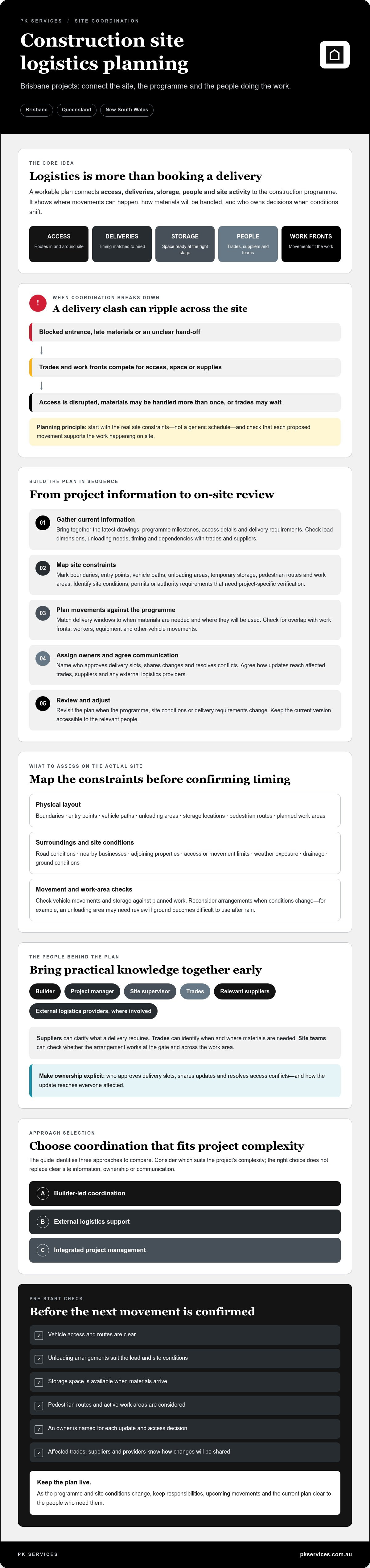
A delivery clash is rarely just a delivery problem. A blocked entrance, late materials or unclear hand-off can disrupt trades and work fronts across a site. Construction site logistics planning Brisbane projects need starts with these real constraints, not a generic schedule.
Access can change, and teams may be unsure who has the latest update. A useful plan connects the programme with vehicle access, delivery timing, people and work areas. It also names who is responsible, so suppliers and site teams know what’s expected and who to contact when conditions shift.
This guide covers how to build a plan from early project planning through on-site execution. It explains what to map, how to coordinate delivery windows and hand-offs, and how to make ownership and communication clear. It also outlines how to review the plan as the site, programme and access needs change. These principles are relevant to projects in Brisbane and across Queensland and New South Wales.
Key Takeaways
- Effective construction site logistics planning Brisbane connects access, deliveries, storage and work fronts to the project programme.
- Map site constraints and planned movements before confirming delivery timing, so logistics support the work happening on site.
- Compare builder-led coordination, external logistics support and integrated project management to find an approach that suits the project’s complexity.
- Use a pre-start checklist to clarify vehicle access, unloading, storage, pedestrian routes and who owns each update.
- Review the plan as the programme and site conditions change, keeping responsibilities and upcoming movements clear.
What construction site logistics planning Brisbane projects need to solve
A site logistics plan coordinates access, deliveries, storage, people and site activity so work can proceed in the right place and sequence. It connects the physical site to the construction programme. Construction logistics includes the movement of materials and equipment, but site planning goes further: it considers how those movements fit around workers, work fronts and changing site conditions.
That distinction matters. Booking a freight provider may arrange a vehicle and delivery time, but it doesn’t determine where the vehicle can enter, how it will unload or whether there’s space for the materials at that stage of the programme. Those decisions belong in the site coordination process, with clear hand-offs between the site team, suppliers and any external logistics providers.
Each plan should reflect the actual project. A compact site beside busy roads or neighbouring businesses has different access and storage limits from a larger site with more room to separate activities. Programme changes also matter. If several trades need the same work area, or materials arrive before there’s room to store them, the plan can create clashes instead of preventing them. Poor coordination can block access, lead to materials being handled more than once, or leave trades waiting for space or supplies.
Which site constraints should Brisbane project teams assess first?
Start with what the site can physically support. Record boundaries, entry points, vehicle paths, unloading areas, storage locations and pedestrian routes. Then check the surroundings, including road conditions, nearby businesses, adjoining properties and any site-specific limits on access or movement.
Assess weather exposure, drainage and ground conditions for the site rather than relying on broad assumptions. An unloading area that works in dry conditions, for example, may need reconsideration if the ground becomes difficult to use after rain. Mark constraints on a site plan, then check that proposed vehicle movements and storage won’t obstruct planned work.
Who needs to contribute to the logistics plan?
Involve the builder, project manager, site supervisor, trades and relevant suppliers early. Each brings a different perspective: suppliers know what a delivery requires, while trades can identify when and where materials are needed. A plan built without these inputs may look workable on paper but fail at the site gate.
Name the person who approves delivery slots, shares changes and resolves access conflicts. Agree how updates will reach the people affected, including external logistics providers where they’re involved. The goal of construction site logistics planning Brisbane teams can put into practice is not simply to schedule arrivals. It’s to connect decisions about access and movement with the programme and the work happening on site.
How to build a construction site logistics plan step by step
A practical approach to construction site logistics planning Brisbane teams can use follows a clear sequence: gather current information, map constraints, coordinate movements, assign owners and review the plan as the project changes. This keeps logistics connected to the programme rather than treating deliveries as separate bookings.
- Gather project information. Bring together current drawings, programme milestones, access details and known delivery requirements. Ask trades and suppliers about load dimensions, unloading needs, timing and dependencies.
- Map constraints. Mark access routes, unloading points, temporary storage and work areas. Identify which site conditions, permits or authority requirements need project-specific verification before relying on a proposed arrangement.
- Plan movements against the programme. Match delivery windows to when materials are needed and where they’ll be used. Check for overlaps with work fronts, workers, equipment and other vehicle movements.
- Assign owners and agree communication. Name who approves delivery slots, updates the plan and resolves conflicts. Set out how changes will reach affected trades, suppliers and any external logistics providers.
- Review and adjust. Revisit the plan when the programme, site conditions or delivery requirements change. Make sure relevant people can access the current version.
What information should the team collect before planning?
Use the latest available drawings and programme, then check that access details reflect conditions on the ground. Ask suppliers and trades for practical delivery information, not just an expected arrival time. A bulky load may need a particular unloading area, while a trade’s work may depend on materials arriving in sequence. Record assumptions that still need confirmation, including project-specific permit or authority requirements, and identify who will verify them.
How should delivery movements and work fronts be coordinated?
Map vehicle routes, delivery windows, unloading points and temporary storage against planned site activities. Sequence arrivals so one delivery doesn’t block another vehicle, interrupt work or leave materials in the way of an upcoming work front. If a delivery is late, changed or incomplete, the agreed contact should tell affected teams promptly and confirm the next step. That could mean adjusting the work sequence or checking a revised arrival time.
Logistics planning also connects to broader project decisions. A change to a work front can affect access, labour and delivery timing, so coordination needs to extend beyond the site gate. Full-cycle construction project management provides a broader way to connect planning and delivery. Where a team needs support linking project strategy with site execution, PK Services’ construction consulting may be relevant to discuss.
Which logistics planning approach suits your Brisbane construction site?
The right approach depends on the site’s constraints, the number of moving parts and the team’s capacity to coordinate them. For construction site logistics planning Brisbane projects, the aim is to match support to the work, not assume every site needs the same model.
| Approach | Control | Internal workload | Visibility and flexibility | Best fit |
|---|---|---|---|---|
| Builder-led coordination | High, with decisions kept within the site team. | Higher. The team coordinates suppliers, trades and changes. | Strong if updates are shared consistently; adaptable when an owner can respond. | Straightforward access and delivery needs, with enough team capacity. |
| External logistics-provider support | Shared. Control depends on the agreed transport or logistics scope. | Can reduce coordination effort for the tasks assigned to the provider. | Good visibility requires clear hand-offs; flexibility depends on the provider’s scope and arrangements. | Projects needing defined transport or delivery support. |
| Integrated project management | Coordinated across project decisions and site activity. | Supported through broader programme coordination. | Can connect logistics changes to work sequencing and wider project priorities. | More complex projects where logistics affects several work fronts. |
A transport provider handles the transport scope agreed with the project. That doesn’t automatically include work sequencing, site access decisions or coordination between trades. The site team still needs clear ownership of these wider project needs, even when an external provider is involved.
When can an in-house site team manage logistics planning?
Builder-led coordination can suit a site with straightforward access, predictable delivery needs and clearly separated work areas. Before choosing it, check that the team has time to coordinate suppliers and trades as the programme changes. Document responsibilities, including who updates delivery arrangements, and set regular reviews. Even a simple plan needs an owner and a reliable way to communicate changes.
When should a project team consider external coordination support?
Consider additional support if constrained access, several trades or frequent programme changes are putting pressure on the site team. Project management can help connect logistics decisions with broader delivery priorities rather than treating each delivery as a standalone task. Where sequencing affects planned quality checks, include those checks in the wider coordination discussion.
Choose the model that fits the project’s complexity and the capability already available. If you’re considering how project management could connect planning with site execution, construction project management support may be worth discussing for your project.
A practical Brisbane site logistics planning checklist
A checklist makes the plan usable at the gate and across the site. For construction site logistics planning Brisbane teams should record decisions in a current document, name an owner for each action and share updates with the people affected.
- Access: Confirm entry and exit points, vehicle routes and any site-specific access limits.
- Movements: Check planned vehicle movements against work areas and other scheduled activity.
- Unloading and storage: Confirm where each delivery will be received, unloaded and stored, and that the space will be available.
- People: Mark pedestrian routes and identify who will coordinate movements and communicate changes.
- Contacts and requirements: Keep current details for the builder, site leads, trades and suppliers. Verify authority, access, traffic management and workplace requirements for the specific site and activity. In Brisbane, check whether relevant road matters involve Brisbane City Council or the Department of Transport and Main Roads, and check out Acquired Awareness Traffic Management if your project requires professional planning for public road interfaces and permits.
What should the site team confirm before deliveries arrive?
For each delivery, check the agreed time, access route, unloading location, site contact and any handling or receiving requirements. Confirm the receiving area is clear and won’t conflict with scheduled work. If the timing, load or access arrangement changes, alert affected teams early, agree on the next step and record the revised plan where everyone involved can find it.
How should the plan change as the project progresses?
Review upcoming work fronts and access whenever the programme or site layout changes, and before deliveries that depend on a particular area being available. Record disruptions and recurring clashes, then adjust sequencing, responsibilities or communication as needed. If a new subcontractor’s work affects the plan, consider their capability and coordination needs using this construction subcontractor vetting guidance.
Set a review rhythm that fits the project. Revisit the plan when milestones shift, delivery needs change or site conditions affect agreed arrangements. Keep one current version, note what changed and tell the relevant people. This helps prevent teams from working from different assumptions.
Broader project coordination can also help connect logistics decisions with delivery priorities. PK Services can discuss your project coordination needs.
Bring site logistics planning from strategy to Brisbane site execution
A useful plan informs decisions on site. Assess project conditions, connect movements to the programme, make ownership clear, then review and adapt as work progresses. This keeps construction site logistics planning Brisbane projects grounded in delivery realities, rather than leaving the team with an early document that no longer reflects the job.
Consulting and end-to-end project management can connect planning decisions with execution across the project lifecycle. This can be useful when access arrangements affect the programme or site changes need to be considered alongside wider project priorities. If a project has a capability gap, trades and contractor services may also be relevant. These services address site capability needs, not freight or transport.
What should you prepare before seeking project support?
A clear brief helps a project team discuss the right issues from the outset. Bring together:
- Project stage and location: Explain where the project stands and identify the Brisbane site.
- Programme constraints: Note key milestones, sequencing pressures and upcoming changes.
- Access challenges: Describe known limits affecting site entry, vehicle movements or delivery arrangements.
- People already involved: List the trades, suppliers and project stakeholders, including who currently owns coordination.
- Open decisions: Identify coordination gaps or specific issues the team needs help resolving.
You don’t need to have every answer. A concise picture of what’s known, what’s changing and where decisions are getting stuck gives the discussion a useful starting point.
How can PK Services support planning through delivery?
PK Services provides construction consulting and project management, supporting projects from strategic planning through to on-site execution. With over 15 years of construction industry experience, the business can help connect project-level decisions with practical coordination needs. The right scope depends on the project and its requirements, so discuss the details rather than assuming a particular service or outcome.
Bring your programme, site constraints and current coordination questions to the conversation. This gives the team a clear basis to discuss whether its support fits your project in Brisbane.
Turn your logistics plan into coordinated site action
A strong plan connects site access, delivery movements and work fronts to the construction programme. Clear owners help everyone know who approves changes, shares updates and resolves clashes. Regular reviews keep the plan useful as site conditions and project needs evolve.
Effective construction site logistics planning Brisbane teams can put into practice isn’t just about arranging deliveries. It links decisions across the project, from early planning through on-site execution. The right level of coordination depends on site constraints, project complexity and the capability already in place.
PK Services brings over 15 years of construction industry experience, with consulting and project management support across planning and execution. Trades and contractor services may also help address relevant site capability needs. Discuss the project stage, access challenges and coordination priorities to identify what support may fit.
Discuss your Brisbane construction project with PK Services to explore support for a more connected plan and coordinated site team.
Frequently Asked Questions
What is construction site logistics planning?
Construction site logistics planning coordinates how people, materials, vehicles and site activities work together throughout a project. The plan typically sets out access, delivery timing, unloading and storage areas, responsibilities and communication processes. It should reflect the site layout and construction programme, rather than rely on a generic template. Treat it as a working document and review it when site conditions, work sequencing or delivery requirements change.
How do you plan construction site logistics in Brisbane?
For construction site logistics planning Brisbane projects, start with current project information and a site-specific assessment of access, boundaries, surrounding activity and planned work. Match vehicle movements, delivery windows, unloading and storage to the programme and work fronts. Assign owners for approvals, updates and resolving issues. Check which local authority and workplace requirements apply to the specific site and activities, then update the plan when arrangements or conditions change.
Who is responsible for construction site logistics planning?
Responsibility depends on the project structure and the roles the team has agreed. A builder, project manager or site manager may lead planning, with trades, suppliers and logistics providers contributing details about their needs. Record who approves delivery arrangements, communicates changes and resolves conflicts. Don’t assume a transport provider owns wider site coordination. Confirm the provider’s agreed scope and make sure someone on the project team remains responsible for the other planning tasks.
What should a construction site logistics plan include?
Include a site layout showing access, vehicle movements, unloading and storage areas, plus delivery timing and planned work fronts. List key contacts and clarify who owns approvals, updates and escalation. Set out how the team will communicate changes or clashes. Include safety and authority considerations only after checking what applies to the particular site and activity. Keep the plan clear, current and accessible to the people who need to use it.
How often should a construction site logistics plan be reviewed?
Review the plan before work starts and whenever a change could affect access, deliveries, site layout or sequencing. Include upcoming movements and work fronts in regular project coordination so conflicts can be identified early. There’s no single review frequency that suits every project. Set a rhythm that fits the programme and site conditions, record revisions, notify affected parties and confirm they understand the updated arrangements.
Should a construction project use a logistics provider or a project manager?
It depends on the project’s needs and the scope assigned to each role. A logistics provider may handle agreed transport or delivery activities, while a project manager coordinates broader project requirements and stakeholders. A project may use both, or its internal team may manage the work. Compare options against site complexity, team capacity and communication needs. Agree responsibilities in advance so important coordination tasks don’t fall between parties.


