

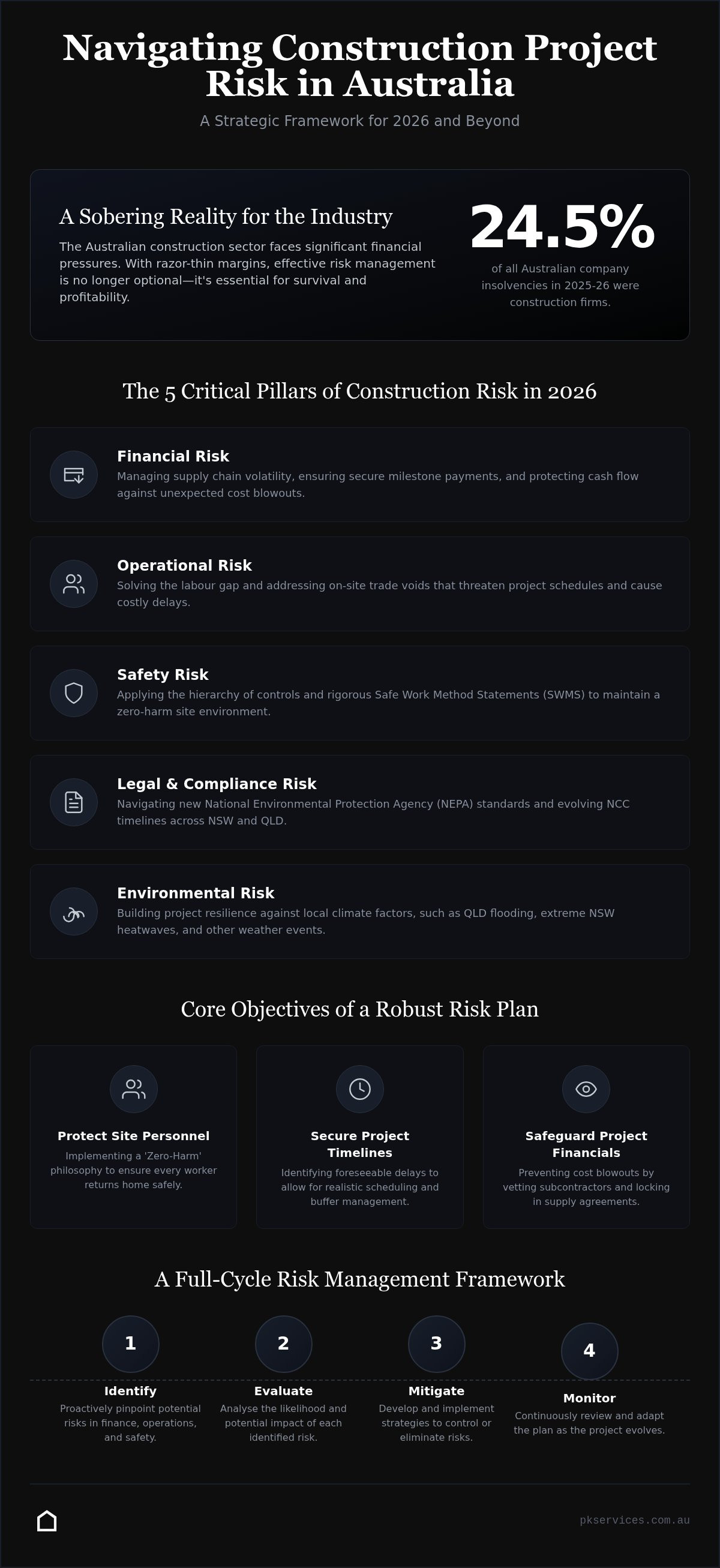
Did you know that construction firms accounted for 24.5% of all Australian company insolvencies in the 2025-26 financial year? It's a sobering reality for project managers across NSW and QLD who are constantly juggling trade voids and volatile supply chain costs. You're likely feeling the pressure of increasingly strict WHS compliance while trying to keep your project on track and under budget. Mastering construction project risk management Australia is no longer just a box-ticking exercise; it's the primary driver of your project’s success.
We understand that the current landscape feels like a moving target. With the establishment of the National Environmental Protection Agency (NEPA) in July 2026 and deferred NCC 2025 adoptions, staying ahead requires more than just grit. This guide provides the strategic frameworks and local insights you need to protect your margins and ensure site safety. We'll show you how to turn these complex regulatory burdens into streamlined operational excellence.
In the following sections, we'll explore specific strategies for filling labour voids, navigating the latest environmental reforms, and building a resilient site culture. You'll gain the clarity needed to deliver projects seamlessly while maintaining a zero-harm environment for every worker on the ground. Let's redefine how you approach risk to secure your project's future.
Key Takeaways
- Master the core principles of construction project risk management Australia to balance commercial viability with strict WHS duties across NSW and QLD.
- Protect your profit margins by identifying financial risks early, focusing on supply chain volatility and secure milestone payments.
- Solve labour shortages and trade voids on-site through a strategic approach to procurement and rigorous subcontractor vetting.
- Shift from basic compliance to a proactive risk culture where safety performance directly correlates with your project's bottom line.
- Implement a full-cycle framework that leverages 15 years of expertise to rediscover excellence from pre-construction planning to site execution.
What is Construction Project Risk Management in Australia?
At its core, construction project risk management Australia is the systematic process of identifying, evaluating, and mitigating uncertainties before they impact your site. It isn't just about avoiding accidents. It's about protecting every facet of your operation from unpredictable supply chains to labour shortages. In 2026, the industry has shifted. We've moved away from reactive "firefighting" toward sophisticated, data-driven forecasting. This evolution allows project managers to anticipate trade voids and material price spikes months in advance.
The Australian context is particularly demanding. You're required to balance stringent Work Health and Safety (WHS) duties with the commercial reality of project viability. With construction companies representing 24.5% of all insolvencies in the 2025-26 financial year, the margin for error is razor-thin. Adopting fundamental Risk Management Principles ensures that safety and profitability aren't competing interests; they're mutually inclusive. Modern sites now treat the 'Zero-Harm' philosophy as the baseline, not the ceiling.
The Core Objectives of a Risk Plan
A robust risk plan serves as a roadmap for project stability. It moves beyond simple compliance to achieve three primary goals:
- Protecting Site Personnel: Implementing a 'Zero-Harm' philosophy ensures every worker returns home safely. This is the non-negotiable standard for modern Australian sites.
- Securing Timelines: Identifying foreseeable delays, such as trade voids or weather events, allows for realistic scheduling and buffer management.
- Safeguarding Financials: Preventing cost blowouts by vetting subcontractors and locking in supply agreements protects the firm's bottom line.
Australian Standards and Frameworks
Reliable risk management relies on proven structures. The AS/NZS ISO 31000:2018 provides the national benchmark for managing uncertainty. While this standard offers a high-level framework, its application must be tailored to local NSW and QLD building codes. Regulators like SafeWork NSW and Workplace Health and Safety Queensland (WHSQ) set the bar for site execution. In 2026, these bodies have increased their focus on proactive planning. They expect more than a signed form; they demand a living strategy that evolves with the project. Aligning your site-wide WHS management plan with these standards is essential, especially for projects exceeding the $250,000 threshold where a principal contractor and formal plan are mandatory.
The 5 Critical Pillars of Construction Risk in 2026
Effective construction project risk management Australia requires a holistic view of five core pillars. These aren't isolated issues. They're interconnected threats to your project's health, ranging from physical site safety to the digital resilience provided by managed IT services like JP Technical. In 2026, the complexity of these risks has reached a new peak, demanding a more sophisticated approach to oversight. Failure in one area often triggers a domino effect across the entire site.
Navigating Labour Shortages and Trade Voids
The labour gap is the primary operational risk in 2026. Skilled trades are scarce, and competition for quality contractors is fierce across the eastern seaboard. Securing reliable, skilled tradespeople requires a proactive procurement strategy that goes beyond the lowest bid. Trade voids are the failure to fill essential on-site roles. When these gaps occur, project momentum stalls and overheads climb. Addressing this requires a partner who can fill trade voids with proven professionals, ensuring the project lifecycle remains uninterrupted.
Managing Supply Chain and Financial Volatility
Global material costs continue to squeeze local Australian margins. Contracts must be resilient to survive these fluctuations. You should structure agreements to mitigate unforeseen expenditure through escalation clauses or strategic early procurement. Protecting your profit is about more than just cutting costs; it's about smart financial oversight. For deeper insights, explore our guide on Improving Construction Business Profitability NSW.
Effective construction project risk management Australia involves constant monitoring of these five pillars. The establishment of NEPA on 1 July 2026 has introduced tougher federal oversight, while the deferred NCC 2025 adoption in NSW and QLD (now set for 1 May 2027) creates a fragmented regulatory landscape. If you're looking to streamline your operations, we can help you manage the entire process from strategy to site execution.
WHS Compliance vs. Strategic Risk Mitigation
Many firms view Work Health and Safety (WHS) as a hurdle to be cleared. They treat it as a series of forms to be signed and filed away. In the context of construction project risk management Australia, this "box-ticking" approach is a dangerous gamble. In 2023-24, the Australian construction industry recorded 17,600 serious workers' compensation claims with a median payout of $20,000 per claim. These aren't just safety statistics; they're direct hits to your profit margin. Beyond the immediate payout, poor safety records lead to higher insurance premiums and potential site shutdowns that cripple your schedule.
Strategic risk mitigation treats safety as a business asset rather than a liability. It identifies the blind spots that a standard WHS inspector might miss, such as the ripple effect of site congestion on worker fatigue. High-performing projects in 2026 use safety performance as a primary driver of ROI. By lowering your incident rate, you reduce the average WorkSafe premium rate, which sits at 1.8% of rateable remuneration for the 2026-27 period. Site leadership is the catalyst here. Leaders must enforce protocols not as a chore, but as a commitment to professional excellence.
Beyond the SWMS: Creating a Proactive Culture
Safe Work Method Statements (SWMS) are the floor, not the ceiling, of risk management. A document doesn't save lives on a busy site; a proactive culture does. Engaging your tradies in the risk identification process is the fastest way to get genuine buy-in. When a sparky or a chippie feels responsible for the site's collective safety, they become your most effective risk sensors. Professional site management ensures these standards never slip, even during the high-pressure final stages of a build. It's about moving from "have to" to "want to" when it comes to site safety.
Strategic Advisory for Complex Site Logistics
Managing high-risk work in dense urban centres like Sydney or Brisbane requires more than just a site fence. You're dealing with tight footprints, strict traffic windows, and proximity to the public. Strategic resource planning reduces site congestion, which is a leading cause of on-site incidents. By mapping out every crane lift and delivery window, you eliminate the chaos that leads to errors. This level of foresight is a hallmark of Construction Business Consulting Australia. We help you organise the entire process, ensuring that complex logistics don't become a liability for your project margins.
Implementing a Full-Cycle Risk Management Framework
Success in 2026 requires a full-cycle framework. It's the backbone of construction project risk management Australia. This isn't a static document tucked away in a site shed. It's a dynamic process that guides your project from the initial strategy to the final handover. Without a continuous loop of assessment and adjustment, your risk plan becomes obsolete the moment the first excavator arrives on-site.
A full-cycle approach ensures that every uncertainty is accounted for at every stage. It creates a seamless transition between planning and execution. We break this down into five distinct phases:
- Phase 1: Pre-Construction Assessment. Identify site-specific constraints, such as dense urban logistics in Sydney or Brisbane, and develop a strategic planning roadmap.
- Phase 2: Procurement and Vetting. Screen subcontractors for financial stability and technical skill to prevent trade voids later in the project.
- Phase 3: On-Site Execution. Maintain continuous monitoring of safety protocols and productivity to catch deviations early.
- Phase 4: Incident Response. Establish clear recovery protocols to minimise downtime if a safety or financial issue occurs.
- Phase 5: Knowledge Capture. Conduct a post-project review to store data for future builds, especially with the NCC 2025 adoption approaching in May 2027.
Vetting and Resource Planning in NSW and QLD
Thorough subcontractor vetting is essential to avoid financial contagion. With 3,435 construction firms entering administration in the 2025-26 financial year, the risk of a subbie failing mid-project is high. One insolvency can stall your entire site and trigger cascading delays. Using local site management to oversee trade performance ensures that quality remains high and schedules are met. For a deeper look at our vetting process, read our guide on Vetting Construction Subcontractors Australia.
Monitoring and Adjusting Risk Controls
Agile risk management is the new standard. You can't rely on a plan made six months ago when site conditions change daily. Use real-time data to track productivity and safety metrics across the project lifecycle. This allows you to adjust controls instantly, preventing minor issues from becoming major blowouts. This proactive stance is part of a Full Cycle Construction Project Management strategy. It's about staying one step ahead of the market. If you're ready to secure your next project, contact us to manage the entire process today.
Redefining Excellence: The PK Services Approach to Risk
At PK Services, we believe that true excellence is found in the details. Many firms offer high-level advice, but few stay to ensure that advice translates into site-level results. Our approach to construction project risk management Australia is grounded in 15 years of industry expertise. We've spent over a decade navigating the specific challenges of the NSW and QLD markets, from shifting building codes to the complexities of urban logistics. This deep local experience allows us to identify hidden risks, such as subtle trade availability patterns or specific regulatory nuances, long before they impact your project margins.
We position full-cycle management as the ultimate risk mitigation tool. By managing the entire process from start to finish, we eliminate the friction that often occurs when strategy is handed off to execution. This end-to-end oversight ensures that the risk plan developed in the pre-construction phase remains a living, breathing reality on the ground. We don't just identify problems; we provide the trades and leadership required to solve them. Our goal is to rediscovery excellence through strategic oversight, ensuring your project is protected from every angle.
Strategic Consulting for Modern Firms
Modern construction requires more than just grit; it requires strategic foresight. Our advisory services are designed to optimise operational performance for SMEs across Queensland and New South Wales. We understand that smaller firms often face the same regulatory pressures as Tier 1 contractors but with fewer internal resources. We tailor our risk solutions to fit your specific project scale and commercial goals. This bespoke approach ensures that you aren't over-burdened by unnecessary processes while still maintaining total compliance. PK Services bridges the gap between high-level strategy and practical on-site execution. For readers interested in how general contracting excellence is achieved in other regions, you can discover Prestige Operations and their approach to commercial and residential projects.
Site leadership is where your risk strategy succeeds or fails. Professional site management is the difference between a project that limps to completion and one that sets a new benchmark for quality. We are committed to filling labour voids with vetted, skilled trades who understand our redefined standard of excellence. This isn't just about supplying bodies to a site. It's about supplying the right expertise to keep your project moving safely and efficiently. By integrating skilled trade services with authoritative management, we ensure every milestone is met without compromising site safety. If you are ready to secure your project's future, contact PK Services today to secure your next project's success.
Secure Your Project's Future with Strategic Oversight
Mastering construction project risk management Australia is no longer an optional extra; it's the foundation of every successful build. You've seen how a proactive culture and a full-cycle framework can transform compliance into a commercial advantage. By moving beyond simple "box-ticking" and addressing trade voids with precision, you protect your margins and your people. The complexities of the 2026 market demand a partner who understands the local nuances of NSW and QLD.
PK Services brings 15+ years of industry expertise to your site. We provide expert site management across NSW and QLD, offering end-to-end project oversight that bridges the gap between strategy and execution. We don't just identify risks; we manage the entire process to ensure your project stays on track. It's time to rediscover excellence and build with confidence.
Partner with PK Services for Strategic Construction Excellence and let's redefine what's possible for your next project. Your success starts with a resilient plan and the right team to deliver it.
Frequently Asked Questions
What are the most common risks in Australian construction projects?
Common risks include financial instability, trade voids, and WHS compliance. In the 2025-26 financial year, construction firms made up 24.5% of all Australian insolvencies. This highlights the severe impact of unmanaged financial risk. Operational risks like labour shortages also lead to project delays. Environmental factors, such as flooding in QLD or heatwaves in NSW, represent significant threats to site productivity and worker safety that require pre-construction planning.
How has WHS legislation changed for NSW and QLD in 2026?
The regulatory landscape in 2026 is defined by the establishment of the National Environmental Protection Agency (NEPA) on 1 July. While the NCC 2025 adoption has been deferred to May 2027 in NSW and QLD, firms must still prepare for more stringent oversight. There is a clear shift toward requiring proactive, data-driven risk forecasting rather than just basic compliance. Regulators now expect site-wide WHS management plans to be living strategies that evolve with the build.
What is the difference between a risk assessment and a SWMS?
A risk assessment is a high-level evaluation of all uncertainties, including financial, legal, and operational factors. In contrast, a Safe Work Method Statement (SWMS) is a specific document required for high-risk construction work. While the SWMS focuses on the safety of a particular task, it is only one component of construction project risk management Australia. A full-cycle framework integrates these tactical documents into a broader strategy to protect your project’s commercial viability and site safety.
How can I mitigate the risk of labour shortages on my site?
Mitigating labour shortages requires a proactive procurement strategy that prioritises reliability over the lowest bid. You can address trade voids by partnering with experts who supply vetted, skilled trades. Effective site management ensures that these resources are utilised efficiently to maintain project momentum. By vetting subcontractors for financial stability, you reduce the risk of a "domino effect" where one trade's failure causes cascading delays across your entire NSW or QLD project site.
Does every construction project need a formal risk management plan?
Any project with a cost of $250,000 or more legally requires a principal contractor and a site-wide WHS management plan. However, even smaller builds benefit from a formal strategy to safeguard profit margins. Without a plan, you are vulnerable to supply chain volatility and trade voids. Implementing a robust framework ensures that your project remains commercially viable while meeting the high safety standards expected by SafeWork NSW and Workplace Health and Safety Queensland.
How do I calculate the ROI of investing in risk management consulting?
ROI is calculated by measuring the direct costs saved through incident prevention and reduced downtime. You should also factor in lower insurance premiums, as the average WorkSafe premium rate for 2026-27 is 1.8% of rateable remuneration. Investing in construction project risk management Australia consulting prevents expensive liquidated damages and protects your reputation. Often, the cost of an expert advisory service is recovered by preventing a single major delay or a critical trade void on-site.
What role does insurance play in a construction risk management strategy?
Insurance acts as a financial safety net for residual risks that cannot be entirely eliminated, such as workers' compensation claims. While the median payout for construction accident claims in 2022-23 was $18,479, insurance doesn't cover the operational downtime or reputational damage. A strategic risk plan works alongside your policies to lower the frequency of claims. This proactive approach helps reduce your premium rates while ensuring that the site continues to function smoothly after an incident.
Can strategic resource planning prevent project delays?
Strategic resource planning is essential for preventing delays in dense urban centres like Sydney and Brisbane. By mapping out delivery windows and trade schedules, you eliminate site congestion and the resulting safety risks. This level of foresight ensures that the project lifecycle moves seamlessly from one phase to the next. It prevents trade voids from stalling progress and allows you to maintain a redefined standard of excellence throughout the entire construction process.


