

Queensland project timelines are shaped by site constraints as much as the planned scope. Effective civil construction project oversight in QLD brings the work scope, inspection reporting, compliance duties and on-site conditions into view together. In Queensland, construction contractors are assessed against the Work Health and Safety Act 2011, according to the Queensland Government.
If you’re overseeing a civil construction project in QLD, it’s natural to focus on the programme and whether work is progressing as planned. Access, ground conditions, interfaces with existing infrastructure and the quality of project records can also shape how work unfolds.
This guide explains how Queensland requirements, inspection reports and project scope inform oversight, and why site constraints matter to timelines. You’ll get a clearer picture of what to track and how coordination supports a more controlled project from planning through delivery.
Key Takeaways
- Understand how Queensland codes and safety obligations shape oversight, and keep compliance in view as the project progresses.
- Use inspection reports to record site conditions, issues and follow-up actions clearly.
- Bring access, site constraints and scope changes into timeline planning early to manage their impact on delivery.
- Clarify the owner’s and contractor’s oversight roles, then consider where business consulting or contractor support can help coordinate the work.
National Construction Code and Queensland Development Code enforcement
Civil construction project oversight in Queensland brings together applicable codes, project approvals, safety duties and site records. The exact requirements depend on the work and its project context.
Queensland construction regulatory framework
The regulatory framework brings together building, planning and safety requirements that shape how construction work is approved and carried out. For civil construction project oversight, identify which requirements apply to the project, then align the scope, inspections and records accordingly.
Queensland’s Building Act 1975 (Qld) and Planning Act 2016 (Qld) form part of this framework. The National Construction Code and Queensland Development Code set relevant technical requirements; project teams need to consider applicable provisions during design and delivery. Further residential changes to the National Construction Code are paused until 2029, except for essential safety and quality matters.
Queensland Government responses to QPC recommendations can affect policy direction or implementation. Track the government’s response and resulting decisions against the project’s procurement and compliance requirements. For dam deformation monitoring, maintain a clear baseline, record measurement trends and connect changes with engineering review and agreed responses. Each reading is more useful when its date, location and follow-up are documented.
Oversight responsibilities and costs
Oversight responsibilities clarify how project owners and contractors coordinate requirements, work records and decisions. Owners define the intended scope and relevant approvals. Contractors plan and document the work, raise site issues and maintain records showing how requirements are addressed. Engaging experienced teams such as McMahons Civil and Contracting PTY LTD helps ensure these responsibilities, site conditions and technical requirements are managed systematically. Clear reporting lines help resolve changes before they disrupt delivery.
In Queensland, construction contractors are assessed against the Work Health and Safety Act 2011, according to the Queensland Government. Keep safety responsibilities visible in site planning and reporting. Oversight costs have no single typical figure: the price depends on project scope, site complexity, inspection frequency and reporting needs, and is given after a quote request.
Oversight risks and penalties
Oversight risks include unclear scope, incomplete inspection records, missed safety issues and disagreements over responsibility for changes. These problems can delay decisions and make it harder to establish what work was completed or what action followed. Record each issue with its date, location, decision and assigned follow-up.
Some QBCC rules apply to building work rather than every civil project. Contractors generally need an appropriate QBCC licence for building work valued over $3,300, including labour, materials and GST. Under section 42 of the Queensland Building and Construction Commission Act 1991, a first unlicensed-contracting contravention can attract up to 250 penalty units. A QBCC Direction to Rectify generally gives the recipient a 35-day compliance period in most cases.
Construction site inspection reports
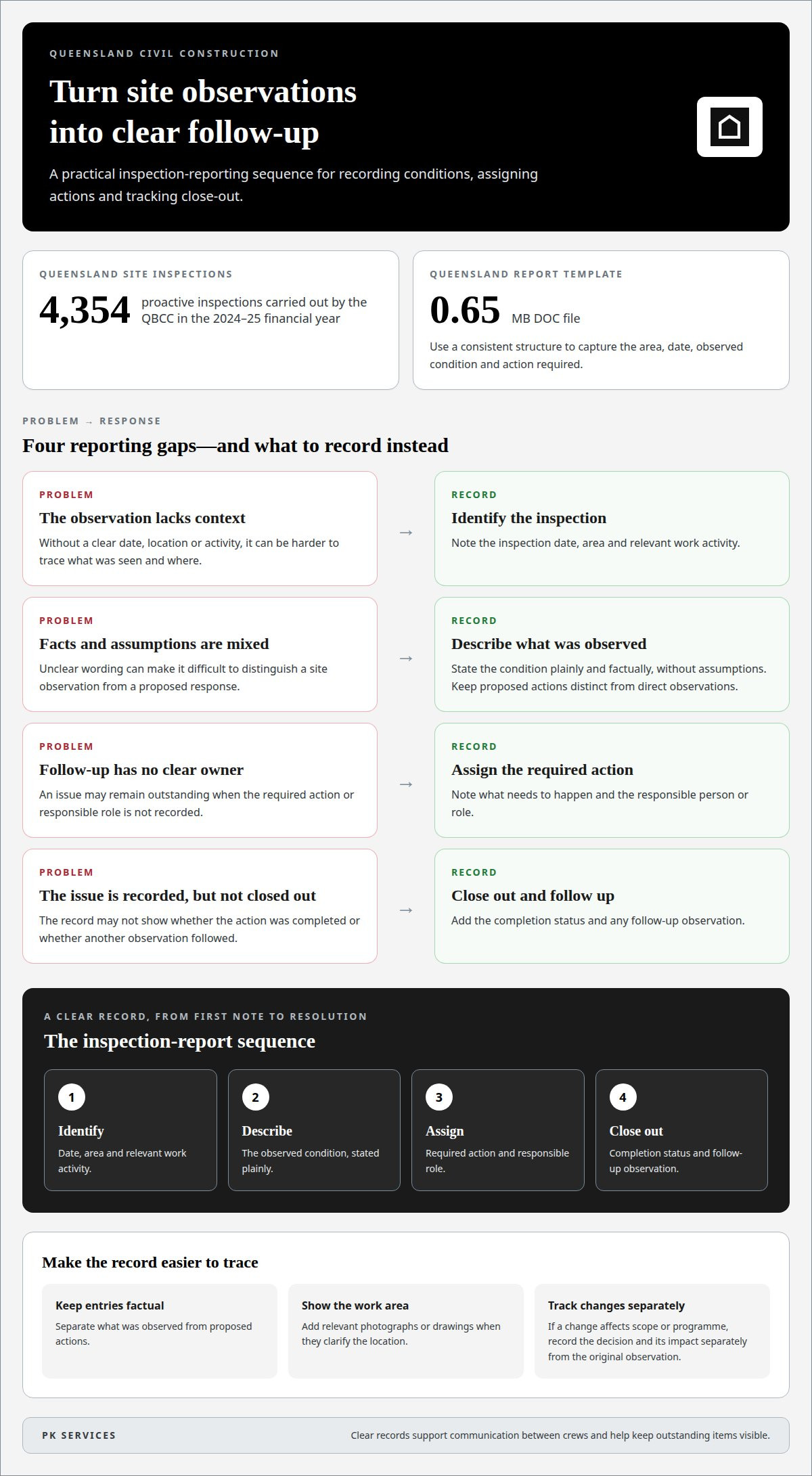
A useful inspection report turns site observations into clear records and follow-up actions. In Queensland, the QBCC carried out 4,354 proactive site inspections in the 2024-25 financial year. That figure underlines why contractors benefit from records that show what was observed, where it happened and how issues were handled.
Queensland’s site inspection report template is a 0.65 MB DOC file. Use a consistent report structure to capture the project area, inspection date, observed condition and action required. For example, record a drainage issue by location, describe the visible condition, then assign follow-up to a responsible person. Specific details help the project team determine whether work needs attention.
Keep entries factual and traceable. Distinguish direct observations from proposed actions. Attach relevant photographs or drawings when they clarify the location, and identify the affected work area or construction stage. If a change affects scope or programme, record the decision and its impact separately from the original observation.
- Identify: Record the inspection date, area and relevant work activity.
- Describe: State the observed condition plainly, without assumptions.
- Assign: Note the required action and responsible role.
- Close out: Add the completion status and any follow-up observation.
For a housing subdivision, reports might track road formation, drainage installation and service interfaces across separate work areas. Contractors can use these records to communicate issues between crews and keep outstanding items visible. Consistent naming and dated entries make it easier to follow an issue from its first observation through to resolution.
Where site capacity is stretched, trades and contractor support can help address essential workforce gaps linked to project delivery.
Project scoping, site constraints and timeline management
Effective oversight starts by defining the work, constraints, decision-makers and reporting points. In Queensland Government building projects, a critical completion date with significant implications is a medium- or high-risk timeframe factor.
Scope should connect deliverables with site conditions and statutory requirements. Map access, interfaces with existing services, environmental sensitivities and approval dependencies. A Queensland Government risk assessment can also consider environmental, cultural, heritage, social, workplace health and safety, and public health and safety issues. These factors influence procurement risk ratings and the controls needed to manage delivery.
To establish oversight, project teams can follow this sequence:
- Define scope: describe work areas, interfaces, acceptance criteria and exclusions.
- Assess constraints: record access, site conditions, sensitive areas and approval dependencies.
- Assign accountability: identify who makes decisions, manages changes and reports progress.
- Link milestones: connect activities to dependencies and any critical completion date.
- Review changes: record the effect of changed conditions on scope, sequence and programme.
This sequence gives the project team a shared basis for assessment. For government work, the department’s risk rating matters because it determines how the project must comply with Queensland Government procurement policies. Complex construction techniques or buildability issues can place a government building project in the medium- or high-risk category. A critical date also needs attention when delay would have significant implications.
Site scale makes practical planning essential. The Coochin Creek Eco-Tourist Resort project covers 45 hectares, while KenLea Estate survey work in Woombye ran from 2021 to 2026. These examples show why oversight should connect work packages to actual locations and dependencies, rather than treating a site as one uniform work area.
Keep the programme current as conditions change. Compare completed work with dependencies, record decisions that affect sequencing and update the relevant milestone. This makes the timeline a working control, not simply a target date.
What are the project owner’s and contractor’s responsibilities for oversight in Queensland?
Oversight works best when the owner and contractor understand their separate project roles. The owner sets the outcome, approves scope changes and establishes how decisions are recorded. The contractor coordinates site delivery, communicates constraints and manages work against the agreed scope. The contract, project plan and approval conditions help define this working relationship.
Owners should maintain clear accountability from procurement through handover. Set out who can approve design changes, resolve interface issues and accept completed work. A clear escalation path helps contractors raise delays or scope conflicts before they affect dependent activities. Link decisions to the relevant work package and programme milestone.
- Owner: define deliverables, constraints, approval pathways and reporting expectations.
- Contractor: plan work, coordinate people and raise emerging delivery issues promptly.
- Both parties: record agreed changes, responsible roles and effects on sequencing.
- Project team: track open decisions through to completion and handover.
Queensland’s Building and Construction Training Policy adds a specific contractual consideration. It ceased to apply to new projects from 1 July 2026. Contractors on projects awarded before that date must continue existing training commitments where their contracts contain policy clauses, until project completion. Owners and contractors should therefore distinguish new procurement requirements from continuing commitments under an earlier contract.
From 1 July 2026, contractors are no longer required to report training hours through Queensland’s Training Policy Administration System. That change affects reporting, not existing contractual clauses. For an older project, the parties should identify the applicable contract provisions, assigned responsibilities and evidence required to demonstrate completion.
Strong role definition turns oversight into an active management function, not just document handling. If your project needs added site capacity, explore trades and contractor support to help address workforce gaps.
PK Services: Business Consulting
PK Services helps construction businesses coordinate complex project demands. Its Business Consulting supports operational decisions, project planning and the management of competing priorities. Turn to this support when scope, site constraints or contractor coordination are making delivery harder to manage.
When a project needs additional site capability, PK Services also provides Trades & contractor services. For businesses seeking continuity across multiple stages, PK Services can manage the entire process from start to finish. The right support depends on what your team needs to move forward, whether that means strengthening business operations or filling essential workforce gaps.
For a practical conversation about your project or business needs, contact PK Services.
Set your next project up for clearer decisions
The next step is to turn project oversight into a practical working approach. Before work advances, align decision-making with delivery priorities. This gives your team a clearer basis for handling new constraints, coordinating responsibilities and keeping progress visible.
Strong civil construction project oversight in QLD is about more than tracking work. It also means creating the conditions for timely decisions when the site, scope or programme shifts. A focused discussion with PK Services can help identify where business consulting or project management support would be useful, without adding complexity where it isn’t needed.
PK Services works with construction businesses on operational challenges and project needs. If you’re ready to discuss the right support for your next stage, contact PK Services about your project.
Start with a clear view of what needs attention, then move forward with purpose.
Frequently Asked Questions
What does civil construction project oversight include in Queensland?
It brings project scope, delivery coordination, compliance records and decisions into one management view. For example, a roadworks team can link a changed service location to the affected work area, responsible role and programme activity. This helps show how a site issue affects delivery, keeps decisions traceable and distinguishes completed actions from items still requiring attention.
Which Queensland laws, regulations and standards apply to civil construction projects?
Applicable requirements depend on the project’s work and approvals. Queensland’s framework includes the Building Act 1975 (Qld), Planning Act 2016 (Qld), Work Health and Safety Act 2011 and Work Health and Safety Regulation 2011. The National Construction Code and Queensland Development Code also apply to relevant building work. Project teams should map each requirement to the work package or approval it governs.
What approvals and permits are required for civil construction in Queensland?
Required approvals depend on the proposed work, its location and its effects. Queensland’s development assessment framework is established by the Planning Act 2016 (Qld). An assessment considers how the proposal fits the applicable planning framework and site constraints. For example, a project involving sensitive environmental or heritage areas may need those impacts addressed through its assessment and approval conditions before relevant work proceeds.
Which Queensland agencies oversee civil construction projects and what are their roles?
The QBCC oversees licensing compliance and building work matters within its remit, while Queensland Government agencies apply procurement policies to government projects. Workplace Health and Safety Queensland provides audit report templates for qualified and experienced safety auditors to use alongside legislation during internal reviews. These roles differ, so connect each requirement with the relevant contract, work activity and reporting process.
What qualifications and licences are required for civil construction project managers and supervisors in Queensland?
Licensing requirements relate to the work being performed, not simply a job title. Contractors generally need an appropriate QBCC licence for building work valued over A$3,300, including labour, materials and GST. Project managers and supervisors should have skills suited to their responsibilities, such as coordinating work packages, interpreting project records and escalating site issues. The role and work type determine which licensing rules are relevant.
How are civil construction projects in Queensland monitored for safety, quality and environmental compliance?
Teams monitor performance through planned inspections, clear records and timely follow-up. A useful system connects each finding to its site location, evidence, action owner and close-out status. Safety reviews can use Workplace Health and Safety Queensland’s audit templates alongside legislation. Quality and environmental checks should reflect project specifications and approval conditions. Record issues separately so corrective actions remain easy to track.


