

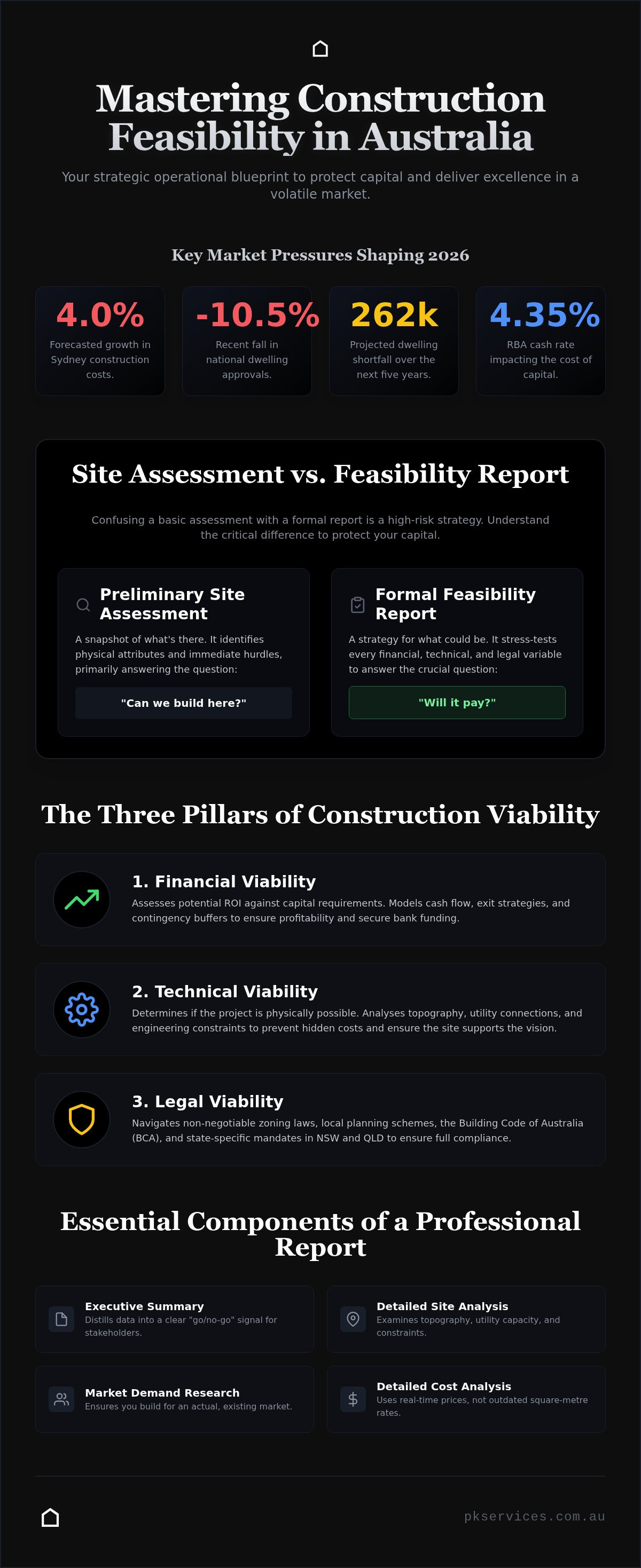
In 2026, the most dangerous part of your build isn't the site work. It's the data you ignore before the first shovel hits the dirt. Sydney construction costs are forecasted to grow by 4.0% this year. National dwelling approvals recently fell by 10.5%. The margin for error has vanished. A construction project feasibility study Australia is no longer just a box to tick for the bank. It's your strategic operational blueprint.
You've likely felt the squeeze of rising material costs. Labour shortages across QLD and NSW remain a constant headache. Navigating the NSW Building (Approvals and Practitioners) Bill 2026 feels like moving the goalposts mid-game. You need a clear "go/no-go" signal to protect your capital and satisfy your lenders. We understand the pressure to deliver excellence in a volatile market.
This guide helps you master the essentials of Australian construction feasibility. We'll ensure your project delivers maximum ROI and operational excellence. We'll break down the data required to secure bank funding and provide an operational roadmap for execution. Let's redefine your project standards and secure your site's future.
Key Takeaways
- Understand the critical difference between a basic site assessment and a formal feasibility report to protect your capital in 2026.
- Identify the core components of a professional construction project feasibility study Australia to secure bank funding and stakeholder confidence.
- Navigate complex NSW and QLD regulatory frameworks to avoid compliance hurdles and ensure your design meets the latest building codes.
- Follow a practical five-step framework to filter project ideas and establish a definitive "go/no-go" signal before you build.
- Bridge the gap between high-level strategy and site execution by integrating feasibility data with a robust project management roadmap.
What is a Construction Project Feasibility Study in Australia?
A construction project feasibility study Australia is the definitive line between a profitable venture and a financial sinkhole. It's a comprehensive evaluation of a proposed project's technical, financial, and legal viability. In 2026, relying on gut-feel development is a high-risk strategy that few can afford. With Sydney construction costs forecasted to grow by 4.0% this year and national headline CPI at 4.6%, guessing is simply gambling. At its core, a feasibility study acts as a strategic tool for risk mitigation that converts market uncertainty into a controlled operational roadmap.
Many developers confuse a preliminary site assessment with a formal feasibility report. A site assessment is a snapshot of what's there; it identifies physical attributes and immediate hurdles. A formal feasibility report is a strategy for what could be. It determines if the project should proceed by stress-testing every variable against current market conditions. It moves beyond the "can we build it" question and asks "will it pay?"
The Three Pillars of Construction Viability
Success rests on three critical foundations. If one is weak, the entire project risks collapse before the first slab is poured.
- Financial viability: We assess potential ROI against capital requirements. With the RBA cash rate held at 4.35% as of August 2026, the cost of capital demands precision. We model cash flow, exit strategies, and contingency buffers.
- Technical viability: This determines if the project is physically possible. We analyse topography, utility connections, and engineering constraints. It's about ensuring the site can actually support your vision without hidden costs.
- Legal viability: Navigating zoning, local planning schemes, and the Building Code of Australia (BCA) is non-negotiable. We ensure your design aligns with state-specific mandates in NSW and QLD.
Why Feasibility Matters for Modern Australian Firms
The Australian market has evolved. Lenders are more conservative, and regulations are tighter. A robust construction project feasibility study Australia provides the data required to secure development finance from major banks and private lenders who now demand exhaustive proof of viability. It prevents overcapitalisation in volatile markets like Sydney and Brisbane, where margins can be erased by a single regulatory delay or material price hike.
Beyond the numbers, feasibility establishes a baseline for operational performance. It bridges the gap between high-level strategy and daily site execution. By identifying risks early, you provide your project management team with a clear roadmap. This ensures that when the trades arrive on-site, they are executing a plan that is already proven to work.
Essential Components of a Professional Feasibility Report
A professional construction project feasibility study Australia must be exhaustive. It isn't a collection of guesses. It's a data-driven defence of your capital. Every report starts with a high-impact executive summary. This is your elevator pitch. It distills complex technical data into a clear "go/no-go" signal for stakeholders and investors. If a lender can't see the project's value in the first two pages, the rest of the report won't save your funding. Detailed site analysis forms the physical foundation of the study. We look beyond basic boundaries. Topography, utility capacity, and environmental constraints are examined in detail. These are the variables that trigger expensive variations once construction begins. Identifying these early ensures your budget remains intact. Market demand research is vital in 2026. Australia faces a projected shortfall of 262,000 dwellings over the next five years. However, building the wrong product in the wrong suburb is a recipe for failure. We analyse local absorption rates and end-user preferences in Sydney and Brisbane to ensure your project meets actual market needs. This data helps you avoid the trap of building for a market that doesn't exist. To ensure your development stands out in competitive markets like the Gold Coast, you can explore Property Staging and Furniture Packages to attract premium buyers and maximise your Gross Realisation Value. Traditional square-metre rates are dead. You need detailed trade breakdowns. We calculate costs based on real-time material prices and actual subcontractor quotes. This level of detail is the only way to produce a construction project feasibility study Australia that stands up to bank scrutiny.
Your Gross Realisation Value (GRV) must reflect the current Australian climate. We factor in GST, insurance, and the NSW Building Work Levy for projects over $150,000. Sensitivity analysis is the most critical part of this section. We model what happens if material costs rise by 10% or if the RBA shifts interest rates again. If the project doesn't survive a 10% fluctuation, it's not a viable project. For those who need to bridge the gap between strategy and site execution, our business consulting services provide the necessary oversight to keep your margins secure.
Resource and Labour Supply Assessment
The biggest risk in 2026 isn't just the cost of steel or timber. It's the availability of people. Labour shortages in QLD and NSW are chronic. Subcontractor insolvencies are rising, which shrinks the pool of reliable trades. A professional report must assess the local labour market before you commit. Can you actually staff the site? We evaluate trade availability in your specific region to ensure your timeline is realistic. Integrating professional trade services early is the best way to de-risk the execution phase and avoid the delays that destroy ROI.
Navigating Local Constraints: NSW and QLD Regulatory Frameworks
A construction project feasibility study Australia must account for the legal minefield of state-specific regulations. While the Building Code of Australia (BCA) provides a national baseline for safety and design, its application is filtered through local planning schemes. Brisbane and Sydney operate under vastly different rules. Brisbane City Council might prioritise subtropical design and flood resilience; Sydney councils often grapple with extreme urban density and heritage overlays. Choosing between private certifiers and local government approval pathways is a strategic decision. Private certifiers often offer faster turnarounds, but the new NSW Building (Approvals and Practitioners) Bill 2026 has introduced stricter penalties for certifiers, which may impact their risk appetite. Regulatory bottlenecks don't just delay timelines; they inflate holding costs and interest payments, directly eroding the project's net profit margin.
Queensland Compliance and QBCC Requirements
Queensland's regulatory landscape is currently undergoing its 'Building Reg Reno'. Significant updates commenced in February 2026. The Queensland Building and Construction Commission (QBCC) remains the primary gatekeeper for project viability. Consider these QLD-specific factors:
- Levy Obligations: For any work valued at $150,000 or more, a total levy rate of 0.575% applies as of July 1, 2026.
- Zoning Risks: Feasibility studies in South East Queensland must account for rigorous bushfire and flood zoning.
- Licensing: These environmental factors dictate insurance premiums and licensing requirements that can make or break a project's budget.
The NSW market is adjusting to the Building (Approvals and Practitioners) Bill 2026. This passed parliament on August 4, 2026. This legislation represents a massive overhaul. It replaces the old Design and Building Practitioners Act 2020 and introduces new 'building approvals' and 'completion approvals'. Key NSW constraints include:
- Fee Increases: Fees for licensing and regulatory services from the Building Commission NSW increased by 4.4% on July 1, 2026.
- Site Constraints: Sydney developments face unique hurdles, including complex heritage overlays and extreme urban density challenges.
- Fair Trading Oversight: Working with NSW Fair Trading requires a meticulous approach to residential compliance, especially for class 2 buildings.
A professional construction project feasibility study Australia must anticipate these hurdles to avoid the 'hidden' costs of regulatory friction that often derail ambitious timelines.
How to Conduct a Feasibility Analysis: A 5-Step Framework
Executing a construction project feasibility study Australia requires a methodical approach. Many developers make the mistake of acquiring land before testing its potential. This is a backwards strategy. True viability is determined before you sign a contract. Our five-step framework ensures you only commit capital to projects that can actually deliver.
- Step 1: Define the project scope. Establish your strategic objectives early. Are you building for immediate yield or long-term capital growth?
- Step 2: Preliminary assessment. Conduct a 'back-of-the-envelope' analysis. This filters out the non-starters before you spend money on specialist consultants.
- Step 3: Engage specialist consultants. Bring in the experts. This includes engineers, quantity surveyors, and advisors who understand the local market.
- Step 4: Data synthesis. Compile the technical and financial data into a formal feasibility report. This document must stand up to bank scrutiny.
- Step 5: The final decision. Review, refine, and present to stakeholders. This is your definitive "Go" or "No-Go" signal.
Engaging the Right Advisory Partners
A specialist construction advisory firm offers more than a generalist consultant. You need partners who understand the nuances of the NSW and QLD markets. Look for a team with 15+ years of on-site experience. This background is vital for validating cost estimates and identifying site-specific hurdles. Generalist consultants often rely on theoretical data; advisors with site experience know where the 'hidden' costs usually hide. When you partner with our professional consultants, you gain access to a team that bridges the gap between high-level strategy and site execution.
Identifying and Mitigating Project Risks
Risk is inevitable, but it must be managed. Common pitfalls include underestimating utility connection costs and council contributions. In Sydney and Brisbane, these fees can shift significantly between financial years. Establishing a realistic contingency fund is non-negotiable. In 2026, the 10-15% rule is the standard for healthy projects. A robust construction project feasibility study Australia identifies these 'deal-breakers' before your capital is committed. It allows you to walk away from a bad deal or adjust your strategy to ensure the project remains profitable. We use feasibility to turn uncertainty into a controlled, operational roadmap for your trades and project managers.
Beyond the Report: Integrating Feasibility with On-Site Execution
A report is a promise; execution is the delivery. A construction project feasibility study Australia provides the map, but you still need to drive the vehicle. Without a robust project management strategy, even the most detailed financial model will fail on-site. The real challenge is bridging the gap between high-level strategy and daily site activities. We redefine excellence by ensuring that the data in your report translates into operational performance. This requires full-cycle project management from the initial inception through to final completion.
Many firms treat the feasibility phase as a hurdle to clear for the bank. This is a mistake. The data gathered during this phase should dictate your procurement strategy, your site safety protocols, and your quality control measures. It's the baseline for everything that follows. When strategy and site execution are disconnected, margins erode through delays and miscommunication. We focus on a unified approach where the consultant's vision and the contractor's reality are one and the same.
Strategic Resource Planning and Trade Supply
Securing reliable trades is the most critical hurdle in 2026. Your feasibility study might suggest a 12-month timeline, but that's irrelevant if you can't staff the site. Professional trade services are essential for maintaining standards and reducing rework. Rework is a profit killer that many developers ignore in their initial models. By integrating labour solutions into your broader business transformation strategy, you ensure that your resource planning matches your financial projections. It's about having the right people ready when the schedule demands it. This proactive planning reduces the risk of the "labour gap" that often stalls projects in the mid-cycle phase.
Operational Excellence and Performance Management
You must monitor project health against your original feasibility benchmarks. If your actual costs deviate from the study, you need to know why immediately. Process management allows you to optimise workflows and protect your profit margins in real-time. It's not enough to check the budget at the end of the month. You need a constant feedback loop between the site and the office. This level of oversight ensures that small issues don't balloon into project-ending crises. Ready to validate your next project? Partner with PK Services for strategic construction consulting and ensure your strategy survives the reality of the site.
Secure Your Project's Future with Data-Driven Confidence
The Australian construction landscape in 2026 doesn't reward guesswork. Success now requires a construction project feasibility study Australia that looks beyond the surface of land value. You've seen how critical it's to navigate the shifting regulatory frameworks of NSW and QLD while accounting for the chronic labour shortages impacting site delivery. A robust study is your best defence against market volatility and overcapitalisation.
By integrating technical data with real-world trade supply, you move from a theoretical plan to a controlled operational roadmap. We specialise in bridging this gap. With over 15 years of industry expertise and a focus on end-to-end management, we ensure your strategy survives the transition to the site. We provide the trades and the consulting required to turn viability into high-performance results.
Don't leave your project's ROI to chance. It's time to redefine your project standards with PK Services consulting and ensure every decision is backed by specialist insight. Let's build something exceptional together.
Frequently Asked Questions
How much does a construction feasibility study cost in Australia?
Professional fees for a study depend on the project's scale and the depth of technical data required. While costs vary across the industry, it's helpful to view this as a necessary investment in risk mitigation. A detailed report prevents expensive variations later. The final price often reflects the number of specialist consultants involved, such as engineers and quantity surveyors, to ensure every variable is accurately modelled for your specific site.
Can I do my own feasibility study for a small construction project?
You can certainly conduct a preliminary "back-of-the-envelope" assessment to filter initial ideas. However, a formal construction project feasibility study Australia requires professional validation for bank funding and regulatory compliance. Small projects still face complex hurdles like QBCC standards or NSW Fair Trading requirements. DIY attempts often miss hidden costs like utility headworks or council contributions, which can quickly erase the profit margins on a smaller development.
How long does it typically take to complete a professional feasibility report?
A comprehensive professional report typically takes between four to eight weeks to complete. This timeline depends on the complexity of the site and the availability of specialist consultants like surveyors and engineers. Fast-tracking the process often leads to overlooked risks. Taking the time to gather accurate data ensures your operational roadmap is realistic. This period allows for thorough market research and detailed trade breakdowns that reflect current 2026 material costs.
Is a feasibility study mandatory for securing construction finance in NSW?
Yes, most Australian banks and private lenders require a formal feasibility report before they will approve development finance. They need documented proof of your project's Gross Realisation Value (GRV) and its ability to survive market fluctuations. In NSW, lenders are particularly focused on compliance with the Building (Approvals and Practitioners) Bill 2026. A professional study provides the sensitivity analysis they need to feel confident that your project remains viable if costs rise.
What is the difference between a property feasibility and a construction feasibility?
Property feasibility typically focuses on land acquisition, zoning potential, and the high-level "buy and sell" numbers. Construction feasibility goes deeper into the physical reality of the build. It examines technical constraints, detailed trade costs, and on-site logistics. While property studies tell you if the land is a good investment, a construction study determines if your specific building design is operationally and financially achievable within current market conditions and labour supply constraints.
What happens if my feasibility study shows the project is not viable?
A non-viable result is actually a successful outcome because it prevents a significant financial catastrophe. It provides a clear "no-go" signal before you commit capital or sign construction contracts. When a study shows poor ROI, you have two choices: walk away or pivot the strategy. You might reduce the project scope, choose different materials, or wait for better market conditions. This data allows you to make an objective, unemotional decision about your project's future.
How often should a feasibility study be updated during the project lifecycle?
You should treat your feasibility study as a living document and update it at every major project milestone. Market conditions in 2026 move quickly. We recommend reviewing your figures when you secure planning approval, before signing major subcontracts, and if interest rates shift. Regular updates ensure your contingency buffers remain adequate. This practice helps you monitor project health against your original benchmarks, allowing for real-time adjustments that protect your final profit margins.
Can a feasibility study help with project recovery for a failing site?
Yes, a "rescue feasibility" is a powerful tool for identifying exactly where a project has veered off course. By auditing current costs and trade performance against the original plan, we can find operational efficiencies to save the site. It provides a new roadmap for recovery, helping you renegotiate with lenders or restructure your project management. This strategic intervention uses data to stop the bleed and redirect the project toward a successful, albeit adjusted, completion.


