

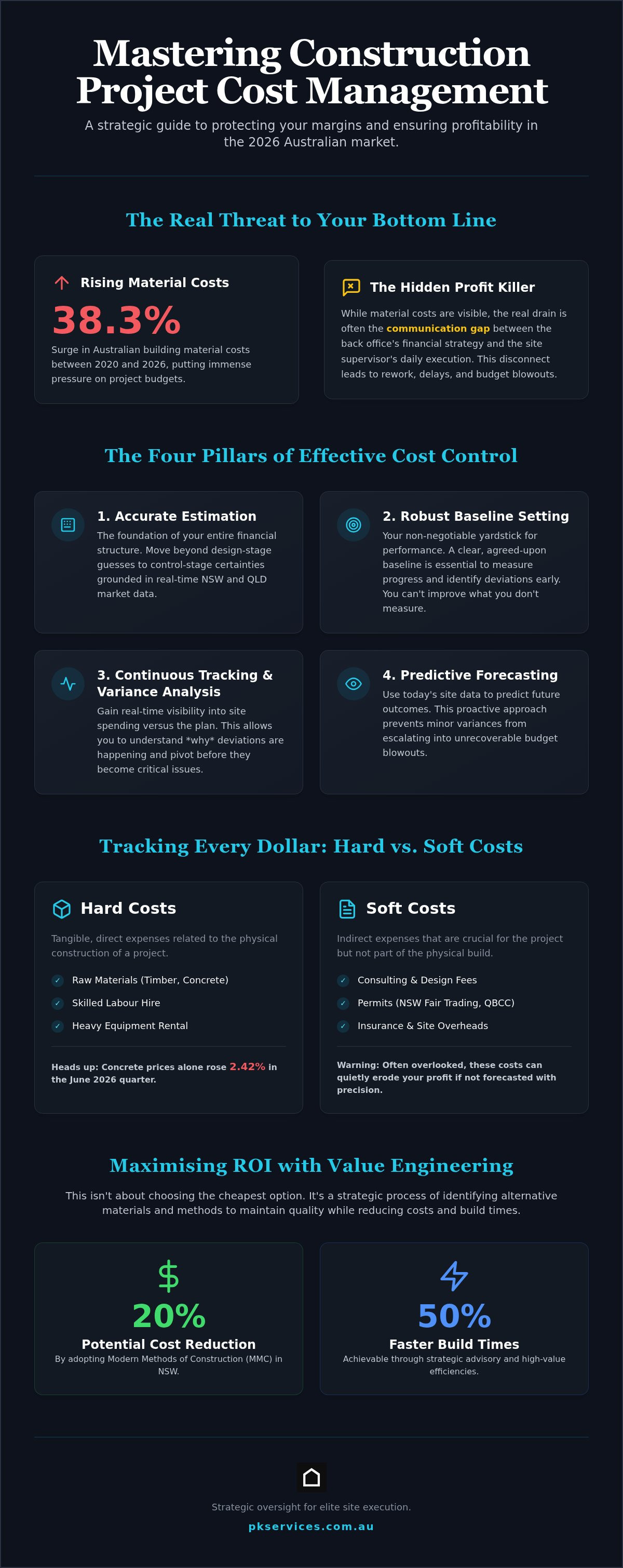
What if your biggest profit killer isn't the rising cost of timber, but the communication gap between your site supervisor and the back office? While building material costs in Australia surged by 38.3% between 2020 and 2026, the real drain on your bottom line often happens in the silence between the site and the boardroom. Effective construction project cost management in 2026 requires more than just a spreadsheet; it demands a seamless bridge between high-level financial strategy and elite site execution.
We know the pressure you're under. It's exhausting to navigate unpredictable labour hikes and late-stage budget blowouts that threaten to kill your profitability. You deserve a business that delivers predictable cash flow and protected margins, regardless of market volatility. This guide will show you how to master strategic oversight to keep your projects on track and your bank balance healthy.
We'll break down the specific regulatory shifts across NSW and QLD, explore how to close the gap between office and site, and provide a roadmap for protecting your margins in a high-cost environment. It's time to redefine your approach to financial control and site leadership.
Key Takeaways
- Learn why viewing financial oversight as a site-level leadership function is the most effective way to secure your firm's long-term profitability.
- Establish robust project baselines to protect your margins against the material price volatility and labour hikes currently affecting NSW and QLD.
- Master construction project cost management by seamlessly integrating high-level business strategy with elite on-site execution.
- Discover how to eliminate the hidden costs of rework and communication gaps through superior end-to-end project lifecycle management.
- Identify the core pillars of accurate estimation that turn unpredictable budgets into reliable and predictable cash flow.
Why Construction Project Cost Management is the Bedrock of Profitability
Construction project cost management is the heartbeat of a sustainable firm. It is the strategic process of planning, estimating, and controlling expenses from the moment a bid is drafted until the final defect is cleared. In the 2026 Australian market, this discipline has evolved. It is no longer about reactive accounting at the end of the month. It is about proactive, strategic oversight that anticipates price hikes and site delays before they happen. Effective management ensures that every dollar spent contributes directly to the project's success and the firm's longevity.
Applying Cost Engineering Principles allows firms in NSW and QLD to protect their margins against a backdrop of rising input prices. Your bottom line is the ultimate indicator of project health. When costs spiral, projects stall, trades walk off, and your reputation in the local market suffers. Real profitability depends on seeing cost management as a leadership function. It is about making the hard calls on site to ensure the financial strategy stays on track. In a landscape of tightening regulatory scrutiny, being "close enough" is no longer an option.
The Financial Lifecycle of an Australian Construction Project
Every project follows a distinct financial rhythm. It starts with pre-construction estimation, moves through baseline setting, and ends with post-completion audits. To succeed, you must integrate cost control with scope and quality management. If you focus only on the dollars, quality often slips, leading to expensive rework. Primary leakage points often occur during the transition from the office to the site. When site supervisors are not aligned with the budget, small daily overruns quickly turn into late-stage blowouts. Successful firms use the audit phase to refine their next bid, ensuring an evolution of accuracy.
Hard Costs vs Soft Costs: What You Need to Track
Tracking every cent requires a clear distinction between hard and soft costs. Hard costs are your tangible expenses. These include raw materials like concrete and timber, skilled labour hire, and heavy equipment. With concrete prices rising 2.42% in the June 2026 quarter, these figures must be monitored weekly. Soft costs are often overlooked but can be equally lethal to margins. These include professional consulting fees, insurance premiums, and the specific permits required by NSW Fair Trading or the QBCC. Hidden site overheads, such as temporary power, site security, and waste management, can quietly erode your profit if they are not forecasted with precision from day one.
The Core Pillars of Effective Construction Cost Control
Precision in construction project cost management starts long before the first shovel hits the dirt. It relies on four non-negotiable pillars that turn a speculative bid into a profitable reality. Without these, you aren't managing a project; you're just watching money leave your account. Control is maintained through a rigorous cycle of estimation, baseline setting, and real-time tracking.
The first pillar is accurate estimation. This is the foundation of your entire financial structure. By applying the Core Principles of Cost Estimation, you distinguish between design-stage guesses and control-stage certainties. In the current QLD and NSW markets, where structural timber prices rose 2.85% in Q2 2026, your baseline must be grounded in real-time data. Once that baseline is set, it becomes your yardstick for performance. You can't improve what you don't measure.
Continuous tracking and variance analysis provide the real-time visibility needed to pivot. If your site spending deviates from the plan, you need to know why immediately. Forecasting allows you to predict the future based on today's site data. This prevents minor variances from becoming unrecoverable blowouts. High-performing firms treat the budget as a living document, not a static file in the back office.
Value Engineering: Maximising ROI Without Sacrificing Quality
Value engineering is a strategic tool for cost optimisation. It isn't about choosing the cheapest option. It's about identifying alternative materials or methods that maintain quality while reducing expenses. For example, adopting modern methods of construction (MMC) in NSW can reduce costs by up to 20% and speed up builds by 50%. Strategic advisory helps identify these high-value efficiencies early in the design phase. This ensures the project remains lean without compromising the final result or structural integrity.
Cash Flow Management and Progress Claims
Cash flow is the lifeblood of firms across Queensland and New South Wales. Managing progress claims with precision is vital to avoid the "cash gap" between paying subcontractors and receiving client payments. With the 2026 QBCC regulation amendments tightening licensing and fee structures, your financial administration must be flawless. Professional business consulting can help you refine these internal processes, ensuring your cash flow remains steady and your margins stay protected from the first claim to the final retention release.
Beyond the Spreadsheet: Integrating Site Execution with Financial Strategy
Profit isn't won in a boardroom. It's won on the site. While spreadsheets provide the map, site execution is the journey. If your site supervisor doesn't understand the financial implications of every delay, your budget is at risk. Effective construction project cost management requires a culture where site leadership is directly accountable for financial outcomes. It's about moving away from the "us versus them" mentality between the office and the ground crew.
Poor trade execution is one of the most expensive invisible costs in building. When a subcontractor fails to meet quality standards, the financial blow is twofold. You pay for the initial labour and then pay again to fix the mistake. This rework ripples through the schedule, pushing back every subsequent trade. Schedule slippage is a profit killer. Each day of delay adds to your fixed overheads, from scaffolding hire to site security costs. Bridging the communication gap ensures that the back office knows about site issues the moment they happen, allowing for immediate financial adjustment.
The Strategic Role of Site Oversight
Professional site management is your primary defence against budget erosion. By utilising professional site management services, firms can ensure that quality control is integrated with financial oversight. High-quality site management turns real-time data into actionable decisions. If a delivery is late or a trade is understaffed, the office needs to know immediately to adjust the forecast. Better resource planning and logistics on the ground reduce waste. It ensures that expensive skilled labour is used efficiently and materials aren't sitting idle or getting damaged. This level of oversight protects the bottom line by keeping the project moving at its peak efficiency.
Project Recovery: Rescuing a Failing Budget
Sometimes, despite your best efforts, a project starts to bleed. Identifying red flags early is critical for project recovery. These include frequent disputes over progress claims, a high volume of rework, or a consistent failure to meet weekly milestones. When a project exceeds its initial cost baseline, you need a radical shift in strategy. Strategic consulting can help rescue a failing budget by performing a deep-dive audit of current site practices. Turning around a struggling asset requires a fresh set of eyes to identify where the leakage is occurring. It's about redefining excellence on site to save the bottom line before the damage becomes permanent. Successful construction project cost management involves knowing when to call in experts to course-correct before the profit is entirely consumed by delays.
Navigating Local Challenges: Labour, Materials, and Compliance in AU
The Australian construction sector in 2026 is defined by a higher cost base. Since March 2020, material input costs have climbed by 38.3%. While the extreme inflation of previous years has cooled to 2.5% annually, the baseline remains elevated. For firms in NSW and QLD, construction project cost management is no longer just about tracking spend. Success requires navigating a dense web of local regulations and a tightening labour market. Input prices for house construction rose 2.1% in the June 2026 quarter alone. You must also account for specific volatility, such as the 7.21% rise in copper prices and the 6.15% surge in plasterboard costs during that same period.
Managing Labour Costs and Trade Services
Finding the right hands for the job is a major financial hurdle. There is a significant difference between labour hire and professional trade services in NSW. Basic labour hire might fill a hole, but professional tradespeople bring the expertise required to reduce project risk. High-quality trades help you avoid the rework that kills margins. If you don't account for these shifts, your initial budget becomes irrelevant. With the superannuation guarantee rate at 12% since July 2025, every hour on site must be productive. You also need to factor in state-specific overheads like payroll tax. In NSW, the rate is 5.45% for businesses above the $1.2 million threshold, while QLD sits at 4.75%. Managing contractors for peak performance requires a partner who understands these local financial pressures.
Compliance and Regulatory Cost Factors
Compliance is a major budget item in 2026. In NSW, the *Building (Approvals and Practitioners) Bill 2026* has overhauled the approvals system and repealed the *Design and Building Practitioners Act 2020*. Firms now handle 'building approvals' and 'completion approvals' instead of the old construction certificates. From 13 February 2026, all class 1b and class 2 to 9 buildings in NSW must have essential fire safety measures inspected and tested. In Queensland, the *QBCC Amendment Regulation 2026* introduced stricter licensing and new infringement notices for section 109C. New QLD dwellings must also hit a 7-star NatHERS thermal rating and follow a whole-of-home energy budget under NCC 2022. Non-compliance is expensive. Fines, stop-work orders, and safety failures carry hidden costs that can bankrupt a project. Meeting these modern Australian standards is non-negotiable for project delivery. Maintaining these standards protects your bottom line from the start. To secure your margins against these local complexities, partner with our trades and contractor services to ensure your next build stays on track.
Redefining Excellence: The PK Services Approach to Cost Management
PK Services doesn't just provide advice. We deliver results. Our approach to construction project cost management is built on 15 years of trade and advisory expertise. We've spent over a decade on the ground in NSW and QLD, learning what actually works. We understand that a project's success depends on the synergy between the back office and the site fence. Our team bridges this gap by combining high-level financial strategy with elite site execution. We are setting a new standard for construction consulting in Sydney and Brisbane. It's about more than just numbers; it's about redefining excellence in every interaction. We believe that professional site management is a prerequisite for financial success, not an optional extra. Our personality is bold, innovative, and deeply reliable.
Strategic Advisory for Sustainable Growth
Profitability isn't a happy accident. It's the result of robust systems. Improving construction business profitability starts with a deep audit of your current operations. We provide tailored solutions that optimise your performance from the ground up. Choosing a boutique advisory partner offers a distinct advantage over global firms. You get direct access to experts who value a personal connection. We don't deliver generic reports. We build the operational frameworks your business needs to survive and thrive in a volatile market. It's a partnership designed for sustainable, long-term growth. We focus on the evolution of your business, ensuring you stay ahead of regulatory changes and market shifts. This refined approach ensures your firm remains competitive while maintaining superior standards.
Full-Cycle Management: From Inception to Completion
Managing the entire project lifecycle is the only way to ensure total cost control. We handle everything from initial procurement strategy to final site completion. This seamless integration removes the communication breakdowns that typically lead to budget blowouts. Our 15-year legacy is built on providing skilled trades that fill essential labour voids while maintaining high standards. We manage the entire process to ensure our promise of excellence is met at every milestone. By aligning strategy with site reality, we protect your margins and deliver predictable cash flow. Your project deserves a partner who understands the weight of the bottom line. This end-to-end approach ensures that nothing is left to chance. We position ourselves as a modern alternative to traditional firms, valuing both high-end results and simple, direct connections. Contact PK Services today to optimise your next project.
Secure Your Future Profitability Today
Mastering construction project cost management in the 2026 Australian market requires more than just keeping an eye on the books. It demands a total integration of high-level business strategy and elite site execution. You've seen how bridging the gap between the office and the ground crew prevents the hidden leakages that kill profitability. By establishing robust baselines and navigating local NSW and QLD regulations with precision, you turn market volatility into a manageable variable.
The path to redefining excellence starts with a partner who understands the grit of the site and the nuance of the boardroom. PK Services brings 15+ years of industry expertise to your project, supported by a specialised trades and contractor network. Our proven end-to-end project lifecycle management ensures that your vision is protected from inception to completion. Don't leave your margins to chance in an unpredictable market.
Redefine your project excellence with PK Services and build a foundation for sustainable growth. We are ready to help you lead your firm into a more profitable future.
Frequently Asked Questions
What is the most common cause of construction cost overruns in Australia?
Poor communication between the site and the office is the leading cause of overruns. While material costs rose 38.3% since 2020, the real damage happens when site supervisors fail to report daily delays. This lack of transparency leads to late-stage budget blowouts that are impossible to recover. Effective construction project cost management requires daily site reporting to ensure the back office can adjust the financial forecast before minor issues become major liabilities.
How does Value Engineering differ from simple cost-cutting?
Value Engineering focuses on optimising functionality and quality for the lowest cost, whereas simple cost-cutting often sacrifices long-term performance for immediate savings. In NSW, adopting modern methods of construction is a prime example of Value Engineering. It can reduce building costs by up to 20% while speeding up delivery. Cost-cutting might involve using cheaper materials that lead to expensive rework, whereas Value Engineering redefines the build process to maintain high standards.
Can professional site management actually reduce my project costs?
Professional site management reduces costs by eliminating rework and preventing schedule slippage. Every day a site is delayed adds significant fixed overheads, including scaffolding hire and security. By integrating elite site execution with financial strategy, managers ensure trades are scheduled efficiently and materials are handled correctly. This proactive oversight protects the bottom line from the invisible costs of poor logistics, ensuring that skilled labour is always productive and waste is minimised.
What are the specific financial reporting requirements for NSW construction projects in 2026?
Under the Building (Approvals and Practitioners) Bill 2026, NSW firms must now navigate completion approvals instead of traditional occupation certificates. From February 2026, all class 1b and class 2 to 9 buildings require essential fire safety measures to be inspected according to AS 1851-2012. These changes demand stricter financial reporting on compliance activities. Accurate record-keeping is essential to avoid the heavy infringement notices and stop-work orders that can arise from non-compliance.
How do I manage material price fluctuations in a fixed-price contract?
Managing fluctuations in a fixed-price contract requires proactive procurement and robust contingency planning. Many firms now order volatile materials, such as copper or timber, well in advance to lock in prices. Since copper rose 7.21% in the June 2026 quarter, early procurement is vital. You should also include specific rise and fall clauses where possible. Effective construction project cost management involves constant market monitoring to adjust your procurement strategy before price hikes erode your fixed margins.
Is it better to use labour hire or specialized trade services for cost control?
Specialized trade services offer superior cost control compared to general labour hire. While labour hire fills immediate gaps, specialized trades provide the expertise needed to maintain high standards and reduce the risk of rework. PK Services leverages 15 years of industry experience to supply trades that understand the financial impact of their work. High-quality trade execution ensures that the job is done right the first time, protecting your project budget from the cost of defects.
What is the role of a construction business consultant in project recovery?
A construction business consultant acts as a strategic auditor during project recovery. They identify red flags, such as frequent progress claim disputes or failed milestones, and implement systems to stop the financial bleed. By bridging the gap between high-level strategy and site execution, consultants help firms redefine their operational processes. This fresh perspective allows businesses to optimise their performance and turn around struggling assets before they become permanent financial losses.
How often should construction project costs be tracked and reported?
Project costs should be tracked daily and reported weekly to maintain real-time visibility. Monthly reporting is too slow for the fast-paced 2026 market, where material inputs can shift significantly within a few weeks. Weekly variance analysis allows you to compare actual site spend against your initial baseline. This frequency ensures that any deviations are caught early, allowing for immediate corrective action to protect your profit margins and maintain a predictable cash flow.


